

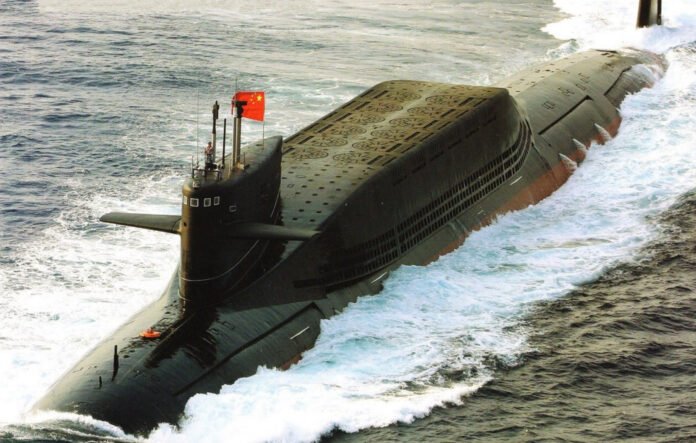
Melbourne: China has rapidly expanded its nuclear-powered submarine fleet in recent years, and has now surpassed US submarine production rate, according to a new report by a London-based think tank.
The increase in Chinese submarine numbers will present a growing challenge for Western countries, despite the continued qualitative differences of Chinese submarines compared to US and European designs, the International Institute of Strategic Studies (IISS) says.

Writing in the IISS’s Military Balance blog, Senior Fellow for Military Capability and Data Assessment Henry Boyd and Research Fellow for Defence Procurement Tom Waldyn said that China launched 10 submarines with an estimated displacement of 79,000 tonnes (approximately 87,000 tons) between 2021 and 2025.
These figures surpass the rate of submarine production in the US, which launched seven boats displacing 55,000 tonnes during the same period.
“Most significantly, this includes the seventh and eighth Type 094 (Jin) nuclear-armed ballistic-missile submarines (SSBNs), which come as part of the emergence of Beijing’s nuclear triad,” according to the authors.
They noted that commercially available satellite imagery taken in early 2026 showed six Type 094s in total, spread between the Bohai Shipbuilding Heavy Industry Co (BSHIC) shipyard in Huludao, the 1st Submarine Base at Jianggezhuang, the Xiaopingdao test facility and the 2nd Submarine Base at Yalong Bay on Hainan Island.

“Allowing for additional boats either on deterrence patrol or under cover for refit during this period, it is almost certainly the case that China has launched a seventh and eighth Type-094 in 2024 and 2025, respectively,” the authors conclude.
The increase in Chinese submarine building capacity came about because of an expansion at the BSHIC shipyard in Huludao between 2019 and 2022, which saw the construction of a second submarine manufacturing hall and other facilities.

The state-owned company is responsible for the construction of China’s fleet of nuclear-powered submarines.
In addition to the Type 094s, Bohai is also producing nuclear-powered guided-missile submarines (SSGN) for the People’s Liberation Army – Navy (PLAN), with the report suggesting that nine Type 093B (Shang III) boats have been launched between 2022 and this year, based on commercial satellite imagery of the facility and US government assessments.
The Type 093B is an improved variant of the earlier Type-093A (Shang II) submarine deployed by the PLAN during the 2010s, with the authors stating that the upgraded design is reportedly fitted with a vertical launch system (VLS) for guided missiles.
A new class of SSGN, already known to be in development and reported elsewhere as having been designated the Type 09V, has also been launched this month, according to the report.
The VLS for these PLAN SSGNs are likely to carry anti-ship missiles such as the hypersonic YJ-19 displayed at China’s military parade in September last year, rather than land-attack missiles typically carried by US Navy SSGNs, reflecting the PLAN’s “primary focus on peer-level naval combat in the Western Pacific, compared to the wider expeditionary power-projection mission that the US Navy has held for decades.”
However, the report authors also note that the limiting factor for PLAN submarine operations were their relative noise levels rather than total inventory, noting that both the Type-093 and Type-094 hulls were noisier and therefore easier to track when deployed.
“For this reason, the Type-094 SSBNs are currently believed to only operate in the relatively protected waters of the South China Sea, where other PLA assets are able to offer them some protection,” the authors conclude.
However, that assessment comes with a big caveat: the understanding of sub noise levels was based on a 2009 US Office of Naval Intelligence (ONI) report, which said Chinese subs made noise comparable to late Cold War Soviet design.

