

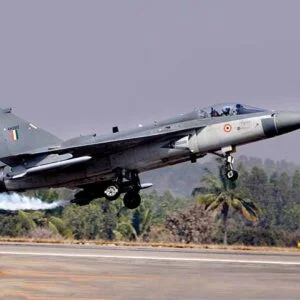
New Delhi: Bharat Heavy Electricals Limited (BHEL) has marked a significant milestone in India’s push towards aerospace self-reliance by expanding its role in critical fighter jet programmes.
Following its successful delivery of Compact Heat Exchangers for the Tejas variants, BHEL is now developing advanced Pump Modules for the Tejas MK-2 and the Advanced Medium Combat Aircraft (AMCA). Additionally, the company will supply essential Heat Exchangers and Fuel Coolers for the AMCA, underscoring its growing prowess in indigenous manufacturing.

This development aligns seamlessly with the Aatmanirbhar Bharat initiative, which emphasises building a robust domestic defence ecosystem. BHEL’s contributions come at a pivotal time when India seeks to reduce reliance on foreign suppliers for high-technology components in its fighter jet fleet.
The Tejas MK-2, an enhanced 4.5-generation multirole fighter, and the fifth-generation AMCA represent cornerstones of the Indian Air Force’s modernisation drive. BHEL’s expertise in thermal management systems has been honed over decades in power generation and heavy engineering sectors. Compact Heat Exchangers, previously supplied for Tejas MK-1A and MK-1 trainers, manage engine bleed air efficiently, ensuring optimal performance under extreme conditions.
These lightweight, high-efficiency units are vital for avionics cooling and environmental control systems in modern combat aircraft.
The new Pump Modules for Tejas MK-2 and AMCA are sophisticated hydraulic components designed to handle fuel, oil, and coolant circulation with precision. Engineered for high-pressure environments, they incorporate advanced materials to withstand temperatures exceeding 200°C and vibrations during supersonic flight. This indigenous development mitigates supply chain risks previously tied to overseas vendors.

For the AMCA, BHEL’s Heat Exchangers and Fuel Coolers address the unique demands of stealth-oriented stealth fighters. Fuel Coolers regulate temperatures in internal weapon bays and avionics, while Heat Exchangers support the aircraft’s integrated power and thermal management system. These systems are crucial for maintaining low radar signatures and sustained high-thrust operations from advanced engines like the GE F414 or future indigenous powerplants.
BHEL’s expansion into these programmes stems from rigorous qualification trials conducted at its Hyderabad and Bangalore facilities. Partnerships with Hindustan Aeronautics Limited (HAL) and the Aeronautical Development Agency (ADA) have accelerated technology transfer and certification processes. This collaboration exemplifies the public sector’s pivot towards defence aerospace, leveraging existing infrastructure for national security needs.

Economically, these contracts bolster BHEL’s order book, projected to exceed ₹3,000 crore in aerospace-related revenues over the next five years. They also create high-skill jobs in precision engineering, with over 500 engineers now dedicated to fighter jet components. Indigenous production cuts costs by 30-40% compared to imports, freeing resources for further R&D.
BHEL has the challenge to scale production to meet Air Force timelines—AMCA prototypes are slated for 2028-29 flights. BHEL is investing ₹500 crore in new test rigs and cleanroom facilities to ensure quality. Material science advancements, such as titanium alloys and ceramic coatings, are key to meeting AS9100 aviation standards.
Strategically, BHEL’s role enhances India’s deterrence posture amid regional tensions. The Tejas MK-2 will bridge gaps in squadron strength until AMCA induction around 2035, with over 200 units planned. Self-reliance in subsystems like these reduces vulnerabilities exposed during past conflicts and sanctions.
BHEL eyes opportunities in engine overhauls for Su-30MKI and future UAV programmes. Its track record positions it as a linchpin in the defence corridor, from Lucknow to Bengaluru. This progression not only fortifies the aerospace supply chain but also inspires private players to innovate.

