

During the ongoing Iran War interception rates have been impressive. A successful shoot-down that requires a high-end interceptor, however, can be a Pyrrhic victory. The defender burns through scarce and expensive munitions while the attacker draws from comparatively large stockpiles of low-cost systems. This is the drone attrition trap. And it is not new.
The news that has dominated the unfolding of the war is the asymmetric cost of fighting the war footed by the US and Israel and their opponent Iran. Iran fields more than 600,000 active personnel, an estimated 2,000–3,000 ballistic and short-range missiles, and a substantial inventory of unmanned aerial vehicles.

One system which has earned a name for its performance vis-à-vis its cost is the Shahed-136 drone.
Shahed-136 is a low-cost, propeller-driven one-way attack drone (a loitering munition) referred to as a poor man’s drone. Its intended use is for long-range strikes and for being launched in volume. Russia has used it in the war against Ukraine for repeated large-scale attacks, including against infrastructure, while also leaning on it to stretch air defences through saturation and steady pressure.
Shahed’s appeal is simple economics and availability, including production in Russia or manufacture to a similar design. In fact, the Shahed family of drones consist of much effective though slightly costly other variants too. But the maximum mayhem has been caused by Shahed-136.
The family includes jet-powered derivatives, too, like Mohajer-6. A larger armed unmanned aircraft used for surveillance and strike missions, also treated as a core element of Iran’s drone inventory. Shahed-238 (variant) – a jet-propelled, longer-range evolution in the Shahed family that differs from the Shahed-136 in propulsion and performance. In modern conflicts, inexpensive one-way attack drones have shifted the mathematics of air defence by rewarding mass, persistence, and saturation as much as precision.

Despite its compact size, the 50-kilogramme warhead can cause severe structural damage to power grids and fuel storage tanks. The smaller Shahed-131 variant carries a significantly lighter warhead of about 15 kilogrammes, intended for shorter-range tactical missions. Military analysts state the warhead typically uses RDX or similar high-energy explosives to maximise the blast radius upon impact.
Shahed’s appeal is simple economics and availability, including production in Russia or manufacture to a similar design. In fact, the Shahed family of drones consist of much effective though slightly costly other variants too. But the maximum mayhem has been caused by Shahed-136
The drone trades a larger payload for long-range capability, relying on GPS guidance to hit exact coordinates with high accuracy. The 50-kilogramme payload is most effective when used in swarms, where multiple drones overwhelm air defences to ensure at least one strike.

Military engineers say the key to their effectiveness lies in the numbers. The drones are relatively cheap and easy to mass-produce, especially compared to the sophisticated systems used to defend against them.
The Shahed‑136 was first unveiled around 2021 and gained global attention after Russia began deploying the Iranian-supplied weapons during its invasion of Ukraine in 2022.
The Kremlin has since received thousands of the drones and begun producing them based on Iranian blueprints, highlighting their replicable and scalable design.
In fact, Iran has drawn from Russia’s extensive battlefield experience with the drones, including modifications such as anti-jamming antennas, electronic warfare-resistant navigation, and new warheads.
Intelligence from a recent Pentagon briefing confirms what analysts feared. American systems have no effective countermeasure for the Shahed-136 kamikaze drone. Iran is launching drones that cost less than a used car ($20k). The US is forced to scramble $3 Million Patriot interceptors and $400,000 Iron Sieve missiles to stop them.
Despite its compact size, the 50-kilogramme warhead can cause severe structural damage to power grids and fuel storage tanks. The smaller Shahed-131 variant carries a significantly lighter warhead of about 15 kilogrammes, intended for shorter-range tactical missions. Military analysts state the warhead typically uses RDX or similar high-energy explosives to maximise the blast radius upon impact
This is a “cost exchange” so lopsided it’s unsustainable. The US is burning through strategic inventory at a rate that cannot be replaced. If the US is struggling with “low-tech” drones, the next phase is terrifying. Iran hasn’t even fully unleashed its Hypersonic arsenal yet.
Iran’s hypersonic missiles include Fattah-2. A manoeuvring hypersonic glide vehicle that Washington has no analogue for. No Patriot battery on Earth stops a missile traveling at Mach 15. No THAAD system can engage a target moving with that level of speed and terminal-phase manoeuvrability. The Pentagon knew this before the first bombs dropped on February 28. If you can’t stop a basic Shahed, you stand zero chance against a hypersonic strike.
CNBC reports that public estimates put an individual Shahed drone at somewhere between $20,000 and $50,000. The ballistic and cruise missiles raining down on Iran, in contrast, can run in the millions of dollars each.
Air defence systems used to shoot down Shahed drones can run between $3 million and $12 million per interceptor, US Department of Defence budget documents show. Nations have also experimented with cheaper defence options like mass-produced interceptors, fighter jet fire and electronic weapons targeting the drone’s GPS.
But while American allies have managed to intercept the vast majority of incoming drones with the help of US-provided defence systems such as the ‘Patriot’ missile, many Shaheds have still managed to hit their targets.
Air defence systems used to shoot down Shahed drones can run between $3 million and $12 million per interceptor, US Department of Defence budget documents show. Nations have also experimented with cheaper defence options like mass-produced interceptors, fighter jet fire and electronic weapons targeting the drone’s GPS
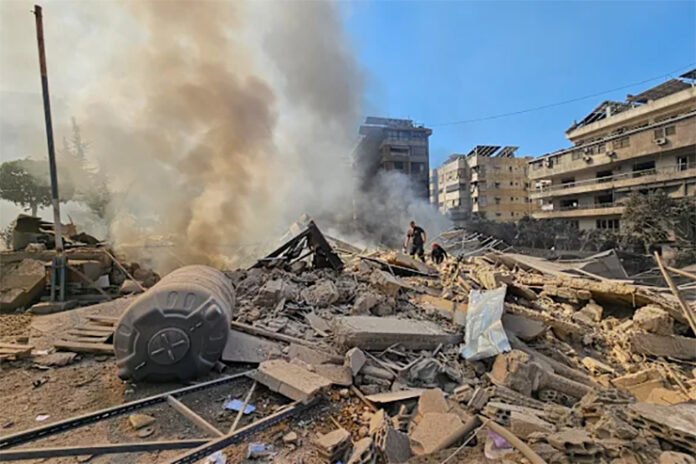
The United Arab Emirates Ministry of Defence said on March 10 that out of 941 Iranian drones detected since the start of the Iran war, 65 fell within its territory, damaging ports, airports, hotels and data centres.
It raises the question of how sustainable a sustained war is.
The one-way attack drones, also used by Russia in the war against Ukraine, have a relatively light payload but can be used to exhaust air defence systems ahead of more damaging future attacks. They have a range of up to 1,200 miles.
Belying facts, the Shahed-136 can be intercepted, and air defences have shown they can bring it down with layered approaches that include short-range missiles, gun systems, and mobile teams using heavy machine guns or autocannons.
Electronic warfare, including satellite-navigation jamming, can also degrade guidance and reduce accuracy. Its relatively slow speed can make it vulnerable, but low-altitude routes and mass launches can still complicate detection and strain interceptor stockpiles. Ukrainian defenders have repeatedly shown successful shootdowns of Shahed-class drones using both guns and missiles.
Reportedly the Shahed-136 has proven so effective that the US has reverse-engineered it and deployed its own version on the battlefield against Iranian targets. In its Iran attacks over the weekend, the US Central Command confirmed that it had used its drones modelled on the Shahed for the first time in combat
While the US and its allies have shot down most Shaheds, the CNBC piece flags a United Arab Emirates Ministry of Defence statistic: “Out of 941 Iranian drones detected since the start of the Iran war, 65 fell within its territory, damaging ports, airports, hotels and data centres.”
Meanwhile, it is reported that the Shahed-136 has proven so effective that the US has reverse-engineered it and deployed its own version on the battlefield against Iranian targets. In its Iran attacks over the weekend, the US Central Command confirmed that it had used its drones modelled on the Shahed for the first time in combat.
Reportedly, after recovering downed Shahed-136s, US teams reverse-engineered a domestic analogue, the Low-Cost Unmanned Combat Attack System (Lucas). Though it has a shorter reach, its punch is comparable. Iran is believed to turn out thousands of cheap drones for roughly $20,000–$50,000 apiece; at those price points, large salvos can be used to probe defences and force costly intercepts, making even imperfect hits operationally disruptive. In turn, the United States has moved Lucas into high-rate production and reportedly deployed it for missions in Iran, but its success rates are not yet available.

-The writer is a New Delhi-based senior commentator on international and strategic affairs, environmental issues, an interfaith practitioner, and a media consultant. The views expressed are personal and do not necessarily carry the views of Raksha Anirveda
