

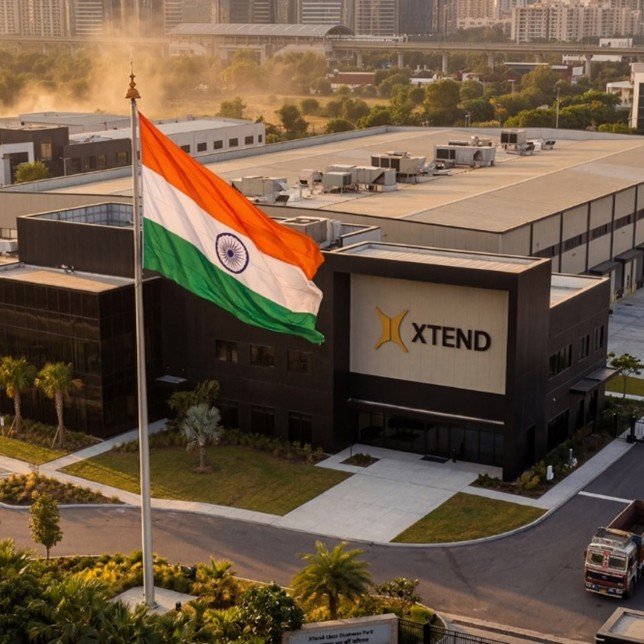
Tel Aviv: Israeli AI robotics company, XTEND has signed an approx. US $ 11 million manufacturing and distribution agreement with Indian defence technology company, Rayonix Tech Private Limited for UAV systems.
XTEND is partnering with Rayonix to expand its XOS autonomy platform into the Indian market. Rayonix has been appointed exclusive manufacturing and distribution partner in India for select XTEND UAV platforms with initial commitment of about US $ 11 million, with payments and exclusivity tied to performance milestones and regulatory approvals.

Rayonix will set up localised manufacturing, testing and distribution for UAVs in India, with technology transfer and “operational enablement” from XTEND.
XTEND’s XOS operating system will be the software backbone of these drones, providing human-guided autonomy, AI-driven navigation, mission planning and real-time control for multi-domain robotic systems.
According to the company, XOS will allow XTEND’s drones to be deployed remotely by military units in various scenarios precisely, intuitively, and immersively.
Last year the Israel Defence Forces (IDF) acquired 5,000 first-person-view (FPV) assault drones from X-TEND under a contract worth around US $ 6 million. These drones are capable of carrying a payload of 2.5 kilograms, enough to carry small explosive charges. They are intended primarily as low-cost, single-use suicide drones to be deployed with combat battalions, probably at the company level.

The details of the operation of these drones in the last wars in Gaza and Lebanon are classified but sources said that they proved to have “very high combat capability”.
The drones made by X-TEND have been selected by the US Department of Defence to develop and supply AI-enabled one-way attack drones, also known as loitering munitions. This contract reflects a major US military shift toward affordable, autonomous drone systems influenced by lessons from recent conflicts like the Russia-Ukraine war.

The XTEND drones are capable of coordinated swarm missions and are produced at a new manufacturing facility in Tampa, Florida, ensuring American-made production with no Chinese components.

-The writer is an Israel-based freelance journalist. The views expressed are of the writer and do not necessarily reflect the views of Raksha Anirveda
