

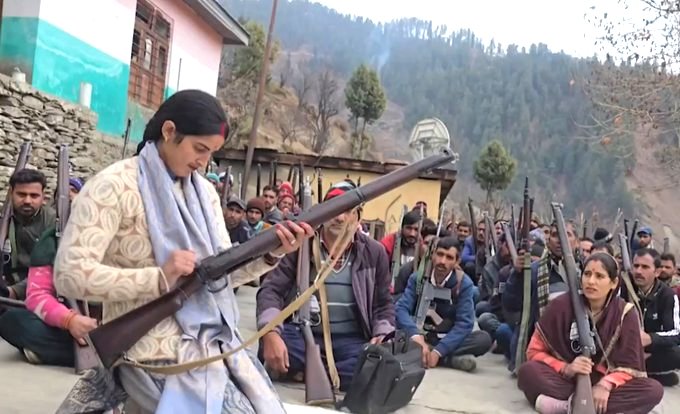
In the mountainous hamlets and forested reaches of Jammu & Kashmir’s Chenab and Pir Panjal ranges, the concept of security has never been abstract. For decades, it has been deeply embedded in the everyday realities of villagers who face the threat of terrorist infiltration, targeted violence and systemic vulnerabilities due to terrain and sparse state infrastructure. Against this backdrop of protracted conflict, the recent rise of women volunteers in Village Defence Guards (VDGs) marks a significant evolution in India’s internal security architecture, one that is rooted in history, animated by state policy, and reshaping gendered norms of defence and citizenship.
From Village Defence Committees to Village Defence Guards: History, Policy and Figures
The roots of community defence in Jammu & Kashmir go back to the mid-1990s, when militancy surged in the Jammu region and remote villages faced repeated attacks by armed groups. In response, local defence structures known as Village Defence Committees (VDCs) were created. These groups consisted of local volunteers, often led by a Special Police Officer (SPO), armed with basic rifles and charged with defending their communities until regular forces could arrive. The idea drew on older practices of arming local actors for border defence during the 1965 and 1971 wars, when ex-service personnel were mobilised to check infiltration and espionage along vulnerable frontiers.

Over time, shifting patterns of militancy, changing political priorities and concerns over inconsistent oversight led to the gradual decline of many VDCs, leaving behind both memories of valour and lessons on the risks of loosely regulated civilian defence. Recognising these lessons, the Union Ministry of Home Affairs (MHA) spearheaded a transformation of the model. In March 2022, the scheme was reconstituted, renamed Village Defence Groups (VDGs) and structured with clearer administrative supervision, remuneration and integration with formal security forces.
According to the Ministry of Home Affairs annual report for 2022-23, the sanctioned strength of VDGs in Jammu & Kashmir is 4,985, of which 4,153 groups have been constituted and are operational across the region. Alongside them, 32,355 Special Police Officers are engaged in various security responsibilities, including anti-terror operations and civilian protection.
The roots of community defence in Jammu & Kashmir go back to the mid-1990s. In response to repeated terror attacks, local defence structures known as Village Defence Committees were created, often led by a Special Police Officer. These groups consisted of local volunteers, armed with basic rifles
The members of these groups, designated as Village Defence Guards, function under the supervision of district superintendents of police or senior superintendents of police. Unlike the earlier VDC model, where only SPOs received remuneration, all VDG members are now paid a monthly stipend, typically ₹4,000 in general areas and ₹4,500 in more vulnerable locations, reflecting an effort by the Home Ministry to formalise and stabilise community-based security participation.
Women Volunteers and the Gendered Landscape of Community Security
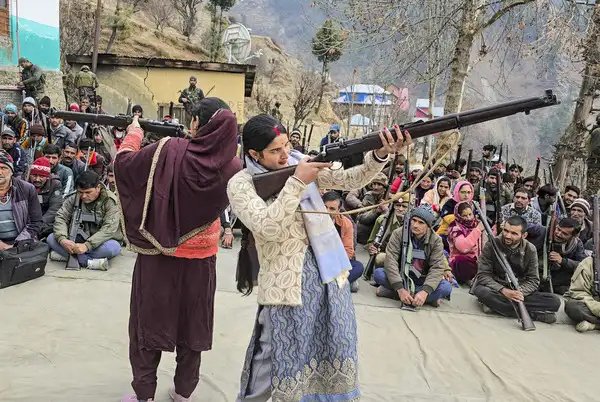
While the overall number of VDGs and SPOs illustrates the scale of the programme, a deeper transformation has been unfolding at the social level: the increasing participation of women as armed volunteers. In districts such as Doda, where terrorism historically claimed civilian lives, including during massacres such as at Kulhand, women are no longer just witnesses to violence but proactive defenders of their villages. In this district alone, officials report that at least 250 women VDG members are presently trained and armed to confront militants if necessary, in a cohort that complements close to 6,000 members across 875 Village Defence Groups in the district.

Recent reporting suggests that in some areas of the Chenab Valley, structured training programmes now include women volunteers, accounting for an estimated 18–20 per cent of recruits, indicating a deliberate push to deepen female participation in local defence. Such participation carries significant operational implications. In many villages, male members are away for work during the day, leaving women exposed and vulnerable; training in firearm handling, area domination, patrolling and self-defence directly addresses this gap in protection capacity.
These developments reflect a broader shift in security policy that acknowledges the gender-specific dimensions of vulnerability and agency. Women no longer represent only those to be protected but are recognised as stakeholders and active agents in local security governance. Their involvement changes community dynamics, enhancing early warning, expanding intelligence networks and challenging the deeply entrenched narrative that only men serve in defence roles.

The Home Ministry says the sanctioned strength of VDGs in J&K is 4,985, of which 4,153 groups have been constituted and are operational across the region. Alongside them, 32,355 Special Police Officers are engaged in various security responsibilities, including anti-terror operations and civilian protection
Training, Modernisation and Strategic Integration
Quantitative data on the number of VDGs only tells part of the story. The quality of training and integration with regular forces is equally important. In areas such as Doda, the Army, Border Security Force (BSF), CRPF and J&K Police are now conducting intensive multi-tier training programmes for VDG members. These cover the handling of modern weapons, including semi-automatic rifles, defensive tactics, bunker construction and methods for repelling attacks, skills that significantly exceed the basic rifle proficiency of earlier iterations.
In one such initiative, around 150 VDG members from 17 villages near the Doda-Chamba border underwent training that included automatic rifle handling and self-defence drills, demonstrating a concerted effort to elevate VDG capabilities beyond ceremonial symbolism to actionable readiness. Elsewhere, Army training reached about 600 village volunteers, helping them master squad post drills and minor tactical operations that contribute to both individual confidence and collective deterrence.
This layered approach, combining community recruitment, structured training and integration with formal security strategies, aligns with the Home Ministry’s vision of VDGs as a force multiplier. Instead of replacing professional forces, VDGs extend the reach of the security grid, especially in remote and border-proximate villages where rapid response times can mean the difference between life and death.
Unlike the earlier VDC model, where only SPOs received remuneration, all VDG members are now paid a monthly stipend, typically ₹4,000 in general areas and ₹4,500 in more vulnerable locations, reflecting an effort by the Home Ministry to formalise and stabilise community-based security participation
Historical Resonance and Strategic Successes
While rigorous academic evaluations of the VDG model’s effectiveness are limited, government statements and operational reports suggest that the programme contributes to a broader deterrence ecology in Jammu & Kashmir. For instance, the MHA annual report for 2022-23 noted a decline in organised militant activity and highlighted dozens of counter-terror operations that involved actionable local intelligence, a key function VDGs are positioned to provide. While specific attribution of VDG actions is rarely published in detail, the expansion of groups, recruitment of new members and continued focus on training signal confidence in their utility.
Moreover, administrative data also show that districts such as Reasi are actively enhancing their VDG capacity: in late 2025 alone, 97 new VDG groups were established, and nearly 1,902 additional members were integrated into the security network, replacing older personnel and strengthening the local defence grid.
International parallels reinforce the strategic rationale for inclusive civilian defence. Historical civilian defence units in Israel’s kibbutz system demonstrated the value of community-anchored deterrence in hostile environments. Women’s participation in these units helped expand early warning networks, delay enemy advances and foster a culture of shared responsibility that complemented formal security forces without undermining central control. Such experiences highlight that when civilian defence is regulated, trained and gender-inclusive, it can enhance resilience and deterrence without eroding democratic governance.
The Legal Architecture of Civilian Defence and Constitutional Safeguards
From a legal standpoint, the Village Defence Guard framework operates at the intersection of constitutional permissibility, statutory policing powers and executive policy, rather than as an ad hoc militarisation of civilians. VDGs are not militias in the private sense; they function under the superintendence of the District Police and the executive authority of the Union Ministry of Home Affairs, drawing legitimacy from the Union’s obligation under Article 355 of the Constitution of India to protect states against internal disturbance.
Embedded within the Home Ministry’s broader internal security strategy, Village Defence Committees now reflect a hybrid model that blends local knowledge with professional training, constitutional legitimacy with operational readiness, and individual agency with collective defence
Their arming and training are anchored in the Government Order (No. 287-Home of 2022) issued by the Jammu & Kashmir Home Department on August 14, 2022, which revised the Village Defence Groups Scheme, and in the Ministry of Home Affairs communication of March 2, 2022, authorising the constitution of VDGs under police supervision, stipends and operational parameters. From a gender justice perspective, the inclusion of women volunteers aligns with India’s obligations under CEDAW and evolving constitutional jurisprudence that recognises women as active agents in public security rather than passive beneficiaries of protection.
When properly regulated, trained and supervised, women’s participation in VDGs strengthens, not dilutes the rule of law by expanding lawful state presence into remote areas while remaining within the bounds of constitutional restraint and civilian supremacy over force.
Towards a Holistic Security Architecture
The rising presence of women in Jammu & Kashmir’s Village Defence Guards is more than a demographic statistic; it represents a reframing of community security that acknowledges gendered experiences of violence and the agency of those traditionally marginalised in defence discourse. Embedded within the Home Ministry’s broader internal security strategy, VDGs now reflect a hybrid model that blends local knowledge with professional training, constitutional legitimacy with operational readiness, and individual agency with collective defence.
In a region marked by four decades of insurgency and cross-border challenges, such hybrid models are not simply tactical adjustments. They are experiments in sustainable, community-embedded security governance, one that recognises that when women stand guard over their villages, they are not merely responding to threats but redefining citizenship, resilience and the very practice of internal security.

The writer is a legal academic with a PhD in Law, working at the intersection of gender justice, public policy, and national security. She is presently serving as Assistant Professor (Gr II) of Law at Amity University, Noida. She can be contacted at sunandini.arun@gmail.com. The views expressed are personal and do not necessarily carry the views of Raksha Anirveda
