

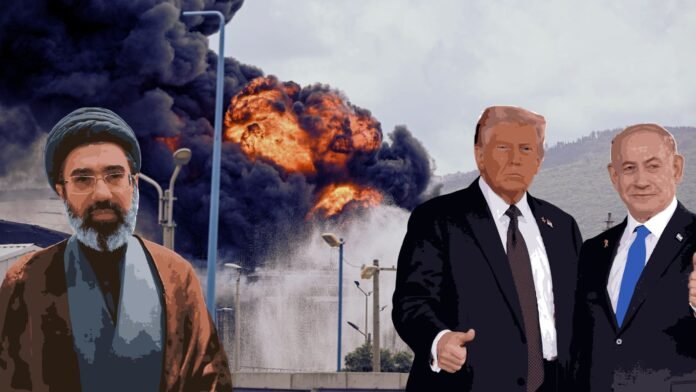
As the United States’ desperation to exit the Iran conflict increases, few developments within the US strategic and security community further reveal that the exit strategies the US is currently planning face strong divisions, which led to the firing of the US Army Chief and two senior military officials. Perhaps the US security community wants to avoid repeating the mistakes it made decades ago in Iran.
The Strategy Under Question
The current strategic deployments and military actions of the US in and around Iran indicate that the US anticipates quick strikes with a powerful shock and awe approach and a rapid withdrawal. However, this would not be merely a mass strike but would target objectives of significant strategic importance, thereby enhancing the credibility of the US and establishing Operation Epic Fury as a successful operation.

The strategy has one primary objective: to carry out multi-stage rapid strikes with a three-prong approach — Ground, Naval, and Air — ensuring full-spectrum dominance and targeting Iran. The tactical objectives are to weaken its energy and nuclear sites, as well as its geostrategic capabilities, by seizing key islands, whether in or around the Strait of Hormuz or Kharg. While the strategic and tactical objectives both seem ambitious in scope and of high strategic importance, the real concern among intelligence and military circles remains: the likelihood of success and the potential risks, which may have sparked a turf war and a cold war between political and strategic bureaucracies. To fully grasp this strategic anxiety, the US must revisit its long-standing failed operation in Iran that contributed to the loss of former US President Jimmy Carter in the 1980 elections.
Operation Eagle Claw
The US launched Operation Eagle Claw to rescue 53 embassy staff held hostage by Iranian revolutionaries in April 1980. A joint operation with coordinated effort and communication across the three services was initiated. The operation outlined clear strategic priorities for each command. US Delta Force was tasked with storming the embassy and securing landing sites. Navy resources, including eight naval helicopters from USS Nimitz in the Arabian Sea, were used for transportation, and the Air Force provided logistical support. Upon reaching the landing zone, the Delta Force was to move to a second location, codenamed Desert Two, which would serve as their hideout.
The US launched Operation Eagle Claw to rescue 53 embassy staff held hostage by Iranian revolutionaries in April 1980. A joint operation with coordinated effort and communication across the three services was initiated. However, the operation went dangerously off track, leading to the deaths of eight servicemen, eventually forcing the operation to be aborted
Two teams were to remain hidden during daylight hours and, with CIA ground support, travel to Tehran at night using six Mercedes trucks, secured in a warehouse by CIA operatives. On the ground, the plan was simple: two teams — one to storm the embassy and another to raid Iran’s Foreign Ministry to rescue additional hostages. However, the operation went dangerously off track, leading to the deaths of eight servicemen, ultimately forcing the operation to be aborted. The reasons for the failure were clear: first, complex operational planning; second, misreading ground realities; and third, operational uncertainties.
The planning was complicated; it relied on multiple high-risk manoeuvres and limited operational security. Multiple movements and imperfect execution created operational challenges and hindered strategic communication. Operational security was compromised by choosing a landing zone near a public road. Shortly after landing, US forces had to detain a bus with 44 Iranian civilians and blow up a fuel tanker that refused to stop, immediately compromising operational security.

Second, the CIA misread ground realities when tasked with surveying and examining operational feasibility and complexities. The CIA’s survey of the landing site and its soil failed to account for recent storms, which created deep deposits and an ankle-deep layer of powdery sand that hampered heavy landings.
The CIA misread ground realities when tasked with surveying and examining operational feasibility and complexities. The CIA’s survey of the landing site and its soil failed to account for recent storms, which created deep deposits and an ankle-deep layer of powdery sand that hampered heavy landings
Furthermore, CIA’s Special Activities Division (SAD) had weak on-ground intelligence due to the 1979 Islamic revolution that dismantled US influence on the ground. This weak intelligence network led to poor security assessments, resulting in errors in site selection and operational security. Moreover, the CIA relied heavily on open-source intelligence, such as TV news channels and outdated blueprints, which provided low-quality intelligence critical for planning and execution.

Third: Operational Uncertainty: Dust storms and technical issues during communication and landing, especially a brownout condition caused by dust clouds from rotor wash, contributed to a fatal collision between a naval helicopter and the Army’s Transport aircraft that resulted in the deaths of eight servicemen.
After the failure of Eagle Claw, the US prepared another operation codenamed Credible Support, but it was aborted when a modified aircraft crashed during training. After a series of failures, the US decided to establish the US Special Forces Command and 160th SOAR: specialised, low-level night flying capabilities led to the creation of the 160th Special Operations Aviation Regiment (Night Stalkers). Even after such significant operational improvements and lessons learned, the US perhaps never launched large-scale ground operations in Iran after 1980 and shifted its policy toward limited, surgical operations with increased focus on covert actions.
The Trump Administration is torn between sceptics and optics, with the US Army Chief and other officials disagreeing with Pentagon leaders and the War Secretary over plans for ground operations in Iran. This disagreement led to the ultimate fallout and the abrupt departure of the US Army Chief and other senior officials
Caught in a Similar Situation
After forty-six years, the US is again facing a desperate need to carry out a multi-stage operation with full-spectrum strikes. Similarly, the US administration previously faced tensions and divisions, and now faces the same dilemma. The then US Secretary of State Cyrus Vance resigned and opposed a risky operation in Iran. Although the CIA offered full support for the operation back then, some within the agency were sceptical about its success.
The Trump Administration was torn between sceptics and optics, with the US Army Chief and other officials disagreeing with Pentagon leaders and the War Secretary over plans for ground operations in Iran. This disagreement led to the ultimate fallout and the abrupt departure of the US Army Chief and other senior officials. Even at the intelligence level, Director of National Intelligence Tulsi Gabbard is nearing the point of resignation. At the CIA, many are sceptical about the ground operation, as reports indicate CIA officials have expressed concern over Iran’s active rebuilding of missile bunkers and the resumption of diplomatic efforts, with Iran choosing more aggressive means of engagement instead of diplomatic dialogue. This issue is becoming more urgent. Despite Trump loyalists in the CIA, including its Director, actively aligning with the White House’s wishes regarding Iran in the near future.
Aside from bureaucratic tussling, there are multiple variables and uncertainties in a multi-stage ground, naval, and air operation in Iran, especially aiming to seize and raid a key island. The US can take risks and launch an Expeditionary Advanced Base Operation (EABO), a modern US Marine Corps warfighting concept designed to deploy small, mobile, and low-signature forces into contested maritime areas. The primary goal is to gain control of maritime sites by establishing advanced bases, ensuring sea denial and control operations around the Strait of Hormuz.
The US can take risks and launch an Expeditionary Advanced Base Operation (EABO), a modern US Marine Corps warfighting concept designed to deploy small, mobile, and low-signature forces into contested maritime areas. The goal is to gain control of maritime sites by establishing advanced bases, ensuring sea denial and control operations around the Strait of Hormuz
However, the US faces the same operational challenges it does now. First: operational assessment of ground intelligence is still uncertain about Iran’s missile capabilities and what risks exist if, during the operation, any missile from a stand-off position hits US Marines, even after maintaining air-ground operational security. Second: complexity – executing a large EABO and full-spectrum operations requires jointness, involving multiple operational and logistical challenges that could complicate US options for sustaining ground forces over a long period. Third: Operational uncertainty – Technical aspects and uncertain environmental and island situations may cause last-minute problems, as experienced during Operation Eagle Claw.
The US faces similar operational tests it faced decades ago, and success will rely only on calculated risks and restraint, not on knee-jerk and impulsive operational responses that may rewind the US nightmare from four decades ago.

The writer is a national security analyst specialising in intelligence and strategic affairs. He has worked extensively with national security and foreign policy think tanks of repute, and has written for publications including The Telegraph, The Print, Organiser, and Fair Observer. He has also been a guest contributor to the School of International Studies at Jawaharlal Nehru University (JNU).
