

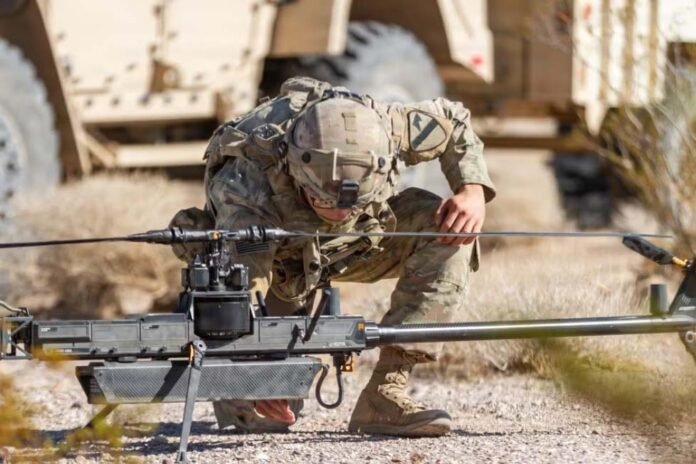
Washington: The US Army-run counter-drone task force has selected Anduril’s Lattice software as the command and control backbone in an $87 million award as the first task order in a enterprise deal worth up to a staggering $20 billion over 10 years.
The company announced the counter-UAS award under Joint Interagency Task Force 401, an inter-service entity tasked with developing solutions to thwart drones for the entire Department of Defence.

Lattice integrates a variety of sensors and effectors that will enable distributed detection, tracking, classification, and engagement of UAS threats in seconds, the company said.
That news follows the announcement about a broader, firm-fixed-price contract to “consolidate current and future commercial solutions—including the proprietary, open-architecture, AI-enabled Lattice suite, integrated hardware, data, computer infrastructure, and technical support services—into a unified, mission-ready capability supporting the Army’s evolving operational and business needs.”
Matthew Steckman, Anduril president and chief business officer, explained that that $20 billion award is more like an “ordering guide where any buyer within the federal government can buy Anduril commercially made products.”
“This is a contract vehicle,” he said. “We got a lot of messages over the weekend, like, ‘Oh, you made $20 billion.’ There’s no money attached to it, this is just a contract vehicle, but it reduces a lot of friction in things that just simply shouldn’t have it.”

The move is the latest in the Army’s push for enterprise contracts, which will allow the Army to be more flexible in getting capabilities to soldiers with less administrative burden, according to the service. Those contracts, equated to buying in bulk, have pre-negotiated terms and pricing to avoid lengthy and redundant negotiations where orders can be placed as soon as a vendor is selected through a competitive process, according to an Army-published article from March 11.
The article notes these contracts can offer commercial products and services through an individually priced or “à la carte” style menu, to provide flexibility to purchase what is needed.


