
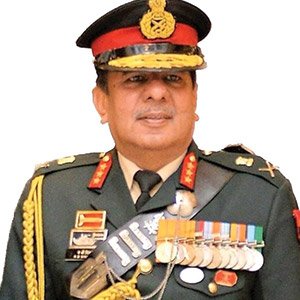
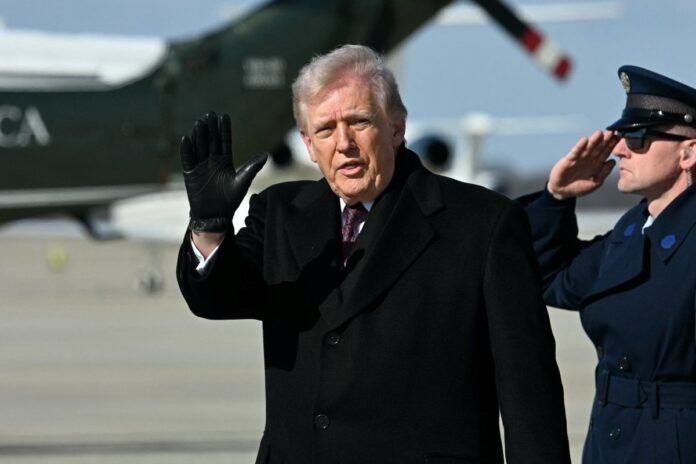
In any national security system, the military is more than just an instrument of force; it is the primary source of professional military advice to the state. Its strength depends as much on its discipline of obedience as on its duty to advise without fear. The American system, developed over two centuries, has relied on this delicate balance: civilian supremacy combined with professional candour. That balance now appears to be disrupted.
The recent removal of several senior military leaders in the United States, including the Army Chief, does not appear to be a routine transition. Leadership changes are common. However, this situation feels different. The sequence, the timing, and the lack of a clear operational trigger suggest that more than an administrative reshuffle was at play. It generates a sense of unease that is difficult to ignore and even harder to dismiss, especially in a system that has traditionally valued the stability of its civil–military balance.

Professional militaries depend on accumulated experience. Strategic insight is not improvised; it is cultivated over decades of command, staff exposure, and institutional learning. When such experience is discarded without a transparent cause, the signal transmitted down the chain of command is unmistakable. It suggests that service continuity depends less on professional competence or integrity and more on alignment with prevailing political expectations.
The American civil-military system, developed over two centuries, has relied on a delicate balance: civilian supremacy combined with professional candour. That balance now appears to be disrupted
Once that idea takes hold, behaviour begins to adjust. Advice is no longer offered on its merit alone. It is weighed, filtered, and sometimes softened before it is spoken. What follows is not an immediate breakdown, but a gradual thinning of candour. Over time, the system loses something essential: the confidence to act professionally when it matters most.
Military leaders are trained to give professional military advice to the government. Civilian leaders can choose to accept or reject this advice. This system works not only because it is written into law but also because it is respected in practice. A good example is Field Marshal Manekshaw advising the postponement of military operations in 1971. When senior commanders are dismissed in ways that seem unrelated to their performance, the understanding behind this becomes quietly pressured. The message doesn’t need to be spoken out loud; it is understood through observation. Officers quickly learn which opinions can be safely communicated upward and which cannot.
That shift is rarely dramatic. It does not announce itself through doctrine or orders. Instead, it manifests in tone, hesitation, and the subtle narrowing of options available to decision-makers. The risk is not that the military will refuse to obey; it is that it will cease to inform fully, and the professional spine will bend, diluting moral courage and integrity — foundations of military professionalism.
The United States has faced moments like this before, though not frequently. The reforms following the Goldwater–Nichols Act were designed precisely to strengthen professional military advice and ensure coherence at the top. The intent was to reduce fragmentation and improve the quality of strategic input reaching civilian leadership. That system, however, only works when officers believe candour will not cost them their careers. Without that culture, structural reform alone cannot carry the burden.

Professional militaries depend on accumulated experience. Strategic insight is not improvised; it is cultivated over decades of command, staff exposure, and institutional learning. When such experience is discarded without a transparent cause, the signal transmitted down the chain of command is unmistakable
History is rarely kind to militaries that drift too close to politics. Once armed forces begin to mirror the preferences of those in power rather than the requirements of strategy, the effects are not immediate but lasting. In Nazi Germany, the general staff did not collapse overnight. It adjusted, step by step, to ideological expectations and, in doing so, lost the habit of independent judgment at critical moments. In the Soviet Union, the purges under Joseph Stalin removed not just individuals but confidence within the system. Officers learned caution where initiative had once been expected. By the time war came, the damage had already been done.
More contemporary examples are less dramatic but equally instructive. In Pakistan, repeated close interaction between military leaders and political authorities has created a cycle where institutional independence is hard to maintain. The result is not a loss of capability, but a gradual change in professional focus. Competence stays intact, but it is exercised in an environment where political considerations are never far away. That closeness begins to influence judgment in subtle ways. Decisions are not always free from expectations, and independence becomes more difficult to uphold in practice than in theory. Over time, the institution adapts to these pressures. What is impacted is not efficiency but ethos. When alignment begins to outweigh objective assessment, the erosion is slow, often barely noticeable, but rarely reversible.

History is rarely kind to militaries that drift too close to politics. Once armed forces begin to mirror the preferences of those in power rather than the requirements of strategy, the effects are not immediate but lasting
The effects do not stay confined within national borders. Allies observe carefully, often interpreting signals that domestic audiences miss. Consistent military leadership has always reassured allies that commitments will be fulfilled with clarity and discipline. When that consistency is broken without a clear reason, doubts begin to emerge, not about capability, which remains strong, but about stability. Institutions like the North Atlantic Treaty Organisation – NATO, rely as much on confidence as on capacity, and confidence is vulnerable to disruptions at the top.
Adversaries interpret the same signals differently. Leaders such as Xi Jinping do not require precise information to form judgments. Patterns are enough. If those patterns suggest distraction or internal strain, they begin to factor that into their own calculations. Decision-making that appears less settled invites testing, sometimes subtly, sometimes more directly. Even a perception of inconsistency can influence behaviour across theatres, from maritime disputes in the Indo-Pacific to competition in the cyber domain.
The responsibility for maintaining that balance does not lie with any single institution. The Congress has a role that extends beyond confirmation. It is intended to probe, question, and ensure that decisions affecting the military are based on national interest rather than short-term preferences
At home, the consequences unfold more quietly. The American military has, for decades, maintained a reputation for remaining outside partisan currents. That distance has not meant detachment from society, but it has ensured a degree of trust that few institutions enjoy. If that perception begins to weaken, the change will not be dramatic. It will show up gradually in who is drawn to serve and how they see the profession. A force that senses advancement depends on more than merit will adapt, in ways that are difficult to measure at first, and difficult to correct later.
Inside the system, none of this goes unnoticed. Officers observe, compare, and draw their own conclusions. They do not need formal guidance to understand what is valued. If the belief takes hold that professional excellence alone is not sufficient, choices begin to shift. Some will adjust. Others will step away. Over time, the institution’s character begins to change, not by design but by accumulation.
The responsibility for maintaining that balance does not lie with any single institution. The Congress has a role that extends beyond confirmation. It is intended to probe, question, and ensure that decisions affecting the military are based on national interest rather than short-term preferences. During such moments, oversight is not obstruction; it is stabilisation. Without that scrutiny, the system defaults to executive preference.
The real question is not about any individual dismissal, nor even about a particular administration. It is about whether the unwritten understandings that underpin professional military conduct will hold. These understandings are rarely tested in calm periods; they are tested precisely in moments of friction
For countries like India, which see the United States both as a partner and as a reference point, these developments are instructive. Civil–military balance is not self-sustaining. It requires ongoing attention, especially during periods of political tension. Institutional habits, once changed, do not automatically revert. That is how institutional drift gradually begins, and then suddenly accelerates.
The real question is not about any individual dismissal, nor even about a particular administration. It is about whether the unwritten understandings that underpin professional military conduct will hold. These understandings are rarely tested in calm periods; they are tested precisely in moments of friction.
What is at stake is not just efficiency or morale, but the quality of judgment at the highest level of national security. Militaries do not fail when they are overruled. They fail when they stop speaking, and their strength erodes, not from outside, but from within.
The author, a PVSM, AVSM, VSM has had an illustrious career spanning nearly four decades. A distinguished Armoured Corps officer, he has served in various prestigious staff and command appointments including Commander Independent Armoured Brigade, ADG PP, GOC Armoured Division and GOC Strike 1. The officer retired as DG Mechanised Forces in December 2017 during which he was the architect to initiate process for reintroduction of Light Tank and Chairman on the study on C5ISR for Indian Army. Subsequently he was Consultant MoD/OFB from 2018 to 2020. He is also a reputed defence analyst, a motivational speaker and prolific writer on matters of military, defence technology and national security. The views expressed are personal and do not necessarily carry the views of Raksha Anirveda
