

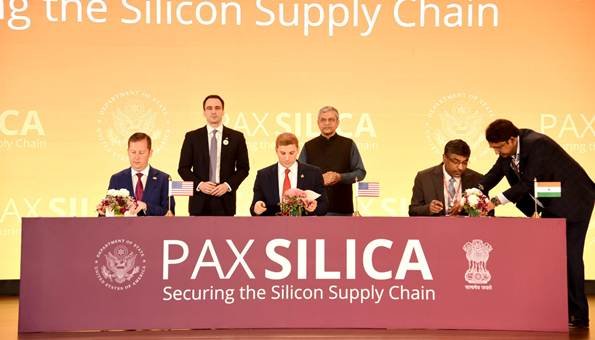
In the closing months of 2025, the global geopolitical landscape underwent a tectonic shift with the birth of Pax Silica. This US-led strategic framework was not merely another trade pact; it was a declaration of technological interdependence among “trusted geographies”. For India, joining as the tenth full member in February 2026 marked the end of “non-aligned” technology procurement and the beginning of “aligned” sovereign capability.
Pax Silica posits that in the age of Artificial Intelligence; a nation’s borders are only as secure as its supply chains. For the Indian defence ecosystem, this alliance represents a “Silicon Shield” — a move to insulate its military modernisation from the coercive monopolies of the East, while leapfrogging decades of legacy hardware development.

Pax Silica posits that in the age of Artificial Intelligence; a nation’s borders are only as secure as its supply chains. For the Indian defence ecosystem, this alliance represents a “Silicon Shield” — a move to insulate its military modernisation from the coercive monopolies of the East, while leapfrogging decades of legacy hardware development
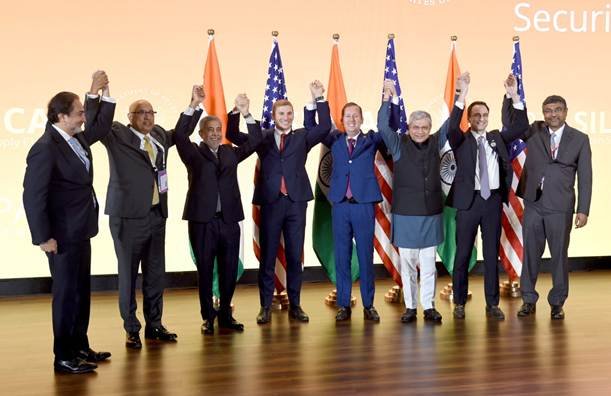
By signing the Pax Silica Declaration and the Joint Statement on the India-US AI Opportunity Partnership, both nations have transitioned from a transactional “buy-and-sell” relationship to a “build-together” framework aimed at ending “weaponised dependency” on non-aligned powers. This collaboration, which upgrades the previous iCET (Initiative on Critical and Emerging Technology) into the broader TRUST (Transforming the Relationship Utilising Strategic Technology) framework, leverages India’s massive engineering talent and the United States’ advanced lithography and design expertise.
The partnership is already yielding tangible results on the ground. On March 31, 2026, Prime Minister Modi inaugurated the Kaynes Semicon OSAT facility in Sanand, Gujarat, following the February 2026 launch of commercial production at Micron Technology’s assembly and test facility. India’s inclusion strengthens the alliance’s access to its vast talent pool and nascent critical mineral reserves, while providing New Delhi with faster access to ASML lithography tools and high-performance GPU infrastructure. Global tech giants like Google have committed to a $15 billion AI hub in Visakhapatnam, while OpenAI has partnered with the Tata Group to expand “Stargate” AI infrastructure across India.
Pax Silica is as much about mines as it is about microchips. By joining it, India gained access to the Mineral Security Partnership (MSP) within the alliance. Evidence of this impact is seen in the March 2026 bilateral deal with Brazil and Australia to co-develop lithium and cobalt refineries
The Problem: The Fragility of the “Old” Ecosystem
To understand the impact, one must look at the crisis of 2025. Following the escalation of the “Magnet Wars,” China enacted strict export freezes on rare-earth elements and high-end gallium/germanium compounds. India’s indigenous drone programmes and the production of the Tejas Mk2 faced immediate delays because critical sensors and permanent magnets were sourced from Chinese-linked refineries.

Furthermore, India’s defence AI ambitions — under the “AI in Defence” (AIDef) initiative — hit a bottleneck. Despite having the software talent, India lacked the physical “compute” (GPU clusters) necessary to train the large language models (LLMs) required for autonomous underwater vehicles (AUVs) and battlefield predictive analytics.
Pax Silica: The Strategic Inflection Point
India’s entry into Pax Silica on February 20, 2026, during the India AI Impact Summit, changed the calculus in three fundamental ways:

Secure Hardware & The GPU Bridge
Under the Pax Silica framework, India secured a “Priority Procurement” status for high-end semiconductors. While the world faced a “compute famine,” India negotiated the establishment of a dedicated AI Sovereign Cluster in Bengaluru, powered by the latest generation of chips. This allows the Indian Ministry of Defence (MoD) to train defence-specific AI models — such as the “Sudarshan-AI” for border surveillance — without the data ever leaving Indian soil or relying on “grey-market” hardware.
Using AI models trained on Pax Silica-secured hardware, the Indian Army has reduced its supply chain latency by 30% in high-altitude regions like Ladakh. The induction of AI-driven swarm drones, which require high-speed processing at the “edge,” has been accelerated. These drones no longer rely on commercial-off-the-shelf (COTS) chips that could have hidden “kill switches,” but on Pax Silica-verified silicon
The Rare-Earth De-risking
Pax Silica is as much about mines as it is about microchips. By joining it, India gained access to the Mineral Security Partnership (MSP) within the alliance. Evidence of this impact is seen in the March 2026 bilateral deal with Brazil and Australia to co-develop lithium and cobalt refineries. This ensures that India’s future fleet of electric military vehicles and missile guidance systems are immune to Beijing’s export whims.
The 18-Month Moving Gap
A core tenet of Pax Silica is maintaining a permanent 18-month lead over adversarial technologies. For the Indian defence R&D (DRDO), this means moving away from “reverse engineering” and into “co-development.” Indian engineers are now integrated into global labs working on Quantum Key Distribution (QKD) and 6G-enabled battlefield networks, ensuring that the Indian Army’s networked warfare capabilities remain ahead of the “untrusted” systems used by adversaries.
Impact on Defence Operations: Data as the New Ammunition
The 2026 designation of the Indian Army’s “Year of Networking & Data Centricity” is a direct byproduct of the Pax Silica environment. The alliance provides the secure “backbone” for India’s shift toward Integrated Battle Groups (IBGs).
Pax Silica opens doors for Indian engineers to work in top-tier global labs. There is a risk that India’s best AI minds will be absorbed by Western defence giants rather than building for the Indian MoD. The “Human Capital Advantage” cited by policymakers must include aggressive incentives to keep talent within the domestic “iDEX” ecosystem
Using AI models trained on Pax Silica-secured hardware, the Indian Army has reduced its supply chain latency by 30% in high-altitude regions like Ladakh. The induction of AI-driven swarm drones, which require high-speed processing at the “edge,” has been accelerated. These drones no longer rely on commercial-off-the-shelf (COTS) chips that could have hidden “kill switches,” but on Pax Silica-verified silicon. With the integration of Dutch and Japanese encryption standards under the alliance, India’s Defence Cyber Agency (DCyA) has reported a significant drop in successful “State-sponsored” intrusions into the national power grid and command-and-control centres.
The Risks of Alignment
While the benefits are immense, a discerning strategic analysis reveals two critical challenges for India:
The “High-Tech Dependency” Trap: By aligning so closely with US-led standards, India risks trading one dependency (Russian hardware/Chinese minerals) for another (American silicon/standards). To counter this, the Indian government’s push for the India Semiconductor Mission (ISM) must succeed. Pax Silica must be used as a bridge to build local fabs, not a crutch to avoid building them.
The “Talent Drain” Paradox: Pax Silica opens doors for Indian engineers to work in top-tier global labs. There is a risk that India’s best AI minds will be absorbed by Western defence giants (like Palantir or Lockheed Martin) rather than building for the Indian MoD. The “Human Capital Advantage” cited by policymakers must include aggressive incentives to keep talent within the domestic “iDEX” (Innovations for Defence Excellence) ecosystem.
The Future of Sovereign Power
Pax Silica is more than a tech alliance; it is the infrastructure of 21st-century sovereignty. For India, it provides the “Silicon Shield” necessary to transition from a regional power to a global technological decider. By coupling its massive data pools and human talent with the secure hardware and mineral access of Pax Silica, India is effectively “future-proofing” its defence. The result is an Indian military that is not just bigger, but smarter — capable of winning wars in the “silicon domain” before a single shot is fired in the physical one.

–The writer is Assistant Professor, ICFAI School of Liberal Arts, ICFAI University, Jaipur. The views expressed are of the writer and do not necessarily reflect the views of Raksha Anirveda
