
The ongoing Russia-Ukraine conflict has left Russia facing escalating economic sanctions imposed by the United States and the EU, creating a somewhat economically stifling situation for Moscow. In 2016, NATO responded to the apprehensions of its member states along the Russian borders by reinforcing its military capabilities, particularly in Estonia, Latvia, Lithuania, Poland, and Romania. Furthermore, the United States has stood by its 2008 pledge that Ukraine and Georgia “will become” members. In 2019, the United States also withdrew from the Intermediate Range Nuclear Forces (INF) Treaty after alleging Russian non-compliance. This step further raised the possibility of nuclear deployments in Central and Eastern Europe, along with similar placements around the Russian periphery.
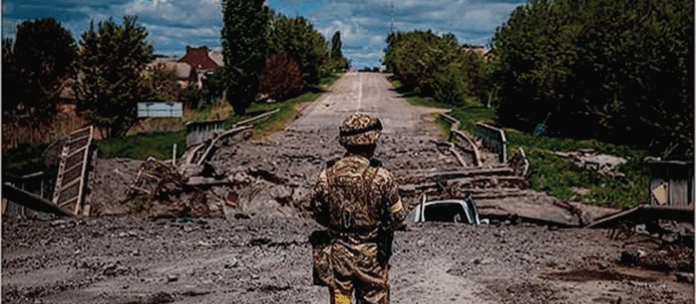
The conflict that began in February 2022 saw Russian calculus assume the West’s indecisiveness and distraction would prevent it from responding forcefully. Despite the reported 190,000 troops massed on the Ukrainian border during early 2022, it was clear that Moscow lacked the manpower to execute a sustained military occupation, especially in the face of consistent foreign support for Ukraine. The failure of attacks on Kyiv, Kharkiv, and other cities in the first few months of the conflict resulted in heavy casualties and forced Moscow to turn its focus back to the Donbas.

The combination of American and EU sanctions made sustenance difficult for the Russian economy, especially with most of its banking and financial institutions losing access to the prevalent dollar-denominated financial system. While this conflict has bolstered President Putin’s standing in Russian domestic politics, it has also resulted in a mass exodus of educated Russians and the curbing of dissent within Russia.
President Putin’s decision to use force and carry out a large-scale invasion, rather than the more limited military incursions seen in Georgia (2008) and the Donbas (2014–15), clearly indicates Russian impatience. President Putin’s February 21 speech, along with his following address, declared the launching of Russia’s “special military operation.” This action essentially denied the very idea of a separate Ukrainian identity and the legitimacy of the Ukrainian state. These acts clearly prompted Ukrainian President Zelensky’s call for resistance.
Historically, before the Orange Revolution, President Putin had assumed that a large number of Ukrainians remained committed to the idea of the “all-Russian” nation and that it was only the manipulation of foreign powers that had pushed Ukraine away from Russia. For several years, that belief was the cornerstone of Russia’s Ukraine policy aimed at preventing the latter’s tilt towards Europe.
However, the current conflict between Russia and Ukraine rests on these same assumptions about Ukraine. Critically, Ukrainian resistance was well beyond Russian expectations. Russian forces suffered significant casualties and failed in their initial objective of capturing Kyiv. Meanwhile, even politicians belonging to the eastern-based Opposition Platform have become vocal against the Russian intervention, along with leading Ukrainian oligarchs. The Opposition Platform’s leader, Yuriy Boiko, has also openly supported President Zelensky.

One of the issues that the Russians face is related to public perception. Consequently, even if Russian forces were to take over Kyiv, a new regime would be unable to establish legitimacy amongst Ukrainians, especially after the revelations concerning Russian war crimes and other atrocities in the regions it has occupied.
In this conflict, Russia has failed to accomplish any of its stated military aims and has suffered significant losses both in terms of troops and equipment. Even previously apolitical Ukrainians have fought back or condemned the invasion. The long list of supporters that the Russians were counting on has failed to materialise. Russian determination to bring Ukraine back into the fold, despite the huge economic cost it is paying through this conflict, indicates that the present crisis goes beyond the issue of Ukraine’s relationship with NATO.

President Putin’s February 21 speech, along with his following address, declared the launching of Russia’s “special military operation.” This action essentially denied the very idea of a separate Ukrainian identity and the legitimacy of the Ukrainian state
The full extent of Russian anxiety related to Ukrainian membership in NATO was never a near-term possibility. It was Yanukovych’s aim to sign a trade agreement with the EU (not NATO) that triggered the protest movement and Russia’s first invasion in 2014. Despite the performance of the Russian military so far and the possible impact of the sanctions imposed on it by Western nations, the possibility of Russian victory remains, but at a much higher cost. The final outcome of the conflict will depend on the West’s response and Ukraine’s resolve to fight for a nation that President Putin believes does not and should not exist.
In this conflict between Russia and Ukraine, the policy approach of the United States and the EU has been primarily related to imposing sanctions against Russia and supporting Ukraine through military equipment. The United States has implemented various sanctions against Russia that have targeted individuals, entities, and sectors of the Russian economy, in an effort to pressure Russia to change its course in Ukraine and adhere to international norms.
The United States has also expanded export controls affecting Russia’s access to sensitive technologies of American origin, restricted the import of certain goods from Russia, and banned Russian use of American airspace and ports. Since February 2022, the United States has imposed economic sanctions on almost 1,900 Russian individuals and entities, alongside an entry ban on several thousand Russian officials, military personnel, government-affiliated personnel, and Russian businessmen.
In response to Russia’s conflict against Ukraine, the United States has increased military deployments to Europe and led a broader NATO effort to prevent further Russian aggression and to defend NATO allies, particularly in Central and Eastern Europe. The American Congress has supported the enhanced force presence and American leadership of NATO defence and deterrence measures. The American Senate also gave its advice and consent to approve Finland and Sweden’s accession to NATO.
The EU has also imposed sanctions on Russia, following the American lead. These sanctions encompass travel bans, asset freezes, and restrictions on economic cooperation, particularly targeting sectors like finance, energy, and defence. Both the United States and the EU have provided political, financial, and humanitarian support to Ukraine. This assistance includes financial aid packages, military assistance, humanitarian aid, and political backing in international forums.
Russian determination to bring Ukraine back into the fold, despite the huge economic cost it is paying through this conflict, indicates that the present crisis goes beyond the issue of Ukraine’s relationship with NATO
The United States and the EU have been actively engaged in diplomatic efforts to find a peaceful resolution to the conflict. They have supported the Minsk agreements, negotiated within the framework of the Organisation for Security and Cooperation in Europe (OSCE), which were aimed at achieving a ceasefire and a political settlement in eastern Ukraine.
In this context, the United States and some EU members that are part of NATO have expressed support for Ukraine and have taken measures to enhance security cooperation with Kyiv, such as providing assistance, conducting joint exercises, and enhancing defence capabilities. Both the United States and the EU have consistently condemned Russian actions in Crimea and eastern Ukraine, highlighting the violation of international law, Ukraine’s sovereignty, and territorial integrity. They have advocated for a rules-based international order and respect for international norms. The United States and the EU have been actively involved in diplomatic efforts to find a peaceful resolution to the conflict, supporting the Normandy Format and the Trilateral Contact Group, which aim to facilitate dialogue and negotiations between Ukraine, Russia, and the OSCE.
Several Western analysts seem to misinterpret the causes of the conflict and have accepted Moscow’s narrative that NATO expansion led to the present conflict. The leadership in Kyiv seeks NATO membership clearly with the aim to counter Russian aggression, which has spanned nearly a decade. While Russia has historically opposed the alliance’s expansion, its profound anxiety is not triggered by NATO membership in the abstract, but by the specific prospect of Ukraine joining the alliance—a prospect Moscow views as an existential threat due to Ukraine’s size, history, and strategic location. Therefore, President Putin’s statement in June 2022 that “There is nothing to worry us in terms of Swedish and Finnish membership of NATO” does not negate the centrality of the NATO issue; rather, it highlights that the fear is uniquely and intensely focused on Ukraine.
Lt Gen S K Gadeock is a distinguished military leader, global strategist, and scholar who served as the Commandant of the Defence Services Staff College. A decorated veteran and former Logistics Advisor to the Botswana Defence Force, he has held numerous high-ranking appointments including Director General of the Amity Institute of Defence & Strategic Studies. Serving on the Advisory Board of Raksha Anirveda, he is a prolific writer and motivational speaker.
