

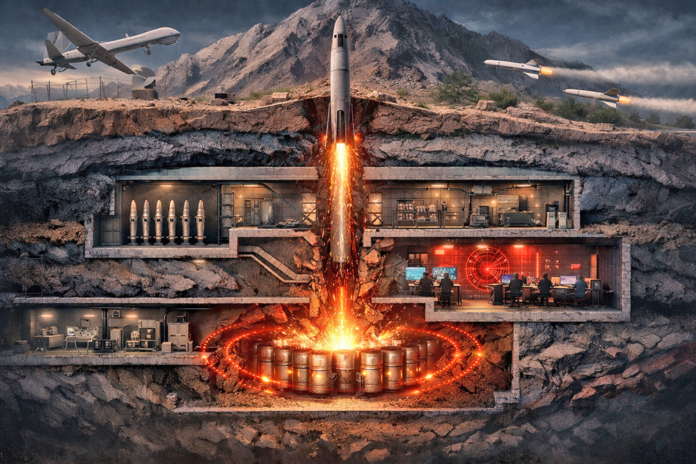
In the arid Badlands of Punjab, a quiet revolution in warfare unfolded during India’s Operation Sindoor in May 2025. It wasn’t the thunder of carpet bombing or the apocalyptic glow of tactical nukes that defined India’s audacious four-day incursion into Pakistani airspace. Instead, it was the surgical whisper of precision-guided munitions — BRAHMOS supersonic cruise missiles and swarms of loitering drones — slamming into the entrances of subterranean tunnels in the Kirana Hills. These weren’t random strikes; they were a calculated entombment. A significant number of Pakistan’s crown jewels, believed to be sequestered in those labyrinthine bunkers, were not vaporised. They were buried alive.
The Kirana Hills, a modest range of quartzite ridges rising like the spine of a forgotten dragon from the Sargodha plains, had long been whispered about in intelligence circles. Satellite reconnaissance, declassified in the operation’s aftermath, revealed a honeycomb of tunnels honeycombed into the rock — some dating back to the 1980s, when Pakistan’s nuclear ambitions first flickered under the shadow of the Cold War. Entrances camouflaged as shepherds’ trails, ventilation shafts disguised as borewells: it was a fortress designed for eternity, impervious to the prying eyes of overhead imagery. Or so Islamabad thought. India’s response flipped the script. By collapsing the cave mouths with pinpoint accuracy, the strikes turned the hills’ greatest strength — impenetrability — into a fatal vulnerability. Entombment is effectively annihilation. No radiation leaks, no escalation to mutual assured destruction. Just silence from below.

Fast-forward eight months to the scorched plateaus of central Iran, where the Zagros Mountains cradle Tehran’s most audacious engineering feat: the “Missile Cities.” These aren’t mere silos; they’re subterranean metropolises, excavated over three decades at a cost exceeding $20 billion. Vast galleries stretch for miles beneath the earth, housing upward of 3,000 short- and medium-range ballistic missiles — Fateh-110s, Sejjils and the hypersonic Fattah-1s that Tehran recently fired at Israel
Operation Epic Fury
Fast-forward eight months to the scorched plateaus of central Iran, where the Zagros Mountains cradle Tehran’s most audacious engineering feat: the “Missile Cities.” These aren’t mere silos; they’re subterranean metropolises, excavated over three decades at a cost exceeding $20 billion. Vast galleries stretch for miles beneath the earth, housing upward of 3,000 short- and medium-range ballistic missiles — Fateh-110s, Sejjils and the hypersonic Fattah-1s that Tehran recently fired at Israel. Elevators ferry launchers to the surface like elevators in a dystopian high-rise; rail lines snake through the depths for resupply. The Islamic Revolutionary Guard Corps (IRGC) touted them as invincible, impervious to the bunker-busters that had humbled Saddam Hussein’s regime in 2003.
Yet in the grinding attritional war that erupted between the US, Israel and Iran in late 2025 — sparked by Hezbollah’s rocket barrages across the Golan and Iran’s proxy escalations in Yemen — these subterranean fortresses are crumbling, not from within, but from without. American B-2 Spirits and B-52 Stratofortresses, shadowed by Israeli F-35s and Reaper drones, have adopted a playbook straight out of New Delhi’s 2025 manual: don’t penetrate; seal. Satellite imagery from Maxar Technologies, analysed by the Institute for the Study of War (ISW), shows the telltale scars — smouldering husks of TELs (transporter-erector-launchers) littering the thresholds of sites like those near Khorramabad and Semnan. Iran’s once-feared salvos, which in the war’s first weeks saturated Israeli Iron Dome batteries with over 1,200 projectiles, have dwindled to sporadic trickles. By March 2026, US Central Command reported a 92 percent degradation in launch capacity from underground bases.
Iran’s gamble on fixed fortresses — echoing Pakistan’s Kirana delusion — has transformed its vaunted deterrence into a liability. In the 1991 Gulf War, Iraqi Scud missiles, scattered like desert nomads across the sands, bedevilled coalition forces for months, launching 88 times and forcing General Norman Schwarzkopf to divert precious air assets to the “Scud hunts.” Hussein’s mobility was his shield; Iran’s static sprawl is her noose
The irony, as noted by Sam Lair, a missile proliferation expert at the James Martin Centre for Non-proliferation Studies, is almost poetic. “What was once mobile and difficult to find is no longer mobile, and easier to hit,” Lair observed in a January 2026 Foreign Affairs dispatch. Iran’s gamble on fixed fortresses — echoing Pakistan’s Kirana delusion — has transformed its vaunted deterrence into a liability. In the 1991 Gulf War, Iraqi Scud missiles, scattered like desert nomads across the sands, bedevilled coalition forces for months, launching 88 times and forcing General Norman Schwarzkopf to divert precious air assets to the “Scud hunts.” Hussein’s mobility was his shield; Iran’s static sprawl is her noose.
The Anatomy of a Doorman Strike
To understand how India’s Kirana operation became the US’s Iranian Rosetta Stone, one must dissect the mechanics. Operation Sindoor was no accident of serendipity; it was a masterclass in asymmetric innovation, born from the ashes of India’s own frustrations in prior skirmishes. The 2019 Balakot airstrikes, where Mirage 2000s pummelled a Jaish-e-Mohammed camp but failed to decisively neutralise deeper threats, exposed the limits of high-altitude bombing against hardened targets. Enter standoff missile strikes.

The BRAHMOS, a ramjet-powered marvel co-developed with Moscow, clocks speeds at Mach 3 and packs a 300-kilogram warhead optimised for “soft” kinetic effects — collapsing structures without the need for shaped-charge penetrators. In Kirana, drones from the DRDO’s Rustom series provided real-time targeting, their electro-optical sensors mapping entrance geometries down to the centimetre. The IAF didn’t need to go in; India turned the door into the bullseye. The result: seismic sensors registered micro-tremors consistent with cave-ins, but no electromagnetic pulses or fallout signatures. Pakistan’s arsenal, while intact, was rendered inert — a ghost fleet in the earth.
America’s adaptation has been swift and scalable. Where early 2025 US strikes on Iranian proxies relied on GBU-57 Massive Ordnance Penetrators — 14,000-kilogram behemoths that cratered but rarely neutralised deep vaults — the new paradigm targets chokepoints: entrances, vents, access roads. MQ-9 Reapers, armed with Hellfire variants tuned for fragmentation, loiter like patient sentinels, zapping TELs the moment they breach the surface
America’s adaptation has been swift and scalable. Where early 2025 US strikes on Iranian proxies relied on GBU-57 Massive Ordnance Penetrators — 14,000-kilogram behemoths that cratered but rarely neutralised deep vaults — the new paradigm targets chokepoints: entrances, vents, access roads. MQ-9 Reapers, armed with Hellfire variants tuned for fragmentation, loiter like patient sentinels, zapping TELs the moment they breach the surface. Follow-on waves from B-2s, laden with JDAMs (Joint Direct Attack Munitions), entomb the rest. It’s not about cracking the safe, it’s about welding it shut.

The efficacy is stark. ISW mapping of strikes near Dorud shows 14 of 18 known entrances collapsed by mid-January 2026. Casualties are minimised — 200-300 per site, mostly from secondary cave-ins — yet the psychological toll is immense. Tehran’s state media, once ablaze with footage of missile parades, now airs defiant montages of “martyred engineers.” Launch rates from fixed sites plummeted from 40 per day in October 2025 to under 10 by March.
Flipping the Deterrence Script: From Sanctuary to Sarcophagus
This doorman doctrine upends decades of underground deterrence orthodoxy. Since the 1950s, when the US Air Force buried its Minuteman ICBMs in Montana silos and the Soviets hollowed out the Urals, sub-surface hardening has been the gold standard for rogue regimes. North
Korea’s Yongbyon complex, China’s “Underground Great Wall” spanning 5,000 kilometres, Iran’s missile metropolises — all bet on the tyranny of distance and rock. Billions poured into seismic dampeners, blast doors and decoy vents, predicated on the assumption that attackers would exhaust themselves in futile penetration attempts.
India’s 2025 proof-of-concept shattered that illusion. Kirana’s fallout rippled globally. For Iran, the timing was catastrophic. Having sunk 15 percent of its GDP into bunker-building since the nuclear deal collapse, Tehran now faces a strategic checkmate. Static fortification was always a high-risk bet in an era of persistent surveillance. India called the bluff.
The US has amplified the lesson with industrial might. Carrier strike groups in the Arabian Sea provide persistent ISR (intelligence, surveillance, reconnaissance), feeding data to AI-driven targeting algorithms that predict emergence patterns — when a TEL might surface for GPS lock or crew rotation. Israel’s contribution, via the Lavender system (a machine-learning tool refined in Gaza operations), flags anomalies in satellite feeds: a puff of dust from a vent, the glint of a rail spur. The result? A force-multiplier effect. What took India 96 hours in Sindoor, the US-Israeli coalition achieves in cycles of 12-24 hours, cycling strikes to exploit recovery windows.
As the Iranian front grinds into its sixth month, with spring thaws exposing more wreckage in the mountains, one wonders what comes next. Will Pyongyang disperse its arsenal further into the DMZ’s hills? Will China’s planners rethink the Underground Great Wall’s depths? For the US, the Kirana echo chamber offers a sobering mirror: even in the age of invincible bunkers, vulnerability is a matter of perspective
However, entombment risks escalation — regimes cornered underground may lash out asymmetrically, via cyber or proxies. And environmentally? Collapsed caverns in seismic zones like Iran’s could trigger quakes. Yet for now, the tactic’s asymmetry holds: low collateral, high denial.
The Evolution of War: From Tunnels to Tombs
Warfare, as Clausewitz observed, is a chameleon — ever adapting to the terrain of technology and will. The tunnel, once a symbol of cunning resilience — from the legendary Cu Chi in Vietnam to Hezbollah’s Lebanese labyrinths — has morphed into a death trap. Drones beget counter-drones; precision leads to pre-emption. India’s Sindoor wasn’t just a strike; it was a semaphore to the world: bury your sword, and we’ll bury you with it.
As the Iranian front grinds into its sixth month, with spring thaws exposing more wreckage in the mountains, one wonders what comes next. Will Pyongyang disperse its arsenal further into the DMZ’s hills? Will China’s planners rethink the Underground Great Wall’s depths? For the US, the Kirana echo chamber offers a sobering mirror: even in the age of invincible bunkers, vulnerability is a matter of perspective. Seal the door, and the fortress falls — not with a bang, but with the grinding of stone on stone.
In Pakistan’s Sargodha, the warhead keepers sleep uneasily. In Khorramabad’s depths, the IRGC is down to its last few missiles. The lesson, etched in rubble, endures: in the calculus of modern conflict, the surest way to neutralise a threat is to make it irrelevant.

–The writer is a globally cited defence analyst based in New Zealand. The views expressed are of the writer and do not necessarily reflect the views of Raksha Anirveda
