

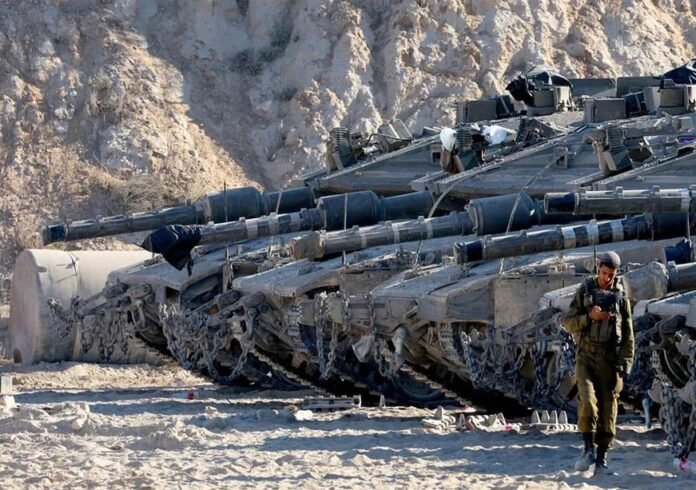
Jerusalem: As Israel participates in a multi-front war with Iran and Hezbollah, the country’s Ministry of Defence said it is focused on keeping munitions stocked to sustain operations.
Last week, Israeli MoD Director General Amir Baram visited three local defence giants — Elbit Systems, Rafael Advanced Defence Systems, Israel Aerospace Industries (IAI) — emphasising that replenishing various types of munitions is a central priority for the country.

The Israel Defence Forces said it has thus far carried out 7,600 strikes in Iran using 4,700 sorties by Israel’s air force, while also carrying out strikes in Lebanon and mobilising troops to the northern front.
Defensively, Israeli air defence systems have had to contend with daily ballistic missile attacks by Iran and increased rocket fire by Hezbollah.
To sustain those operations, Israel’s defence industrial base must accelerate production.
“Months of preparation and early readiness have enabled the IDF to operate with virtually no constraints in Iran and Lebanon,” Baram said during his visit to Elbit Systems on March 9. “At the same time, we are now working to replenish all munitions expended in order to be prepared for any scenario. The decisions we made to expand and accelerate production lines in Israel before the operation will now allow us to take production rates to the next level.”

“Israel has a unique ecosystem that no other country can match,” Baram added. “There is a distinctive integration between the IDF, the Defence Ministry, and the defence industries that enables rapid translation of operational needs and battlefield lessons into real-time modifications.”
Then, at his visit to Rafael on March 12, Baram explained that the “historic achievements” in Iran belong in part to the defence industry. Decades of research, development, and testing have provided the State of Israel with ground breaking capabilities unmatched by any other nation,” he said.

In a statement, Rafael confirmed that it has shifted into a continuous wartime support mode to make sure munitions stay stocked.
“Rafael is engaged in continuous and intensive activity in support of the operational efforts of Operation ‘Roaring Lion.’ At this time, we are focused on providing the operational response required by the IDF and the defence establishment,” the company said, using the IDF’s name for its Iran operation.
Neither the ministry, Elbit nor Rafael specified the particular munitions needing to be replenished, though it could mean artillery shells, such as those that would be used in any expanded fighting on the ground in Lebanon.
In addition to munitions, Israel’s investment in space systems like satellites and imagining — which Baram described as “superpower” capabilities — has played an integral role in Israel’s operations.
At Israel Aerospace Industries on March 5, Baram “visited an operational ground station serving a number of the defence establishment’s satellites, reviewed real-time operational satellite imagery from the fighting in Iran, and discussed the latest developments in the space domain and their direct contribution to IDF strikes in the current campaign,” according to the MoD.
“Space is a first-order strategic national priority. We will continue to advance the buildup of space power by every means possible,” he said.
To keep Israel’s industrial base on track, it’s imperative that supplies continue to flow in, especially during wartime.
During a visit to the country’s Ashdod Port on March 10, Prime Minister Benjamin Netanyahu said, “The State of Israel is showing the world what a fighting nation, a fighting state, and a super-resilient economy look like.”
The Prime Minister’s Office noted that during a tour of the port, Netanyahu conducted an “assessment regarding the continuity of Israel’s maritime trade in the midst of Operation Roaring Lion.”
The assessment by the prime minister included an examination of “port operations, the unloading of goods and supplies for the Israeli economy, and the existing inventory reserves that ensure economic stability,” his office noted. In 2023, the Ashdod port was estimated to handle around forty percent of Israel’s maritime trade. Almost all of Israel’s imports and exports, by weight and volume, arrive by sea.
In addition to maritime trade, Israel has also engaged in a military airlift that saw 50 cargo aircraft land between February 28 and March 9. The ministry said this procurement effort has brought 1,000 tons of weaponry, military equipment, and various types of munitions by air.
“The aerial airlift is led by the IMOD Defence Procurement Directorate (DPD), through its International Shipping Division, the IMOD Missions to the United States and Germany, and the IDF’s Planning Directorate. The Israel Airports Authority and the Israel Civil Aviation Authority are also partners in the operation,” the ministry noted.

