

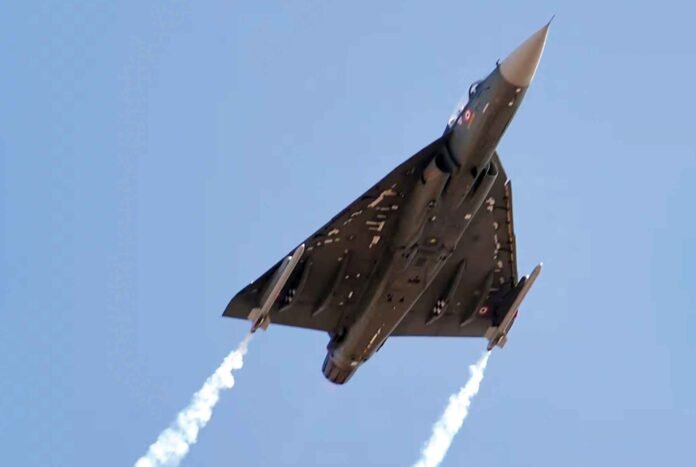
New Delhi: The Indian Air Force has grounded its entire fleet of around 30 single-seat Tejas Light Combat Aircraft following a crash on February 7, 2026, attributed to a suspected brake failure.
The incident occurred at a frontline airbase when the jet overshot the runway upon returning from a training sortie. The pilot ejected safely, averting a major tragedy, but the aircraft sustained significant airframe damage.

This marks the third accident involving the Tejas, raising fresh concerns over the reliability of India’s indigenous fighter jet. No official statement has emerged from the IAF, but sources informed news agency PTI that extensive technical scrutiny is now underway across the fleet. Such grounding halts operational training and readiness for these vital assets.
The first Tejas mishap struck in March 2024 near Jaisalmer. That jet, returning from a firepower demonstration, crashed with the pilot ejecting unharmed. Investigations pointed to possible technical issues, though details remain limited. This event underscored early teething problems in the aircraft’s maturation phase. More gravely, the second incident unfolded at the Dubai Airshow in November 2025. Wing Commander Namansh Syal perished when his Tejas plunged to the ground during an aerobatic display, erupting in flames. A court of inquiry continues to probe the cause, with video footage capturing the dramatic sequence. His death cast a shadow over international showcasing of the platform.
These setbacks coincide with persistent delays in delivering the advanced Tejas MK-1A variant. In 2021, Defence Minister Rajnath Singh finalised a ₹48,000 crore contract for 83 MK-1A jets from Hindustan Aeronautics Limited (HAL). Yet, production lags due to supply chain bottlenecks, notably GE Aerospace’s tardy delivery of F404-IN20 engines. Compounding this, the Defence Ministry sealed a ₹62,370 crore deal in September 2025 for 97 additional MK-1A aircraft. HAL cites engine shortages as the primary culprit, with only a handful of MK-1A jets handed over so far. The original fleet of single-seat Mk-1 variants, numbering about 30-40 operational units, forms the backbone of current IAF Tejas squadrons.
The Tejas itself represents a cornerstone of India’s self-reliance in defence aviation. This single-engine, multi-role fighter excels in high-threat environments, performing air defence, ground strikes, and maritime reconnaissance. Delta-wing design and advanced avionics grant it super-manoeuvrability, with a top speed exceeding Mach 1.6 and a combat radius over 500 km.

Developed under the Light Combat Aircraft programme since the 1980s, Tejas overcame decades of hurdles including technology denials and funding shortfalls. Aeronautical Development Agency (ADA) led the charge, with HAL handling production. Induction into IAF service began in 2015, marking a milestone in indigenous manufacturing.
However, repeated incidents spotlight persistent challenges. Brake systems, fly-by-wire controls, and integration of imported subsystems have drawn scrutiny in past inquiries. The latest grounding mandates fleet-wide inspections of landing gear, hydraulics, and avionics, potentially delaying upgrades and exercises.

For the IAF, strained by squadron shortages—down to 31 against a sanctioned 42—this is unwelcome news. Tejas squadrons at Nal Airbase and Sulur are pivotal for replacing ageing MiG-21s. Grounding risks operational gaps, especially amid border tensions with China and Pakistan.
HAL maintains that accidents stem from isolated occurrences, not systemic flaws. Post-Dubai, the firm asserted no impact on business or deliveries. Yet, public and parliamentary pressure mounts for transparency, with calls for accelerated indigenous engine development via Kaveri derivatives or foreign tie-ups.
GE’s delays trace to global supply chain disruptions and F404 production ramps for other clients. India eyes the more potent F414 for Tejas MK-2, but certification lags. Private sector involvement, including TATA and L&T, aims to bolster assembly lines, yet quality control remains a watch-point.
Geopolitically, Tejas bolsters India’s narrative of Aatmanirbhar Bharat in defence. Exports beckon, with interest from Argentina and others, but reliability doubts could hinder bids. The IAF’s 2026-27 budget prioritises 114 Multi-Role Fighter Aircraft procurement alongside Tejas scaling.
Inquiry outcomes will shape remediation. Past crashes prompted software tweaks and gear reinforcements; similar fixes may follow here. Resuming flights hinges on clearing checks, likely within weeks if no deeper flaws emerge.
Tejas embodies India’s aerospace aspirations, blending innovation with hard lessons. While crashes sting, they fuel iterative improvements essential for a mature platform. The IAF’s commitment endures, eyeing 270+ Tejas by 2035 to fortify air-power.

