

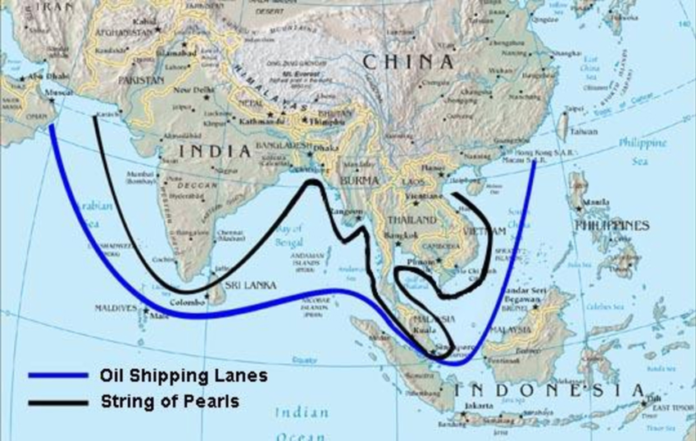
The Indian Ocean Region is no longer a peripheral maritime space. It has become the central artery of global trade, energy movement, and strategic signalling. Nearly 80 per cent of global seaborne oil trade passes through these waters. Whoever shapes this region shapes the future balance of power in Asia.
For two decades, analysts described China’s maritime outreach as the ‘String of Pearls’. The phrase captured Beijing’s investments in ports across the Indian Ocean littoral — commercial facilities that could, under certain circumstances, support naval operations. Today, that metaphor feels incomplete. What began as scattered pearls increasingly resembles something more structured and hardened: a network that may evolve into semi-permanent strategic footholds.

The transformation is gradual, calibrated, and deliberately ambiguous.
China’s access to Gwadar in Pakistan gives it proximity to the Arabian Sea and critical sea lanes. Hambantota in Sri Lanka demonstrated how commercial debt structures can translate into long-term operational leverage. The People’s Liberation Army Navy maintains a logistics base in Djibouti, signalling that Beijing is willing to formalise its overseas military presence when conditions permit. While Chinese officials continue to describe these ports as commercial, the infrastructure specifications often tell a broader story: deep berths, extended runways nearby, storage facilities, and security arrangements compatible with naval use.
The strategic shift is not about declaring bases overnight. It is about creating conditions where naval access can be scaled quickly during crises. Access is power. Permanence is optional.
The PLAN’s evolution reinforces this trajectory. Once focused primarily on coastal defence, it now operates as a blue-water navy with aircraft carriers, nuclear submarines, and long-duration deployment capabilities. Sustained presence requires reliable replenishment and repair nodes. Commercial ports under long-term lease provide precisely that elasticity. They do not need to fly a military flag to serve strategic purposes.

For India, this expanding network represents not just encirclement rhetoric but a material operational challenge. The Indian Navy has traditionally enjoyed a geographic advantage in the Indian Ocean due to proximity and interior lines of communication. However, geography alone does not guarantee dominance in an era of precision weapons, long-range surveillance, and distributed naval task forces.
China’s access to Gwadar, Pakistan, gives it proximity to the Arabian Sea and critical sea lanes. Hambantota in Sri Lanka demonstrated how commercial debt structures can translate into long-term operational leverage. The Chinese navy maintains a logistics base in Djibouti, signalling that Beijing is willing to formalise its overseas military presence when conditions permit
India’s response has been multidimensional.

At the doctrinal level, New Delhi articulated SAGAR, Security and Growth for All in the Region, positioning itself as a net security provider. This is not simply branding. It reflects a strategic decision to frame India’s maritime posture as cooperative rather than coercive. The
emphasis lies on capacity building, humanitarian assistance, disaster relief, and training partnerships with island and littoral states.
Operationally, the Indian Navy has institutionalised mission-based deployments. Indian warships are now routinely stationed in key choke points such as the Gulf of Aden, the Strait of Malacca approaches, and the Mozambique Channel. These are not episodic patrols but continuous presence missions designed to build familiarity, deterrence credibility, and rapid response capability.
India has also expanded logistics agreements with strategic partners. Access arrangements with the United States, France, Australia, and others enable reciprocal use of bases and replenishment facilities. This creates a distributed support network that offsets China’s port access strategy. Unlike Beijing’s model, which often relies on financial leverage, India’s network is rooted in strategic convergence and mutual agreements.
Subsurface competition adds another layer of complexity.
Chinese submarine patrols in the Indian Ocean have increased over the past decade. Even if these deployments are framed as anti-piracy escorts or training missions, their strategic value is clear. Submarines gather intelligence, map seabeds, and familiarise crews with operating environments. In response, India has invested heavily in anti-submarine warfare capabilities, including P-8I maritime patrol aircraft, indigenous submarine construction programmes, and seabed surveillance initiatives.
The Indian Navy has traditionally enjoyed a geographic advantage in the Indian Ocean due to proximity and interior lines of communication. However, geography alone does not guarantee dominance in an era of precision weapons, long-range surveillance, and distributed naval task forces
The undersea domain is becoming the decisive theatre. Surface presence may signal power, but undersea dominance determines survivability.
Economics remains the quieter battlefield.
China’s Belt and Road Initiative integrates infrastructure finance with long-term strategic positioning. Port construction, industrial parks, and connectivity projects create economic dependencies that can translate into diplomatic leverage. India cannot and perhaps should not attempt to mirror the scale of Chinese financing. Instead, New Delhi is focusing on targeted projects where it holds credibility, such as Chabahar in Iran and development partnerships in Mauritius and Seychelles.
India’s comparative advantage lies in trust and historical ties. Many smaller Indian Ocean states are wary of overdependence on a single power. They seek diversified partnerships that preserve autonomy. This is where India’s diplomatic capital matters.
The smaller states of the Indian Ocean are not passive spectators. Sri Lanka, the Maldives, Mauritius, and Seychelles actively negotiate between competing powers. Their decisions are shaped by domestic politics, economic needs, and strategic calculations. A change in government can recalibrate alignment. Therefore, the contest in the Indian Ocean is not purely naval; it is political and economic.
India’s long-term strategic response must therefore be institutional rather than reactive.
First, maritime industrial capacity must expand. Indigenous shipbuilding, maintenance infrastructure, and defence manufacturing determine sustainability. A navy that depends heavily on external supply chains remains vulnerable in prolonged competition.
At the doctrinal level, India articulated SAGAR – Security and Growth for All in the Region – positioning itself as a net security provider. This is not simply branding. It reflects a strategic decision to frame India’s maritime posture as cooperative rather than coercive
Second, maritime domain awareness must deepen. Satellite integration, coastal radar networks, and data-sharing arrangements with regional partners create transparency, which deters surprise deployments.
Third, naval diplomacy must remain consistent. Port visits, joint exercises, hydrographic surveys, and coast guard training generate goodwill that cannot be replicated through cheque-book diplomacy alone.
Finally, India must recognise that the Indian Ocean is no longer insulated from extra-regional rivalries. The United States, France, Japan, and Australia have strategic stakes in ensuring that no single power dominates the region. The Quad framework and other minilateral arrangements provide India with strategic depth without requiring formal alliance commitments.
The central question is not whether China will expand its presence. That trajectory appears steady. The real question is whether India can convert its geographic centrality into strategic centrality.
India must recognise that the Indian Ocean is no longer insulated from extra-regional rivalries. The United States, France, Japan, and Australia have strategic stakes in ensuring that no single power dominates the region. The Quad framework and other minilateral arrangements provide India with strategic depth without requiring formal alliance commitments
If China’s original approach resembled a string of pearls, the current evolution suggests something more resilient and metallic. Access points are hardening. Deployments are lengthening. Patterns are institutionalising.
India’s answer cannot be rhetorical alarmism. It must be structural preparedness. The Indian Ocean will define the next era of Asian power politics. Ports, submarines, logistics agreements, and diplomatic alignments are the new instruments of influence. The contest is not about dramatic confrontations but about endurance, presence, and credibility. In maritime strategy, permanence is often achieved not through declarations but through routine. Whoever normalises presence ultimately shapes perception. And perception, in geopolitics, becomes reality.
India’s task is clear. It must ensure that the waters surrounding it remain open, multipolar, and resistant to domination. That requires steel in shipyards, clarity in doctrine, and patience in diplomacy. The Indian Ocean is not merely a theatre. It is the arena where Asia’s future equilibrium will be decided.

Writer’s Profile: Kiran Pillai is a strategic affairs commentator and founder of Vastuta, a platform focused on geopolitics, technology, governance, and economic strategy. His work has appeared in national publications and policy forums.
