

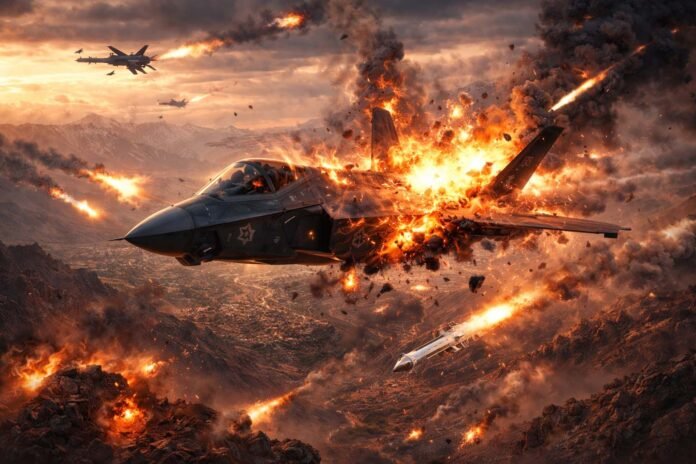
The F-35 Lightning II was sold to the US Congress and the public on a single, almost magical premise: “First Look, First Shot, First Kill.” Lockheed Martin’s marketing materials and Pentagon briefings portrayed the jet as a low-observable aircraft that could penetrate defended airspace, see the enemy before being seen, and fire beyond visual range. The bet was that radar cross-section reduction — faceting, radar-absorbent materials, internal weapons bays and careful engine shielding — would render the airplane essentially invisible to enemy radars until it was too late.
That bet was never absolute. Stealth is a matter of angles and wavelengths — not the cloak of invisibility, not sorcery. Pierre Sprey, the Pentagon analyst who helped design the F-16 and A-10, made the point years ago: there is no single radar in a modern war zone. There are ground-based search radars, height-finders, fire-control radars, airborne early-warning aircraft and low-level gap-fillers. An F-35 can present a tiny radar return when viewed head-on at high altitude, but the moment it banks, climbs or descends toward a target, it offers a different aspect to radars shining up from below or looking down from above. “You can’t be nose-on or dead-level to every radar in the theatre,” Sprey liked to say. Atmospheric attenuation, ground clutter and the sheer proliferation of sensors further complicate the picture.

The F-35 was designed as a multi-role platform that would rarely need to merge with enemy fighters. Its air-to-air doctrine emphasised long-range missiles guided by its powerful APG-81 radar and fused sensor data from the Distributed Aperture System
In level cruise at altitude, the F-35’s coatings and shaping do their work. In the dynamic, three-dimensional geometry of an actual strike mission — especially one that requires the pilot to linger near defended targets — stealth is degraded. The jet does not become visible to the naked eye; it simply becomes detectable by enough radars, often enough, for a surface-to-air missile battery to achieve a fire-control solution.
Dogfights Are Not Obsolete
The F-35 was designed as a multi-role platform that would rarely need to merge with enemy fighters. Its air-to-air doctrine emphasised long-range missiles guided by its powerful APG-81 radar and fused sensor data from the Distributed Aperture System. Yet history refuses to cooperate. From the Korean War through Vietnam, the Gulf War, and the more recent campaigns over Syria and Ukraine, “within visual range” (WVR) engagements have never been eliminated. When two aircraft close to 15 km or less, radar stealth loses much of its value because the fight becomes a “knife fight” of turn rates, sustained g-loads and energy management.
The F-35’s operational reality imposes another constraint: readiness. The aircraft is notoriously maintenance-intensive. Reapplying and maintaining its radar-absorbent coatings after each sortie and scanning millions of lines of code can require dozens of man-hours. The fleet-wide availability rates that the US Air Force has struggled to push above 60 percent in some periods have a direct effect on pilot proficiency
Here the F-35’s design compromises become visible. To accommodate stealth shaping, internal bays and a single Pratt & Whitney engine, the jet is heavier and less agile than the lightweight fighters it was meant to replace. Russian doctrine, by contrast, sacrificed some stealth for super manoeuvrability in the Su-30 Flankers and Su-35 Super Flankers — thrust-vectoring nozzles, canards and high thrust-to-weight ratios that allow the pilot to point the nose almost anywhere while still carrying kinetic energy. In classified RAND Corporation wargames conducted more than a decade ago, teams flying notional F-35s against advanced Flankers repeatedly found themselves “clubbed to death” once the merge occurred. The simulations were not predictions of inevitable doom; they were warnings that kinematics still matter.
The Training and Maintenance Tax
Even if every technical objection were set aside, the F-35’s operational reality imposes another constraint: readiness. The aircraft is notoriously maintenance-intensive. Reapplying and maintaining its radar-absorbent coatings after each sortie and scanning millions of lines of code can require dozens of man-hours. The fleet-wide availability rates that the US Air Force has struggled to push above 60 percent in some periods have a direct effect on pilot proficiency. With aircraft parked for coating repairs, software updates or engine overhauls, flight hours are rationed. The service has at times been forced to cut annual training sorties to keep costs under control — an ironic outcome for a jet that was supposed to be cheaper to operate over its lifetime than the 4th generation aircraft it replaced.

The F-35 programme has already delivered more than 470 aircraft to the US services (and hundreds more to allies); the loss of two would represent a tiny fraction of inventory. At the same time, the weapons causing the majority of destruction inside Iran right now are not necessarily stealth fighters at all; they are B-2s, B-52s with standoff weapons, drones, and cruise missiles launched from ships and submarines far beyond Iranian reach
Inexperienced or rusting pilots matter enormously in the moments when stealth has already been compromised. A pilot who has spent fewer hours practising high-G merges or defensive manoeuvring against surface threats is more likely to make the small errors — predictable climb, predictable turn rate, failure to notch a missile — that an alert SAM crew can exploit.
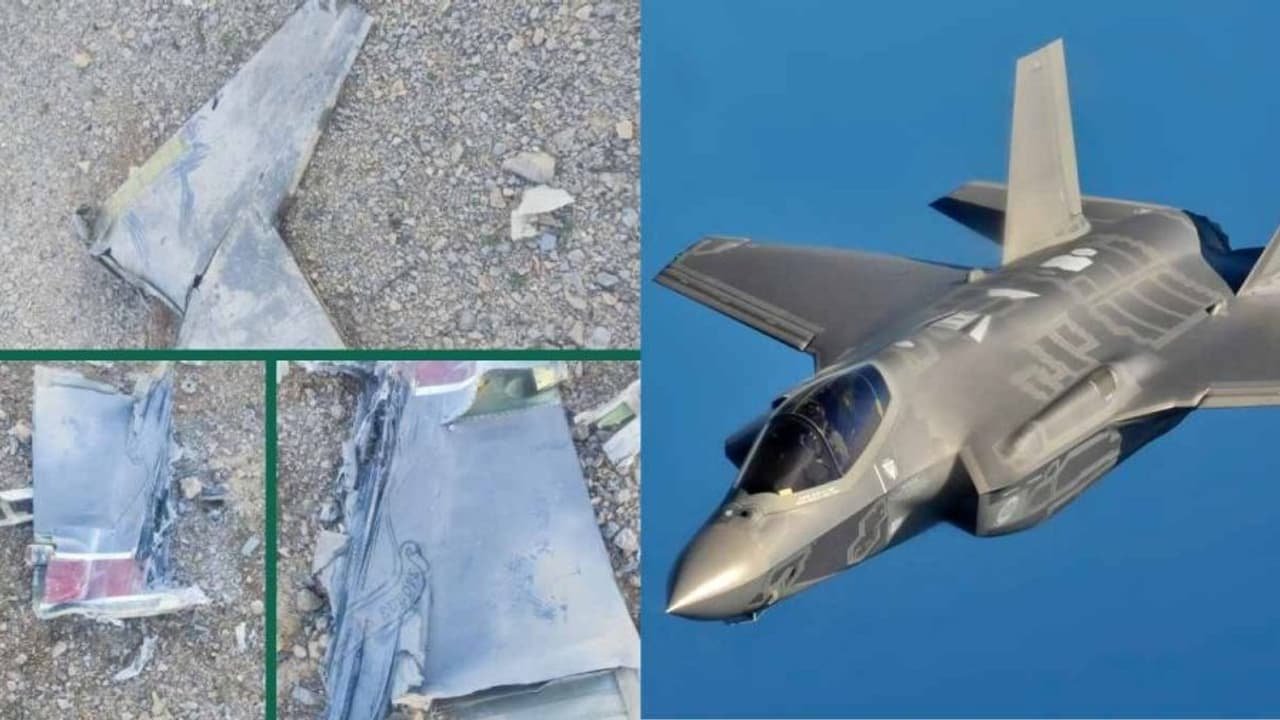

Ground Zero in Iran: What a Shootdown Would Actually Mean
Assume, for the sake of analysis, that Iranian air-defence crews did indeed down one or two F-35s. The most plausible sequence would not involve a magical new radar defeating the jet’s frontal-aspect stealth at long range. It would look more like this: the F-35 is tasked with suppressing Iranian air defences or striking high-value targets. It must descend, slow or manoeuvre in the terminal phase of the mission. Its radar signature blooms from certain angles. An older, relatively cheap Iranian surface-to-air missile — perhaps an upgraded SA-6, a domestically produced Sayyad variant, or even a man-portable heat-seeker — acquires the aircraft in the infrared spectrum. The F-35’s exhaust plume is hot; stealth coatings do little to mask that signature at close range. A fragmentation warhead detonates nearby, damaging control surfaces or the engine. The jet is lost.
A missile is almost always cheaper than the aircraft it kills. That asymmetry does not, however, dictate the outcome of a war. It merely illustrates that no single platform is invulnerable and that cost-per-shot matters. The United States has accepted this reality for decades; its answer has been mass, redundancy, electronic warfare and the ability to absorb losses while continuing to strike from standoff ranges
Such a loss would be embarrassing but not unprecedented. In 1991 Iraqi Air Force pilots downed American F-15 Eagles and F-111s despite the Coalition’s overwhelming technological edge. The United States still won the war. The F-35 programme has already delivered more than 470 aircraft to the US services (and hundreds more to allies); the loss of two would represent a tiny fraction of inventory. At the same time, the weapons causing the majority of destruction inside Iran right now are not necessarily stealth fighters at all; they are B-2s, B-52s with standoff weapons, drones, and cruise missiles launched from ships and submarines far beyond Iranian reach.
The Economics of Asymmetry and the Limits of Clickbait
Social-media accounts have seized on the imagery: a $100-million stealth fighter supposedly felled by a missile that costs a few hundred thousand dollars. The arithmetic is real and has been real since the 1970s, when the first precision-guided munitions appeared. A missile is almost always cheaper than the aircraft it kills. That asymmetry does not, however, dictate the outcome of a war. It merely illustrates that no single platform is invulnerable and that cost-per-shot matters. The United States has accepted this reality for decades; its answer has been mass, redundancy, electronic warfare and the ability to absorb losses while continuing to strike from standoff ranges.
Iran’s incentive to claim kills is obvious: domestic morale, regional signalling to proxies and the hope of driving a wedge between Washington and its allies. America’s incentive to deny losses is equally obvious: operational security and the preservation of strategic deterrence. Both reflexes are normal. What is not normal is treating either side’s first-day claims as gospel.
The fog of war may obscure the scoreboard for days or weeks, but the underlying physics, economics and history remain stubbornly clear. Stealth is an advantage, not immortality. And in the end, wars are still won by the side that can absorb punishment and keep hitting back
The Larger Picture
If Iranian crews did score against F-35s, the event would serve less as proof that stealth is obsolete than as a reminder that it has never been a cloak of invisibility. It works best when pilots stay fast, high and at range — precisely the conditions that real combat sometimes denies them. The jet’s limitations in a knife fight, its maintenance burden, and the persistence of visual-range threats were all known to its critics long before the first F-35 rolled off the assembly line. The aircraft remains a powerful sensor platform and a capable long-range striker, but it is not, and was never meant to be a wonder weapon.
The fate of the Islamic Republic will not be decided by whether two F-35s fell over its territory. It will be decided by the cumulative weight of sanctions, precision strikes, internal dissent and the willingness of the United States and its partners to sustain pressure. In that larger contest, a couple of downed fighters — real or claimed — are footnotes. The fog of war may obscure the scoreboard for days or weeks, but the underlying physics, economics and history remain stubbornly clear. Stealth is an advantage, not immortality. And in the end, wars are still won by the side that can absorb punishment and keep hitting back.

–The writer is a globally cited defence analyst based in New Zealand. The views expressed are of the writer and do not necessarily reflect the views of Raksha Anirveda
