

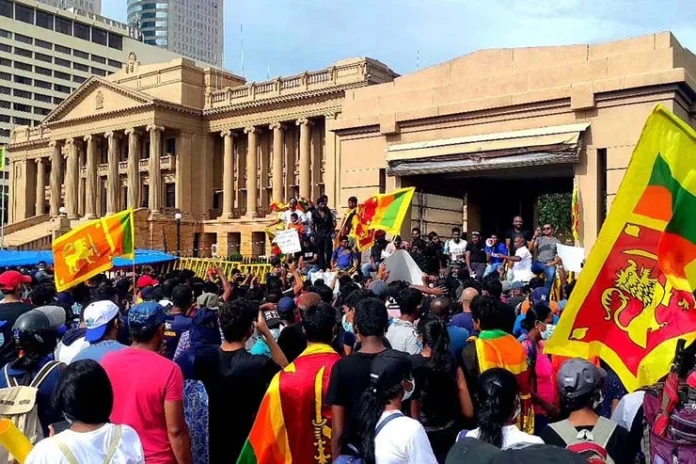
Sri Lanka is on the edge. Faced with an unprecedented economic crisis perceived to be the worst in the island nation’s history, Sri Lanka has been wracked by months of popular protests against the Rajapaksa regime. These protests forced Prime Minister Mahinda Rajapaksa, once a charismatic strongman whose popularity peaked following his successful operation against the terrorist group LTTE nosedived so much that he was forced to resign.

His brother Gotabaya Rajapaksa swept the Lankan elections in 2019 riding high on the promise to revive the sagging Lankan economy and put an end to terrorism and ensure security in Sri Lanka. Owing to the severe economic mismanagement by the regime, he too bore the brunt of popular protests. Initially, he tried to resist but when the Sri Lankans ran out of patience and decided to hit the streets. Finally, he had to relent and also announced his resignation.
Ranil Wickremesinghe, the man who decided to take the tough job of steering Sri Lanka through the economic crisis became the unfortunate casualty. He too announced that he would resign and make way for an all-party government to be formed. But what worries Sri Lanka’s neighbours and the international community is the emergence of a political vacuum.
Destabilising influence
Whenever a coup is orchestrated by the armed forces, what follows is martial law and a massive crackdown on pro-democracy protestors
Democracy requires the presence of robust political institutions and an informed public opinion, which can prevent the usurpation of power by unconstitutional means during peace as well as trying times. But unfortunate is a country where democracy, like the history of democracy in the rest of South Asia in varying periods of time, has been subjected to coups, regime change by violent means and the suppression of democratic values and subversion of democratic political and social institutions by dictatorial forces.

The creation of a political vacuum in the aftermath of the high-profile resignations generates a potentially destabilising influence in the economically-impoverished country. Normally, under peaceful circumstances, such a political vacuum is filled by civilian leaders who enjoy the support of the electorate. But in times of social unrest or economic downturn usurpation of power is considered quite normal.
Possibility of a coup?
As India and Sri Lanka’s other neighbours closely observe the situation on the ground by adopting a wait-and-watch approach, the situation appears to spiral out of control. Popular protests have peaked and there is a likelihood of political leaders not taking up the tough job of marshalling the country in such troubled times. In this context, the world cannot and must not ignore totally the possibility of staging a coup d’etat by the army led by the army officers. Just like Myanmar saw a coup in February 2021 by the military junta.

The army can suspend the constitution and order the formation of an interim government led by civilians and army officers. It will worsen the situation
In the history of regime changes, the armed forces have directly intervened in times of such crises as the one Sri Lanka is facing. Sudan and Egypt are strong examples of such takeovers. The takeover by the armed forces is seen in many circles as necessary to restore law and order in the country by temporarily suspending the democratic processes.
In the event of an army-led coup d’etat, the situation in Sri Lanka will end up deteriorating further. Whenever any coup is orchestrated by the armed forces, what follows is martial law and a massive crackdown on pro-democracy protestors. This is exactly the modus operandi that the Myanmar junta regime has used so far.
Notwithstanding the military chief of Sri Lanka ruling out a coup, in the conflict one cannot rule out the irresistible urge of the army to capitalise on the political and economic instability that Sri Lanka is currently experiencing to its own advantage. The army can suspend the constitution and order the formation of an interim government led by civilians and army officers as a legitimising attempt to justify their unconstitutional rule.
Instead of improving the economic condition of Sri Lanka, a coup would end up worsening the already debilitated economic position of Sri Lanka.
Conclusion
The international community and Sri Lanka’s neighbours should take immediate steps to prevent the events from spiralling out of control
Should a coup take place, the people of Sri Lanka in general and the international community particularly Sri Lanka’s neighbours should take immediate steps to prevent the events from spiralling out of control. Imposing economic sanctions particularly freezing the international assets of the coup organisers should be done. Besides this, if the turmoil worsens resulting in a retaliatory armed forces crackdown and human rights violations the United Nations should consider sending a UN peacekeeping force to bring the situation under control.
Sri Lanka needs to be rebuilt but that should not come at the expense of compromising on hard-won democratic gains.
– The writer is currently working as a Research Associate at Defence Research and Studies (dras.in) and is a columnist. The views expressed are personal and do not necessarily reflect the views of Raksha Anirveda

–The writer is currently working as a Research Associate at Defence Research and Studies (dras.in) and is a columnist. The views expressed are personal and do not necessarily reflect the views of Raksha Anirveda
