

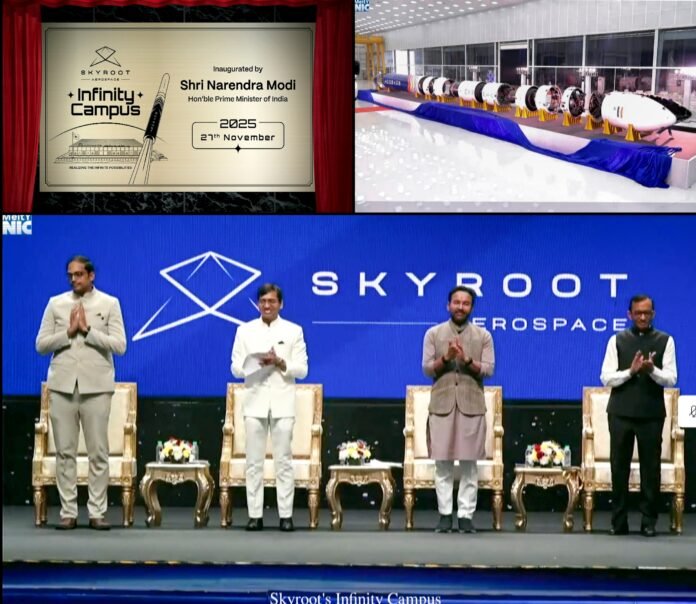
Highlighting the government’s ‘historic’ space reforms, Prime Minister Modi in his address, said that opening up the space sector to private players has resulted in Skyroot Aerospace and others coming up with such innovations.
Today in India’s space ecosystem, private sector was emerging with flying colours. Over 300 space startups were giving new hopes to the sector, he said.

Prime Minister Modi noted, “The Infinity Campus is a reflection of India’s new thought, innovation and the bigger youth power. Youth’s innovation, risk taking-ability and entrepreneurship are touching new heights.”
Pointing out that today, the country’s space sector was becoming attractive for global investors, he said that India’s private space talent was making its own identity across the globe.
“Today, India’s space sector is becoming an attractive destination for global investors. The demand for small satellites is increasing rapidly in the world,” Modi said.
Traceing the journey of the Indian space programme from its nascent stages – where rocket parts were moved in a bicycle, to building the “most trusted launch vehicle”, he said, “The journey might have started with limited resources but the growth proved determination decides dreams.”

At present, the space sector is expanding fast, covering the areas of communication, weather prediction, urban planning and national security, among others.
“So that is why we have made historic reforms in space sector, opened it up to the private sector, made new space policy. Startups and industry were linked with innovation, set up In-Space,” he said.

He further said plans were there to open up the nuclear sector also to private players.
Skyroot Aerospace’s state-of-the-art facility will have around two lakh sq.ft. workspace for designing, developing, integrating and testing multiple launch vehicles, with a capacity to build one orbital rocket every month.
Founded by Pawan Chandana and Bharath Dhaka, both IIT alumni and former scientists of ISRO, Skyroot Aerospace is India’s leading private space company.
With the launch of its sub-orbital rocket, Vikram-S in November 2022, Skyroot Aerospace became the first Indian private company to do so.
According to an official release earlier, the rapid rise of private space enterprises is a testament to the success of the transformative reforms carried out by the NDA Government in the last few years, reinforcing India’s leadership as a confident and capable global space power.
Prime Minister Modi in his address, recalled that India’s space journey started with limited resources, but its ambitions were never limited.
For decades, ISRO has given new wings to the country’s space journey, he said, and stressed that credibility, capacity, and value have established India’s distinct identity in the sector.
He said that the space agency’s facilities and technologies were made available to the startups, and pointed out that India’s space sector has been transformed into an open, cooperative and innovation-driven eco-system in the last six-seven years.
India’s youth always place national interest above all and make the best use of every opportunity, he said and added, when the government opened the space sector, the country’s youth, especially the Gen-Z generation, came forward to take full advantage of it.
“Today, over 300 Indian space startups are giving new hopes to India’s space future. Most of these space startups began with small teams—sometimes two people, sometimes five, sometimes in a small rented room—with limited resources but with determination to reach new heights. I had the opportunity to meet them,” he said, adding this spirit gave birth to the private space revolution in India.
Gen Z engineers, Gen Z designers, Gen Z coders and Gen Z scientists are creating new technologies, the Prime Minister said.
“Be it the propulsion system, composite materials, rocket stages, satellite platforms, India’s youth are working in areas that were unimaginable a few years ago,” he said.
Prime Minister remarked that India possesses space sector capabilities that only a few countries in the world have, while emphasising that its space capability is both cost-effective and reliable, which is why the world has high expectations from the country.
The global companies want to manufacture satellites in India, avail launch services and seek technology partnerships, and stressed that the nation must make the most of this opportunity, he added.
He highlighted that over the past decade, a new wave of startups has emerged across diverse sectors such as FinTech, AgriTech, HealthTech, ClimateTech, EduTech and DefenceTech, with India’s youth, particularly the Gen-Z generation, providing innovative solutions in every field.
Informing that more than 10,000 Atal Tinkering Labs have already been set up to instill a spirit of research and innovation among students, the Prime Minister added that work is underway to establish 50,000 new labs in the coming days.

