

Over the past seven and a half decades since Independence, the Indian Navy has undergone a remarkable metamorphosis from a “brown-water” force—focused on defending harbours, ports, and near-shore trade routes—into a confident and capable “blue-water” navy, able to project influence and provide security across the Indo-Pacific. This is not merely a story of acquiring more ships and submarines, but of evolving doctrine, strategic vision and national ambition.
The presence of the Indian Navy is no longer restricted to our coastline or near neighbourhood, but its footprint now stretches from the Strait of Hormuz to the shores of Japan, and from East Africa to the southern reaches of the Indian Ocean.

The underlying message is loud and clear: India is a maritime nation, and our prosperity and security depend on the seas more than ever before. Nearly 95% of India’s trade by volume travels by sea, and most of the oil and gas arrives via overseas shipping lanes. Securing these waters is therefore of vital importance.
Sagar: The Brown-Water Foundation
At Independence, the Royal Indian Navy was a small force with limited reach and scarce assets. India was not expected to play a global or even regional security role. Hence the Navy’s primary task was to patrol the coastal areas, prevent smuggling, enforce the law, and safeguard infrastructure.
However, even in those early days, seasoned naval commanders recognised the need for a dynamic and versatile Navy to safeguard the over 7,500 km coastline and growing maritime trade. Hence the foundation was laid training the manpower and building the infrastructure for a forward-looking Navy capable of projecting power beyond the immediate shoreline.
Mahasagar: The Blue-Water Ambition
The concept of Mahasagar or great ocean— literally symbolised India’s desire to secure and shape the wider Indian Ocean Region (IOR). This laid the foundation for a blue-water navy with three core capabilities:

- Operate independently far from base for long time, without banking on support from home ports.
- Project power across long distance through carrier-based aircraft, submarines and missiles.
- Sea control and sea denial – secure key chokepoints, protect friendly ships and deny freedom of action to adversaries across oceanic spaces.
1947–1970s: Coastal Roots and the First Leap
India inherited at Independence a small, war-weary flotilla and a largely colonial training and command structure designed to protect British imperial sea lanes. The emphasis was not to protect Indian interests. Hence the new nation began its maritime journey with a handful of aging escort ships, minesweepers and sloops, a tiny cadre of trained officers, and almost no indigenous industrial base to build or maintain warships.
The presence of the Indian Navy is no longer restricted to our coastline and stretches from the Strait of Hormuz to the shores of Japan, and from East Africa to the southern reaches of the Indian Ocean. The underlying message is loud and clear: India is a maritime nation, and our prosperity and security depend on the seas more than ever before
In the first two decades, the Navy’s role was largely confined to safeguarding harbours, escorting merchant ships, and performing amphibious or constabulary tasks. Nevertheless, this phase witnessed three major paradigm shifts. First, the Royal Indian Navy was consciously transformed into a truly “Indian” Navy — with Indian officers taking over command and control. The service ethos was also altered for national security instead of imperial whims. Second, specialised professional training institutions like staff courses and schools sprouted to train officers and sailors for naval aviation and submarine arm —for the emerging air and undersea dimensions of maritime warfare.

The third and most visible shift came with the commissioning of INS Vikrant—India’s first aircraft carrier—in the early 1960s, alongside the creation of the Eastern Naval Command. Together with the induction of submarines and missile boats, these developments signaled that India was no longer content with a narrow “harbour defence” mindset. The liberation of Goa in 1961 and the 1965 war became important learning curves for the Navy. But it was the decisive, offensive use of missile boats and carrier aviation in the 1971 war that marked the true leap: from a largely coastal support force to a confident regional navy capable of shaping events far beyond the immediate shoreline.
As part of Operations Trident and Python, during the 1971 Indo-Pak War Indian missile boats struck Karachi harbour and demonstrated how even a relatively modest navy, can shape the outcome of a conflict if used imaginatively. The war also highlighted the vulnerability of India’s sea lanes and underscored the reality that economic and military security were inseparable in the maritime domain.
1980s–2000s: Building the Blue-Water Fleet
The post-1971 era was marked by a systematic expansion and diversification of naval capability. INS Viraat ensured that carrier aviation remained at the heart of Indian naval doctrine and training, preserving the Navy’s ability to project air power at sea. Alongside this, a steadily growing submarine fleet added deterrence, long-range surveillance, and credible undersea warfare capabilities, giving depth and stealth to India’s maritime posture.
The induction of fleet tankers and larger, more capable destroyers further transformed the Navy’s character. These assets provided the endurance needed to keep ships fueled, armed, and provisioned far from shore, enabling sustained operations across the wider Indian Ocean.
During this period, India also began to participate more frequently in exercises and deployments beyond its immediate waters, signaling both growing confidence and a readiness to share security responsibilities in the region. Operation Cactus in 1988—India’s swift intervention in the Maldives to foil a coup—stood out as an early and striking demonstration of the Navy’s ability to function as a rapid-response, regional security provider at short notice.
2004 Onwards: Doctrine, Indigenisation and Strategy
The new millennium brought three big shifts for the Indian Navy: doctrinal clarity, a renewed drive for self-reliance, and a sharper articulation of India’s maritime interests.
a) Doctrinal Clarity
The Indian Maritime Doctrine (2004, revised 2009) and the Indian Maritime Security Strategy (2015) firmly committed the Navy to an oceanic role. These documents pushed thinking beyond simple coastal defence and framed India’s interests in the security and stability of the entire Indian Ocean Region—from the Persian Gulf to the Malacca Strait and further east. For the first time, the Navy’s roles, missions and areas of responsibility were clearly mapped to India’s broader strategic ambitions.
b) The SAGAR Vision
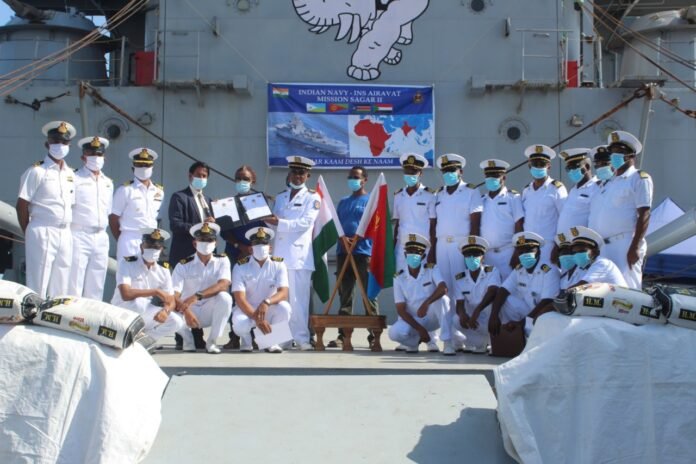
In 2015, Prime Minister Narendra Modi unveiled the SAGAR (Security and growth for all in the region) vision, which recast the Navy’s role around cooperative security, capacity-building and shared prosperity. This translated into mission-based deployments (MBDs), with Indian warships maintaining near-continuous presence in key zones such as the Gulf of Aden, Western Arabian Sea and Malacca Strait, instead of making occasional flag-showing visits.
Under “Mission SAGAR”, the Navy also emerged as a preferred first responder in the wider neighbourhood. Humanitarian Assistance and Disaster Relief (HADR) operations—from evacuations to delivery of COVID-19 relief to island and littoral states—helped cement India’s image as a dependable security and relief partner.
c) From Buyer’s Navy to Builder’s Navy
Perhaps the most profound structural change has been the shift from a “buyer’s navy” to a “builder’s navy”. Indigenisation is now the cornerstone of India’s blue-water capability. The commissioning of INS Vikrant (IAC-1) in 2022—India’s first indigenously built aircraft carrier—marked entry into an elite club of nations with complex carrier-design and construction capability.
Beyond Vikrant, an increasing share of warships and submarines—from Visakhapatnam-class destroyers to specialised anti-submarine platforms—is being built in Indian shipyards, backed by domestic design bureaus and MSME-heavy supply chains. This industrial and technological ecosystem is what ultimately underwrites sustained naval capability and genuine strategic autonomy.
The Contested Mahasagar
India’s rise as a blue-water power is unfolding in an increasingly contested maritime environment. The Indian Ocean—Mahasagar—has become a central arena of geopolitical rivalry, driven in large part by China’s expanding naval footprint and its so-called “String of Pearls” strategy. By cultivating access and influence in ports such as Gwadar, Hambantota and Djibouti, Beijing has sought not only economic leverage but potential military options close to India’s maritime approaches.

New Delhi’s response has been multi-pronged. On the diplomatic and operational front, the Navy has deepened partnerships with Quad members—the United States, Japan and Australia—as well as ASEAN states and African littorals, through regular exercises, logistics support agreements and sustained capacity-building initiatives. These networks are steadily weaving India into a broader architecture of like-minded maritime powers committed to a free, open and secure Indo-Pacific.
Parallelly, India has invested in infrastructure and access arrangements that extend the Navy’s operational reach across key chokepoints. Facilities and basing agreements in countries such as Mauritius and Seychelles, coupled with upgraded infrastructure in the Andaman & Nicobar and Lakshadweep islands, allow Indian warships and aircraft to monitor vital sea lanes from the Gulf of Aden to the Malacca Strait with greater persistence and flexibility.
Looking ahead, plans for a 175–200 warship force—underpinned by nuclear submarines, long-range maritime patrol aircraft, drones and space-based surveillance—signal a steady consolidation of blue-water capability. The Navy is also preparing for the transition to integrated theatre commands, which will bring surface, sub-surface, air, space and cyber assets under unified operational leadership. This shift towards joint, multi-domain warfare is essential if India is to safeguard its interests and shape outcomes in an increasingly crowded and contested Mahasagar.
Why the Indo-Pacific Matters
India’s naval transformation is about far more than prestige; it is about securing one of the world’s most critical maritime theatres. The wider Indo-Pacific carries a dominant share of global seaborne trade and a large portion of the world’s energy flows. Strategic chokepoints such as the Malacca Strait, Bab-el-Mandeb and the Strait of Hormuz are potential pressure valves which, if disrupted, could severely dislocate regional and even global economies.
By moving from Sagar to Mahasagar, India is positioning itself as a stabilising force along this vital maritime highway—one that can deter coercion, protect the free flow of commerce, and uphold a rules-based order at sea.
Perhaps the most profound structural change has been the shift from a “buyer’s navy” to a “builder’s navy”. Indigenisation is now the cornerstone of India’s blue-water capability. The commissioning of INS Vikrant (IAC-1) in 2022—India’s first indigenously built aircraft carrier—marked entry into an elite club of nations with complex carrier-design and construction capability
Humanitarian Reach and Soft Power
Beyond its hard-power credentials, the Indian Navy has emerged as a powerful instrument of India’s humanitarian outreach. From tsunami relief operations in 2004 to non-combatant evacuations during crises in Yemen, Sudan and other conflict zones, Indian warships have repeatedly acted as lifelines for both Indian citizens and foreign nationals. Every such mission reinforces India’s image as a responsible stakeholder and preferred security partner, adding a vital layer of soft power to the Navy’s growing blue-water presence.
Challenges on the Horizon
For all its successes, the journey is far from complete. Several structural challenges still loom large:
- Building, crewing and sustaining a 175–200 warship fleet demands sustained political will, predictable budgets and long-term planning. Capital acquisitions, maintenance and modernisation must be shielded from cyclical cuts and delays.
- Competing with rapidly modernising navies—particularly China’s—requires continuous innovation in undersea warfare, cyber operations, artificial intelligence, space-based surveillance and unmanned systems. The Navy must stay ahead of the curve, not merely catch up.
- India must deepen strategic partnerships while preserving its strategic autonomy. As mini-lateral groupings and coalitions proliferate in the Indo-Pacific, New Delhi must avoid being locked into rigid alliance structures even as it leverages convergences with like-minded partners.
Conclusion
The Indian Navy’s journey from Sagar to Mahasagar mirrors India’s own rise—from a cautious postcolonial state to an aspiring leading power. It captures the shift from purely defensive coastal security to a proactive oceanic strategy; from dependence on foreign suppliers to growing indigenous mastery; and from limited regional relevance to genuine Indo-Pacific significance.
As India marks Navy Day 2025, the Navy’s transformation stands both as a symbol and a driver of national ambition. The task in the decades ahead will be to translate growing capabilities into durable influence, to secure our coasts even as we shape the wider seascape, and to ensure that the Indian Ocean truly lives up to its name—not as a theatre of great-power rivalry alone, but as a space of security and growth for all.
The waves of Sagar have carried India into the Mahasagar. The horizon that now lies ahead is one of immense opportunity—and profound responsibility.

–The writer is a seasoned media professional with over three decades of experience in print, electronic, and web media. He is presently Editor of Taazakhabar News. The views expressed are of the writer and do not necessarily reflect the views of Raksha Anirveda
