
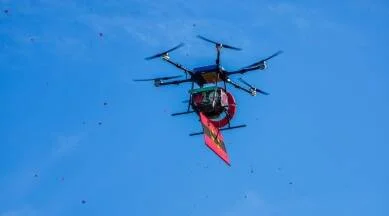
New Delhi: In a move to counter the drones coming across the border with Pakistan, the Indian Army is looking to purchase vehicle-based drone jammers which are capable of detection and neutralisation of drones/swarms from multiple directions.
A request for proposal (RFP) for the jammers was floated by the Army on January 18 with specifications and numbers of such vehicle-based systems that it wants to purchase. At present, the RFP says 20 such vehicle-based jammers are needed.

The Defence Research and Development Organisation (DRDO) and Bharat Electronics Limited (BEL) have developed such vehicle-based drone jammers in addition to the technology being developed by private companies.
The RFP states that the drone jammer (vehicle-based) should provide multi-sensor-based (at least two sensors) complete and comprehensive solutions with regard to unmanned aircraft systems (UAS), drones and swarms. “The system should be capable of UAS/drones/SWARMS detection, tracking, designation & neutralization of swarm/ drones/ UAS approaching simultaneously from multiple directions,” it states.
It further adds that the jammer should integrate all detection sensors and identify threats to provide the operator with composite air situation pictures and facilitate the selection and management of responses for countering UAS/drone, using jammer systems.
The jammer should have a radio frequency (RF) detector, 3D radar (Drone Detection Radar), RF and satellite navigation jammer system, and command and control centre (C2 Centre).

The jamming of drones is done in a variety of ways. One of the methods is RF jamming, which disrupts the radio frequency link between the drone and its operator by generating large volumes of RF interference. Once the RF link, which can include Wi-Fi links, is severed, a drone will usually either descend to the ground or initiate a ‘return to home’ manoeuvre.
Another method is to disrupt the drone’s satellite link, such as GPS or GLONASS. Drones that lose their satellite link will usually hover in place, land, or return home. Yet another way to tackle the drone threat is by ‘spoofing’. This allows the jammer to take control of or misdirect the targeted drone by feeding it a spurious communications or navigation link.

The drones can also be neutralised by ‘dazzling’. This means using a high-intensity light beam or laser to “blind” the camera on a drone. Lasers and high-power microwaves can also be used to destroy the vital parts of a drone, causing it to crash.