

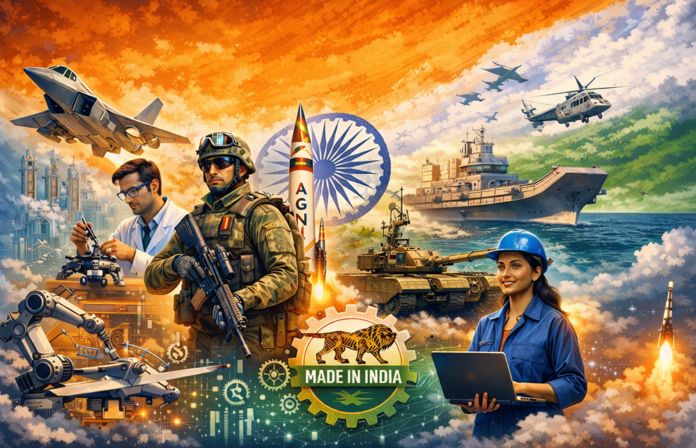
For decades, the story of India’s military-industrial complex was a paradox of massive ambition and systemic dependency. India was the perennial “world’s largest arms importer” a nation that could build sophisticated fighter jets and tanks under license but could not modify a single line of their source code without an arduous “No-Objection” process from a foreign capital. However, the draft Defence Acquisition Procedure 2026 (DAP 2026) put forth by the Ministry of Defence depicts a changing landscape.
The latest figures from the Ministry of Defence reveal a watershed moment in which India’s defence exports for FY 2025–26 have surged to an unprecedented ₹38,424 crore (approximately $4.6 billion). This is a staggering 63% growth over the previous year. While this milestone is surely a triumph for the “Make in India” initiative, a closer look at the export basket—still heavily weighted toward sub-systems, components, and ammunition—reveals a lingering glass ceiling. To shatter it, India is moving beyond the factory floor and into the design lab with the draft DAP 2026.

The DAP 2026 envisages a brand-new and revolutionary philosophy of “Owned by India”. More than just a rebranding of self-reliance or “Aatmanirbharta”, India appears to be walking the talk to decouple Indian military hardware from foreign geopolitical strings and position itself as a primary arsenal for the Global South
The DAP 2026 envisages a brand-new and revolutionary philosophy of “Owned by India”. More than just a rebranding of self-reliance or “Aatmanirbharta”, India appears to be walking the talk to decouple Indian military hardware from foreign geopolitical strings and position itself as a primary arsenal for the Global South.
Why “Made in India” Was Not Enough
Historically, India’s “Make” programmes have often been more sophisticated forms of “glorified assembly”. When India exports a component for a French Rafale or an American F-15, it earns foreign exchange but without gaining any strategic leverage. More critically, when India seeks to export full platforms built under licence, it remains tethered to the original equipment manufacturers’ (OEMs) geopolitical interests.
If a nation in Southeast Asia or Africa wants to purchase an Indian-made platform that contains a proprietary Western engine or radar, the sale can be vetoed by the donor nation. This “End-Use Monitoring” and “Third-Party Transfer” restriction has long been the invisible chain on India’s export ambitions.
If a nation in Southeast Asia or Africa wants to purchase an Indian-made platform that contains a proprietary Western engine or radar, the sale can be vetoed by the donor nation. This “End-Use Monitoring” and “Third-Party Transfer” restriction has long been the invisible chain on India’s export ambitions
The Pivot to Sovereign Design Authority
The Draft DAP 2026 aims to sever this chain by mandating Sovereign Design Authority. Under the new “Buy (Indian-IDDM)” category requirements, the “Indigenous Design” criteria are being tightened to ensure that Indian companies own the “Design Kit”, owning the blueprints, the source code, and the intellectual property (IP).

By moving the indigenous content (IC) threshold to 60% and emphasising perpetual IP licensing, the government is signalling that it will no longer settle for being a satellite in a foreign OEM’s orbit. For the first time, DAP 2026 recognises that in modern warfare, the software is as much a weapon as the missile it guides. Owning the “brain” of the platform could allow India to modify its systems for specific regions – a maritime-hardened sensors for littoral states in the ASEAN bloc or desert-optimised electronics for the Middle East.
An example of this is when India purchased the Dassault Rafale, which were not the standard French Air Force versions. Because India (and France) owned the integration rights, they implemented 13 India-Specific Enhancements (ISE). But it was not before India paid a whopping amount to buy the rights to such enhancements from France.

Additionally, sovereign design authority would allow India to make unfettered sales of full-scale systems like the Akash-1S missile or the Pinaka rocket launchers, to friendly states without fearing a secondary veto from the West.
Adopting a spiral development style is a fundamentally different approach to how the Indian military has been buying technology, so far. The intention appears to be to move away from an ‘all or nothing’ approach and be more agile. Instead of the military waiting long years for a 100% finished product, as has been the traditional rule, the spiral development pathway would enable them to use a partially completed version
“Alternative” Arsenal
This shift comes at a time when the Global South is increasingly wary of the “geopolitical strings” attached to Western and Chinese military hardware. For many nations in Africa, the Middle East, and Southeast Asia, buying Western tech often means subscribing to Western political values, while buying Chinese tech raises concerns about data backdoors and “debt-trap” diplomacy.
India could offer a third way of high-tech, battle-hardened hardware that comes with “No Strings Attached.“ We are already witnessing this strategy bear fruit. Armenia has become a premier customer for Indian artillery (ATAGS) and missile systems precisely because India provides a reliable, non-interfering alternative to traditional power blocks. The Philippines and Indonesia are purchasing India’s BRAHMOS to secure their sovereignty in the South China Sea – not as part of any Western alliance, but as an exercise in regional self-determination.
The Road to 50,000 Crore
The government’s target of ₹50,000 crore in annual exports by 2030 is no longer a pipe dream but could become a mathematical inevitability if the DAP 2026 is executed with precision. By fostering a “Sovereign Design” ecosystem, India could move to a competitive defence manufacturer.
The challenge, however, remains in the “Deep Tech” sectors. While we excel in missiles and software, we still face high import dependencies in critical components like jet engines and high-end semiconductors. The DAP 2026 aims to address this through the Low-Cost Capital Acquisition (LCCA) and Spiral Development pathways.
as the 2026 ASEAN Year of Maritime Cooperation unfolds, India’s role as a “Security Provider” is evolving into that of a “Security Producer” and the draft DAP 2026 reflects that. By prioritising “Owned by India” over “Made in India,” the nation is ensuring that its defence exports are not just commercial transactions, but tools of diplomatic and strategic influence
Adopting a spiral development style is a fundamentally different approach to how the Indian military has been buying technology, so far. The intention appears to be to move away from an ‘all or nothing’ approach and be more agile. Instead of the military waiting long years for a 100% finished product, as has been the traditional rule, the spiral development pathway would enable them to use a partially completed version, which they could “spiral” to a 100% completion over the next few years.
Such a move should encourage the defence startup ecosystem, who get paid for incremental milestones, while also fixing the bugs for upgraded versions, as each version is put in the hands of the soldiers early in the process to be used and tried. The LCCA pathway will complement this by providing a streamlined “fast lane” for procurement, specifically designed to bypass the usual multi-year bureaucratic hurdles for projects valued under ₹75 crore.
Overall, as the 2026 ASEAN Year of Maritime Cooperation unfolds, India’s role as a “Security Provider” is evolving into that of a “Security Producer” and the draft DAP 2026 reflects that. By prioritising “Owned by India” over “Made in India,” the nation is ensuring that its defence exports are not just commercial transactions, but tools of diplomatic and strategic influence.

Unnati Misra, a lawyer by training, is a research consultant at the Centre for Geopolitical & Strategic Studies, Chintan Research Foundation. The views expressed are of the writer and do not necessarily reflect the views of Raksha Anirveda
