

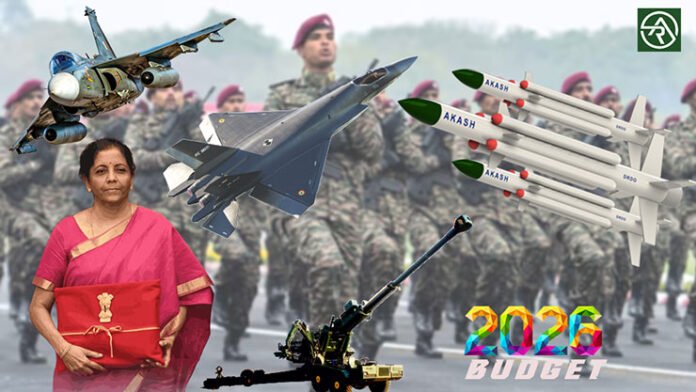
In the wake of ‘Operation Sindoor’ following the Pahalgam terrorist attack, the outlay for defence sector for fiscal 2026-27 saw a record allocation of about Rs 7.85 lakh crore which was a sharp jump of around 28 per cent reflecting a push to strengthen military readiness and domestic manufacturing in the wake of security tensions.
In the first budget since India’s military offensive against Pakistan, Operation Sindoor, and the four-day intense stand-off between the two countries in May, the Centre allocated ₹7.85 lakh crore to the defence sector for boosting India’s defence capabilities. he increased allocation signals a continued focus on military readiness, modernisation, and personnel welfare.

Presenting the Budget for 2026-27 in Lok Sabha, Finance Minister Nirmala Sitharaman said India will continue to take steps towards becoming a Viksit Bharat.
In the last Union budget, the government had made a provision of Rs 6,81,210.27 crore for the Financial Year (FY) 2025-26. The allocation was 9.53 per cent more than the budgetary estimate of FY 2024-25 and stood at 13.45 per cent of the Union Budget. The allocation was the highest among the Ministries.
As the India-Pakistan military conflict highlighted the importance of making the armed forces well-equipped with state-of-the-art weaponry, including technologically advanced aerial vehicles which have become a constant in modern warfare, there has been an expectation that the budgetary outlay for the defence sector will be significantly enhanced.
The rise comes from capital expenditure (modernisation and procurement) and was and even sharper jump of around 28 per cent increase.This reflects a push to strengthen military readiness and domestic defence manufacturing.

The defence outlay is indeed significantly higher as it aims to strengthen air and naval capabilities and accelerate domestic manufacturing.
Presenting the budget, Finance Minister Nirmala Sitharaman set aside Rs 7,84,678 crore as defence outlay for 2026-27 as against last year’s allocation of Rs 6,81,210 crore. The Budget pegs capital expenditure at ₹2,19,306 crore, including ₹63,733 crore for aircraft and aero engines and ₹25,023 crore for the naval fleet.

The total capital outlay has been pegged at Rs 2,19,306 crore.The revenue expenditure has been put at Rs 5,53,668 crore that included Rs 1,71,338 crore for pensions.
She proposed exempting basic customs duty on components and parts required for the manufacture of civilian, training and other aircraft.
She also announced to waive basic customs duty on raw materials imported for manufacture of parts of aircraft to be used in maintenance, repair, or overhaul requirements by units in the defence sector. The two decisions are expected to help the defence aerospace industry.
In 2025-26, the government allocated Rs 6,81,210 for defence budget. The capital outlay was pegged at Rs 1,80,000 crore which increased to Rs 1,86,454 crore at revised estimate stage.
The Defence Ministry was seeking higher military spending this time. The Defence Ministry wanted a 20% increase in military spending after the May conflict.
According to reports, the Indian government is likely to ease conditions for foreign investments into defence units. The Federation of Indian Chambers of Commerce and Industry, which has 250,000 companies as members, has suggested setting up defence-industrial corridors and an export-promotion council to meet the country’s defence-export target of $5.5 billion by 2029.
Operation Sindoor launched on May 7, targetted terror infrastructure at nine known locations in Pakistan and Pakistan-occupied Kashmir in retaliation for the April 22 Pahalgam attack that killed 26 civilians.
Pakistan responded to the Indian attack on terror infrastructure with a swarm of drones and missiles, all tracked and destroyed by Indian forces. In response, Indian armed forces mounted fierce counter-attacks and inflicted heavy damage to several airbases in Pakistan. The hostilities ended with an understanding on stopping the military actions following talks between the Director Generals of Military Operations of both sides on the afternoon of May 10 following a request by Islamabad.
According to Indian Army chief General Upendra Dwivedi, the forces had mobilised their troops during Operation Sindoor and were “fully prepared” for ground operations. Operation Sindoor remains ongoing and any misadventure by the adversary will be dealt with effectively, he said earlier this month.
Reacting to the increase in defence spend, Uday Kotak, Founder & Director, Kotak Mahindra Bank, in a tweet said, “Budget first take. A budget for the real economy. Welcome increase in defence spend. Broad fiscal discipline continues. Works on balancing between financialisation of the economy, and focused development of diverse, deep India long term.”
India’s defence spending has jumped by over 40 per cent in the past 26 years, with defence capex expenditure one of the focus areas. This is in line with the government’s push for an ‘Aatmanirbhar Bharat’, or self-reliant India by encouraging indigenous research and manufacturing.
The focus has also been on increased revenue from defence exports.
As Home Minister Amit Shah said it highlights defence hike as part of strengthening national security and modernising armed forces.
Defence experts noted substantial rise of 15 per cent hike in defence outlay as significant in the context of regional tensions and modernisation.
Experts have pointed out that the larger focus on capital outlay and modern weapons like fighter jets, submarines and cutting edge equipment aligns with strategic priorities and attempts to support local defence industries.
Commenting on the budget Aravind Melligeri, Executive Chairman and CEO, Aequs Limited, said that the SEZ DTA sales and policy continuity support consumer and A&D manufacturing scale.
“The decision to allow eligible SEZ manufacturing units to sell into the Domestic Tariff Area at concessional duty is a significant boost for companies that have created large-scale capacities in both the consumer and aerospace & defence sectors. At a time of global demand volatility and trade disruptions, this pragmatic measure will help improve capacity utilisation, support operating efficiencies, and provide greater flexibility for capital-intensive manufacturing operations. For strategic sectors such as Aerospace and Defence, a more permanent framework for domestic sales from SEZs, would further strengthen India’s ability to meet growing indigenous demand while also becoming globally competitive,” he said.
“More broadly, the Budget’s sustained focus on manufacturing-led growth, infrastructure development, and global competitiveness reinforces long-term policy clarity and investor confidence. Initiatives such as India Semiconductor Mission 2.0, the expanded Electronics Components Manufacturing Scheme, customs duty exemptions for aircraft components and MRO-related raw materials, and the substantial increase in defence spending, with indications of up to a 20% hike, collectively support deeper localisation, modernisation, and private sector participation. Together, these measures will create a stable and enabling framework for companies to scale investments, deepen capabilities, and integrate India more firmly into global manufacturing value chains,” added Aravind Melligeri.
Corporate and economic commentators highlighted that while higher defence outlay is positive for national security, the budget must balance this with growth friendly policies like infrastructure and MSMEs efforts.
Describing the 2026-27 Budget as “historic”, Prime Minister Narendra Modi praised its vision for India’s future development termed Viksit Bharat.
He emphasised the overall strength and direction of the budget, which includes a significant increase in defence spending as part of national priorities.
The prime minister described the budget as providing a clear roadmap for the country’s growth and security objectives.
Prime Minister Modi’s reaction clearly enunciates his emphasis on increased defence allocation as part of a forward-looking, historic budget that reinforces national security and supports India’s long-term “Viksit Bharat” goals.

– The writer is a senior journalist and media consultant. The views expressed are of the writer and do not necessarily reflect the views of Raksha Anirveda.
