

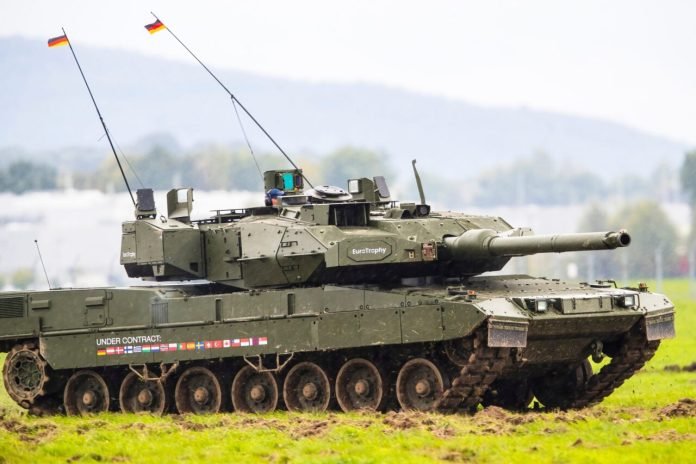
Tel Aviv: The Netherland is building a new armoured unit based on the German Leopard 2A8 main battle tanks (MBTs). The tanks will be protected by the Rafael Trophy active protection systems (APS).
The tanks will be with the new version of the Rafael Trophy system protecting also from overhead released weapon systems.
The wars in Ukraine and in Israel exposed armoured platforms like main battle tanks (MBT) and armoured personnel carriers (APC) to a new threat – top attack by armed drones.
Israel had to use a make shift solution – metal nets that were installed on the upper side of the armoured platform to protect from the new threat.
But Israeli company Rafael used its resources and upgraded its combat proven Trophy active protection systems (APS) so it is capable of protecting from top attack by armed UAVs and loitering weapon systems.
Rafael performed some very successful tests with the upgraded version. “In tests we have conducted in recent months, the initial capability has been proven but work continues to increase it,” a company source said.
The upgraded version will detect overhead threats and operate the active means that explodes the warhead before it reaches the armoured platform.
The Rafael developed Trophy APS is now in big demand in some European counties. The German Leopard MBT will also be protected by this system. A Rafael source said that existing Trophy system can be upgraded after the new version becomes operational.
Recently, Rafael has added a silent mode to the Trophy APS. By using the four passive Electro-Optic (EO) sensors that are incorporated inside Trophy’s radar antennas, the silent mode can be activated. The ELTA Systems’ EO sensor, sometimes known as “Othello,” is a simple-to-install addition to the present Trophy Radar Antennas arrangement.
Both freshly created and already deployed Trophy APS systems can simply be upgraded with the silent mode capability thanks to the easy integration of the EO sensor.
The EO sensor enables the armoured vehicles crews to operate the radar only after the threat has been detected so that the emissions of the radars do not help the enemy to detect the tank or armoured vehicles from long ranges.
Artificial intelligence (AI) makes it possible for the detection to be achieved in microseconds, followed by the selection of the most efficient method of interception.
A comparable tactic is employed against tank rounds, specifically the most deadly type known as the kinetic-energy (KE) round. This type of round fires a long-rod penetrator at nearly hypervelocity, made of heavy alloys like tungsten or depleted uranium, and is made to penetrate powerful anti-personal spheres as well as any tank.

-The writer is an Israel-based freelance journalist. The views expressed are of the writer and do not necessarily reflect the views of Raksha Anirveda
