

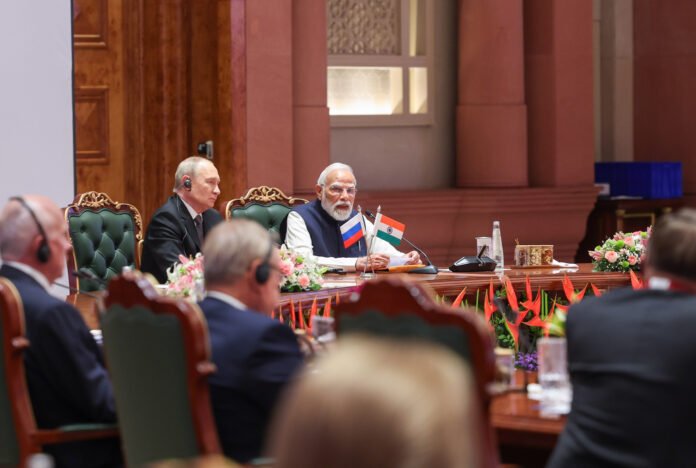
Russian-Indian military-technical cooperation constitutes a key component of President Vladimir Putin’s foreign policy towards India and a vital element of the broader framework of Russian-Indian relations. At the level of official documents, this collaboration is explicitly characterised as a ‘cornerstone’ of the specially privileged strategic partnership, with Putin’s approach focused on transitioning from mere arms trade to collaborative development, manufacturing, and lifecycle support.
Military-Technical Cooperation as the Foundation of the Partnership
In the joint statement issued after the 21st Russian-Indian summit in Delhi, the Kremlin’s political stance is articulated explicitly: military and military-technical cooperation is established as a fundamental component of the special and privileged strategic partnership. The document underscores that, as India advances towards self-reliance, the emphasis is moving towards collaborative research and development, design, and manufacturing of sophisticated defence technologies and systems. This signifies a strategic reassessment of the role of Russian supplies, transitioning from the export of completed equipment to the development of a shared industrial foundation.

The Russian side formally affirms its preparedness not only to sustain the volume of arms exports but also to incorporate Indian allies into production and technological supply chains, drawing on decades of collaboration in aviation, air defence, and naval sectors. This positioning demonstrates that for Putin, defence exports to India serve concurrently as a tool of foreign policy, a catalyst for industrial advancement, and a means of fostering long-term political rapprochement.
Progression of Putin’s Policy Trajectory
Official Russian media emphasise that, according to Putin’s assessment, Russia has played a pivotal role in outfitting and modernising the Indian armed forces for over half a century, encompassing ground forces, air defence, aviation, and the navy. In recent years, however, the Kremlin’s public rhetoric has transitioned from describing itself as an ‘arms supplier’ to portraying itself as a ‘partner in the collaborative development of platforms’, reflecting a strategic political decision.
The joint statement articulates the Kremlin’s political stance: Military and military-technical cooperation is established as a fundamental component of the special and privileged strategic partnership. The emphasis is moving towards collaborative research and development, design, and manufacturing of sophisticated defence technologies and systems
Official materials indicate that the partnership is presently undergoing reorientation towards joint research, development, and production of advanced defence platforms, aligning with India’s pursuit of strategic autonomy. Putin’s statement thus assumes that Russia maintains its leading role in India’s armaments market through enhanced collaboration, not merely by increasing sales volume.
Extent and Organisation of Russian Deliveries
Russian sources emphasise Russia’s prominent role as a supplier of arms to India: according to figures provided by the leadership of Rosoboronexport, Russia’s proportion of military equipment deliveries to the Indian armed forces has surpassed one-third of total imports over the past decade. These evaluations are frequently showcased within the framework of prominent international aerospace and defence exhibitions, where the Indian presence traditionally holds a prominent position on the displays of Russian companies.

The scope of interaction covers not only the export of completed systems but also long-term agreements for maintenance, modernisation, and component supply, which are vital for ensuring the operational readiness of the Indian armed forces, a considerable portion of which relies on Russian platforms. The comprehensive scope of agreements — spanning deliveries to after-sales support — enhances mutual reliance and establishes defence exports as a stable foundation of bilateral relations.
The Russian side affirms its preparedness not only to sustain the volume of arms exports but also to incorporate Indian allies into production and technological supply chains, drawing on decades of collaboration in aviation, air defence, and naval sectors
Transition to Collaborative Manufacturing and Research and Development
Official statements prominently highlight the shift towards collaborative research and development as well as manufacturing in India, which is directly associated with the country’s strategy to achieve self-sufficiency and promote localisation. The joint declaration at the head of state level affirms the commitment to collaborate on the development and production of defence technologies and systems, demonstrating Russia’s willingness to share essential expertise and technological advancements.

State Russian media emphasise that the new policy is a response to India’s pursuit of independence in the defence sector and suggest a shift in partnership towards the development of advanced defence platforms. This signifies a shift in defence sales: exports progressively encompass joint initiatives in which Russian enterprises serve not only as suppliers but also as technology providers and co-investors.
Russia has recently described itself as a ‘partner in the collaborative development of platforms’, rather than an ‘arms supplier’, reflecting a strategic political decision. The partnership is undergoing reorientation towards joint research, development, and production of advanced defence platforms, aligning with India’s pursuit of strategic autonomy
Legal Framework and Political Endorsement
The enhancement of military-technical cooperation is supported by the renewal of the legal framework, which has been authorised at the presidential level in Russia. In a recent decision, Putin authorised the ratification of a military cooperation agreement with India, whose explanatory note explicitly states that it ‘will facilitate the development and enhancement of military collaboration between Russia and India’ and will establish a streamlined process for the entry of warships and the utilisation of airspace and airfields of both nations.
Such agreements establish an institutional framework for long-term supply arrangements, joint exercises, logistical support, and the enhancement of naval and air force presence in each other’s ports and airfields. At the level of public statements from the Kremlin, it is underscored that Russia and India “must collaborate for global stability,” thereby endowing the military-technical aspect with a clear strategic and geopolitical significance.
Russia regards military-technical cooperation with India as a vital component of both foreign and industrial policy. It sustains the operations of defence industries, promotes the advancement of high-tech sectors, and concurrently enhances Russia’s standing as a regional power in Asia
Military-Technical Cooperation as a Tool of Foreign and Industrial Policy
On the Russian side, military-technical cooperation with India is regarded as a vital component of both foreign and industrial policy: it sustains the operations of defence industries, promotes the advancement of high-tech sectors, and concurrently enhances Russia’s standing as a regional power in Asia. For Putin, defence exports to India serve multiple purposes — ranging from strengthening allied relations to advancing Russia’s technological sovereignty through substantial foreign orders.
Official statements emphasise the mutually advantageous character of such cooperation: the Russian side secures consistent demand for defence products and an enhanced presence in one of the world’s largest arms markets, while the Indian side benefits from access to technologies, collaborative R&D, and opportunities to develop its own production infrastructure. Consequently, the ‘defence sales component’ within Putin’s policy towards India extends well beyond traditional exports and serves as a fundamental element in shaping the strategic partnership.

The writer is the Publisher of Frontier India and the author of the book Foxtrot to Arihant: The Story of Indian Navy’s Submarine Arm.
