

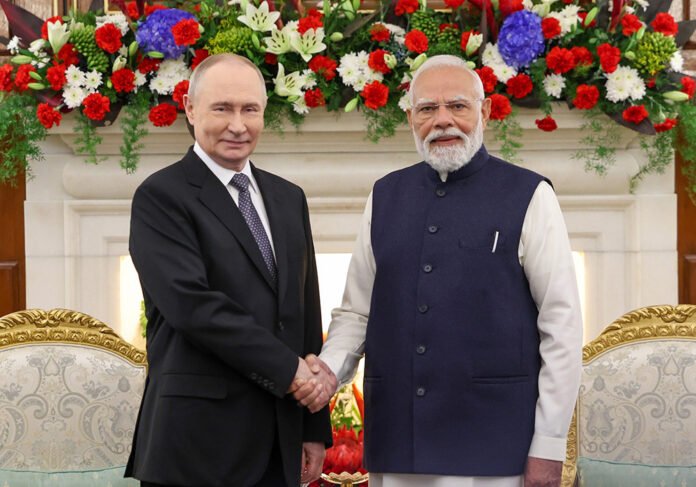
Russian President Vladimir Putin concluded his two-day state visit to India, last week. However, what his visit triggered in terms of messaging will continue to reverberate across the world, particularly Europe and the US for weeks and months.
While the visit helped in reaffirming long-standing trust and mutual understanding between India and Russia, it made it clear that neither ups and down of geopolitics nor US President Donald Trump’s imposition of tariff or sanction would cast a shadow on their relationship, anchored in decades of strategic convergence.

It was obvious when Putin pledged to provide uninterrupted supply of fuel to India and together with Prime Minister Modi inked 16 agreements. They also agreed to expand trade and defence ties. Yet, the message that resonated most strongly, particularly in the US, was India and Russia’s decision to press ahead with a mechanism to settle bilateral trade in national currencies.
Arguably, President Putin’s visit gave anti-Russian and anti-Indian forces unimaginable shocks. Many of them might be rattled by Prime Minister Modi’s decision to be at the airport to personally receive the Russian President in New Delhi. They might be flustered to see Modi and Putin sharing a vehicle from the airport to the Prime Minister’s official residence.
From the airport, both leaders got into the back seat of a white Toyota Fortuner carrying the flags of both India and Russia. However, it was not a rare spectacle. In September 2025, the world witnessed unusual development unfolding before it, when at the SCO summit in Tianjin in China, the two leaders had travelled together in Putin’s bulletproof car, Aurus Senat. Such carpool moments made one thing unmistakably clear: the strong personal chemistry between Prime Minister Modi and Russian President Putin.
Unshakable India-Russia bond
It also reflected that in the complex world of geopolitics, when it becomes very difficult to take a position in favour of a country, India has always sided with Russia, a time-tested friend which has never wilted under the weight of any kind of pressure.

While the visit helped in reaffirming long-standing trust and mutual understanding between India and Russia, it made it clear that neither ups and down of geopolitics nor US President Donald Trump’s imposition of tariff or sanction would cast a shadow on their relationship, anchored in decades of strategic convergence
Although, at times, critics started questioning claims of long-lasting friendship between India and Russia in the wake of New Delhi’s diversification of its purchase of arms and weapons from the US, France, and Israel, instead of just from Russia.
Besides, India became a member of the Quadrilateral dialogue which includes the US, Japan, and Australia. Following the Galwan Valley incident in June 2020, India pulled the shutter down on its trilateral engagement with Russia and China. These developments along with deepening Russia-China alliance with their announcement of “no limits” partnership, emboldened some critics to see red in India-Russia friendship.

Then they interpreted Prime Minister Modi’s rare public rebuke of Russia on the sidelines of the SCO summit in Samarkand in September 2022 that “today’s era is not of war,” as evidence of the emerging faultline between New Delhi and Moscow.
To prove that they are not wrong in their interpretation, they cited the case of Prime Minister Modi cancelling his visit to Moscow for the annual summit with President Vladimir Putin in December 2022 as a sign of growing unhappiness in India towards Russia.
Yet, this did not stop critics from making bold analysis of India-Russia ties; they argued that India itself underlined its discomfort when New Delhi highlighted the Ukraine war’s negative impact on global fuel and food prices at the first ‘Voices of the Global South’ summit in early January 2023.
However, while flagging all these as signs of a drift in India’s relations with Russia, these critics, influenced by Western countries’ anti-Moscow narratives, forgot that New Delhi consistently abstained from UN resolutions that condemned Russia’s actions since its invasion of Ukraine in February 2022. Even a day before Russian President Putin’s visit, India abstained from a UN resolution demanding that Moscow immediately return Ukrainian children transferred during the ongoing conflict.
Russia’s pro-India stances
Likewise, Russia has always stood by India. When Pakistan-based terrorists killed 25 Indian nationals and one Nepali citizen in Pahalgam in Jammu and Kashmir on April 22, Russian President Putin was among the first international leaders to condemn the deadly terror attack in Jammu and Kashmir. On May 5, he called Prime Minister Modi and strongly condemned the terror attack in Pahalgam.
Incidentally, India had used Russian made S-400 missile systems during the conflict, India-Russia jointly produce Brahmos missiles or Sukhoi-30 MKI aircrafts, manufactured by Russia’s Sukhoi and built under licence by India’s HCL – in hitting Pakistan hard during its military campaign from May 7 to May 10.
Putin pledged to provide uninterrupted supply of fuel to India and together with Prime Minister Modi inked 16 agreements. They also agreed to expand trade and defence ties. Yet, the message that resonated most strongly, particularly in the US, was India and Russia’s decision to press ahead with a mechanism to settle bilateral trade in national currencies
On Kashmir, Russia has consistently supported India, calling it as a bilateral issue to be resolved between India and Pakistan through dialogue. It has rejected third-party mediation on Kashmir and called the abrogation of Article 370 in 2019 an “internal matter”.
In 1998, following the nuclear tests in Pokhran, the US, Japan, and several western countries had imposed sanctions on India. But not only Russia refused to slap any sanction on India, but also offered all necessary help meant for strengthening bilateral engagements.
To the chagrin of the US, the then Russian Prime Minister Yevgeny Primakov visited India in December 1998 and signed as many as seven agreements with New Delhi.
In 1971 when the US administration under President Richard Nixon and its close European ally, the United Kingdom tried to influence the outcome of the India-Pakistan war by directing US Navy’s Seventh Fleet to advance towards the Bay of Bengal and Great Britain’s HMS Eagle, its powerful aircraft carrier to the Arabian Sea, the Soviet Union, Russia’s predecessor, threatened that if India was attacked by any power in the world, it would be considered as an attack on the Soviet Union. It led to both the US and the UK refraining from targeting India and changing the course of the 1971 War.
India-Russia trusted partnership
Therefore, a trusted partnership between India and Russia was not built in a day. Decades of unwavering support to each other during the time of their needs, stood by the two countries in good stead. In the current situation when the US has imposed a steep 50% tariff on India for purchasing Russian oil, India has chosen to turn challenges into opportunities. It can be seen in New Delhi’s decision to diversify its trade with multiple countries from across the world.
In this context, its decision to widen the basket of trade with Russia is seen as a major move. During Putin’s two-day visit, both countries committed to achieve a $100 billion target in bilateral trade well before 2030. Both sides also announced an Economic Cooperation Programme until 2030. “This will make our trade and investment more diversified, balanced, and sustainable; and will also add new dimensions to our areas of cooperation,” Prime Minister Modi said in his statement during a joint press conference on December 5.
A trusted partnership between India and Russia was not built in a day. Decades of unwavering support to each other during the time of their needs, stood by the two countries in good stead. In the current situation when the US has imposed a steep 50% tariff on India for purchasing Russian oil, India has chosen to turn challenges into opportunities. It can be seen in New Delhi’s decision to diversify its trade with multiple countries from across the world
Amid this, a major step towards strengthening economic ties was their decision to continue bilateral trade through the Rupee-Ruble mechanism. They also agreed to maintain their consultations on enabling the interoperability of the national payment systems, financial messaging systems, as well as central bank digital currency platforms.
In the area of defence, though no big-ticket deals were made and for this, critics argue that it was done to avoid attracting sanctions from the US and its European allies, who are already unhappy with India for not pressurising Russia to end war with Ukraine.
In other words, non- announcement of any significant defence deal was more to do with India’s balancing act than anything else. India does not want to undertake any step that would hurt its national interest, especially when its trade deal with the US is at an advanced stage of talks. But then, it should not be forgotten that both India and Russia are strengthening their defence ties through the Inter-Governmental Commission on Military & Military Technical Cooperation (IRIGC-M&MTC) route.
Established in 2000, it oversees the entire spectrum of military-technical collaboration between the two countries. On December 4, ahead of the annual summit between Prime Minister Modi and Russian President Putin, India’s Defence Minister Rajnath Singh co-chaired the 22nd session of (IRIGC-M&MTC) at Manekshaw Centre in New Delhi.
At the meeting, as per the statement from the Ministry of Defence, India voiced its determination “for capacity building of its indigenous defence industry for both local production and exports, under the vision of Aatmanirbhar Bharat.”
In that meeting, emphasis was also laid on exploring opportunities for enhancing collaboration across niche technologies. Broadly speaking, joint research and development, co-development, and co-production of advanced defence technology and systems have been the thrust of India-Russia cooperation in defence.
President Putin’s visit reaffirmed the truth that India–Russia relationship rests not on transient tactical alignments, but on decades of strategic trust, political comfort, and mutual reliability. Despite sharp shifting global power equations, Western pressures, or periodic doubts raised by critics, both New Delhi and Moscow have shown that their partnership has the resilience to adapt and the confidence to evolve
India wants Russia to deliver the rest of the two squadrons of S-400 missile systems. India plans to acquire another five squadrons of S-400 missile systems and is also interested in S-500 platforms. To upgrade Sukhoi-30 MKI jet fleet and enhance its lethal capabilities, India wants Russia to supply R-37 and RVV-BD air-to-air missiles. India is also keen for joint production of an advanced version of BrahMos supersonic cruise missile.
Overall, President Putin’s visit reaffirmed the truth that India–Russia relationship rests not on transient tactical alignments, but on decades of strategic trust, political comfort, and mutual reliability. Despite sharp shifting global power equations, Western pressures, or periodic doubts raised by critics, both New Delhi and Moscow have shown that their partnership has the resilience to adapt and the confidence to evolve.
The decisions taken during this visit, from expanding trade and defence cooperation to strengthening financial interoperability and consolidating energy and nuclear cooperation, underscore their shared determination to strengthen their relationship.

–The writer is a senior journalist with wide experience in covering international affairs. The views expressed are of the writer and do not necessarily reflect the views of Raksha Anirveda
