

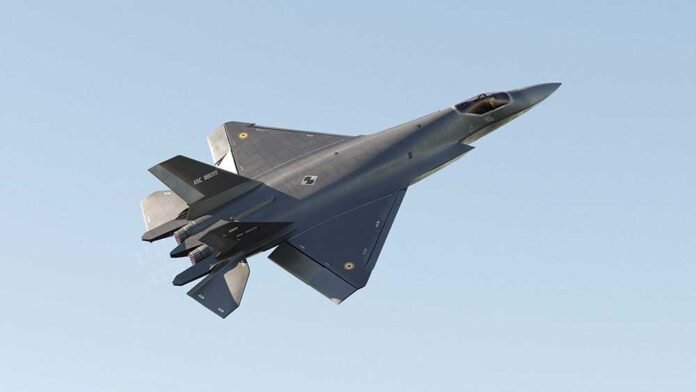
New Delhi: The Defence Research and Development Organisation’s (DRDO) Aeronautical Development Agency (ADA) is on the verge of releasing an Expression of Interest (EOI) to invite bids for selecting a production partner for the Advanced Medium Combat Aircraft (AMCA), a 5.5-generation stealth fighter jet.
This marks a pivotal shift in India’s defence manufacturing landscape, as it aims to harness the growing capabilities of the indigenous aerospace sector. The EOI is expected within the next few weeks, with the first AMCA prototype targeted for rollout between 2026 and 2027.

The ADA’s EOI is specifically designed to tap into India’s expanding aerospace ecosystem, offering domestic companies opportunities to participate in the manufacturing and supply chain for the AMCA program. Several Indian firms—including TATA Advanced Systems Ltd (TASL), Larsen & Toubro (L&T), Mahindra Aerospace, Dynamatic Technologies, Bharat Forge, Sansera Engineering, Azad Engineering, Aequs, and Godrej Aerospace—already supply components and systems to global aircraft manufacturers such as Boeing and Airbus. International aerospace giants like Pratt & Whitney, Rolls-Royce, and Collins Aerospace are also increasing their sourcing from India, reflecting the country’s growing stature in the global supply chain.
On May 26, Defence Minister Rajnath Singh approved the AMCA program for production, explicitly allowing private sector participation for the first time in such a high-profile fighter jet project. The announcement clarified that only indigenous firms—including non-governmental entities—are eligible to bid, but they may form joint ventures or consortia to strengthen their proposals. This policy is intended to overcome the longstanding capacity shortfall in the Indian Air Force (IAF) by leveraging the broader capabilities of India’s private sector.
Hindustan Aeronautics Limited (HAL), traditionally the sole licensee for manufacturing fighter jets for the IAF, is preparing to bid for the AMCA contract through a consortium model. HAL has already solicited proposals from indigenous companies and is currently evaluating 24 responses to form a consortium for the AMCA program. In this model, HAL will act as the lead partner, while other private firms will be allocated equity shares based on their financial and technical contributions.
This approach represents a significant evolution in India’s defence manufacturing, as HAL will, for the first time, face competition for a fighter aircraft manufacturing license. The consortium model is designed to accelerate production timelines, expand the supplier base, and eliminate bottlenecks associated with a single manufacturer. The Ministry of Defence was informed of this model before the Empowered Committee for Capability Enhancement of the IAF submitted its report on March 3, which recommended measures to optimise the IAF’s capabilities.

HAL’s willingness to open up fighter jet manufacturing to private participation is already being tested in the Light Combat Aircraft (LCA) TEJAS MK-1A program. For the first time, major sub-assemblies—such as the centre fuselage and rear fuselage—are being manufactured by private companies like VEM Technologies and Alpha Tocol, respectively. Other components, including vertical fins, radars, and wings, have been outsourced to TASL and L&T, setting a precedent for future collaboration in the AMCA project.
The ADA will oversee the selection of the production partner and lead the initial manufacturing of five AMCA prototypes. The success of these prototypes will determine subsequent production orders. The open bidding and consortium approach is expected to foster competition, enhance efficiency, and drive innovation, ultimately strengthening India’s domestic aerospace ecosystem and reducing reliance on foreign imports.

The imminent issuance of the EOI for the AMCA program signals a transformative phase in India’s defence sector, with HAL preparing to lead a consortium of private firms in a bid to manufacture the nation’s next-generation stealth fighter. This collaborative model, already being piloted in the Tejas program, is poised to accelerate the development and induction of the AMCA, positioning India as a significant player in advanced combat aircraft manufacturing.

