

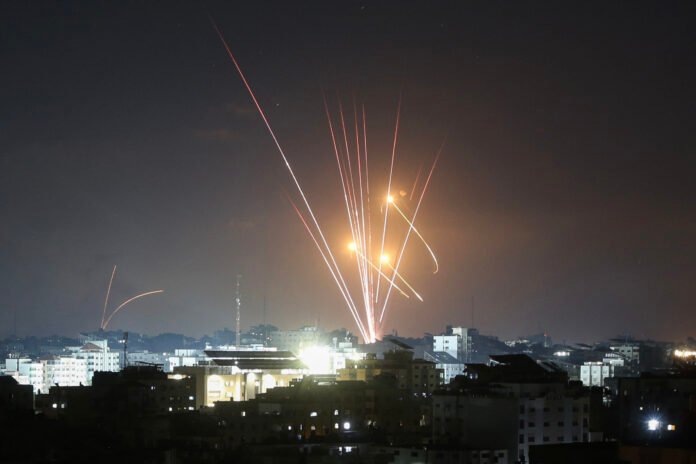
Tel Aviv: The Pentagon is closely following the use of the Iranian long-range ballistic missiles and the Israeli capabilities to counter them with an eye on the US “Golden Dome” missile-defence programme.
The ongoing US-Iran war, which has escalated since early 2026 with large strikes and Iranian missile barrages, has had a profound impact on the US Golden Dome missile defence programme. Originally unveiled by President Trump in January 2025 as an ambitious multi-layer shield against ballistic, hypersonic, and cruise missiles, inspired by Israel’s Iron Dome, the programme seeks to be operational by 2029 at a cost of approximately $175 billion.

The war has provided real-world validation for the Golden Dome’s necessity while exposing urgent gaps. US forces, aiding Israel, depleted 25% of THAAD interceptors (150 units) and significant SM-3 stocks in prior 2025 clashes, with replenishment taking 1.5-2 years at current rates—risks amplified in the prolonged 2026 conflict.
Interceptor shortages have created a “race of attrition,” straining US manufacturing capacity amid strong consumption. This has prompted requests to expedite the Golden Dome by increasing Patriot/THAAD production and incorporating Israeli systems such as Arrow, which has demonstrated greater effectiveness (currently 96% against Iranian barrages).
One year after its January 2025 launch, the US Golden Dome missile-defence initiative remains in its early, conceptual phase, having made little visible progress despite $25 billion in funding. The ambitious project aims to create a comprehensive, multi-layer shield by 2028, but faces delays, technical disputes, and undefined, complex, space-based architecture.
The programme is largely in the conceptual phase, with no hardware deployed and limited, if any, major contracts awarded as of early 2026. Congress allocated $25 billion for the initiative in 2025.

While aiming for initial operational capability by 2028, officials admit the timeline is risky and complex. The system is intended to protect the entire continental US from ballistic, hypersonic, and cruise missile threats, likely using a “system of systems” approach.
The project faces significant challenges, including the need for new space-based interceptors, advanced sensors, and laser technologies, some of which are still in early development.


-The writer is an Israel-based freelance journalist. The views expressed are of the writer and do not necessarily reflect the views of Raksha Anirveda
