

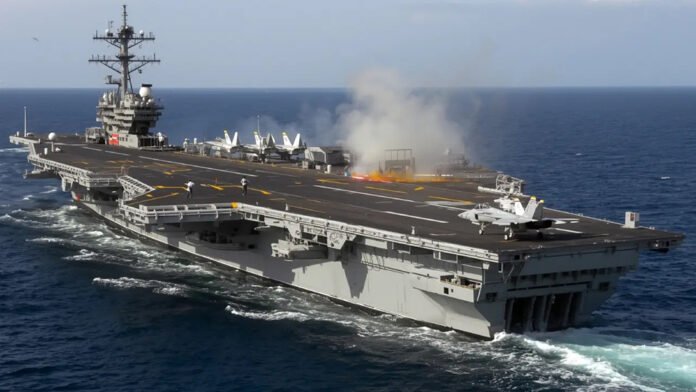
In the high-stakes arena of great-power competition, few assets embody raw strategic leverage like the US Navy’s nuclear-powered supercarriers. Yet in recent weeks, a coordinated propaganda barrage from Tehran and Beijing has sought to portray these floating fortresses as relics — vulnerable, overpriced targets whose era is ending. Iranian state media and aligned outlets have circulated claims that the USS Abraham Lincoln was struck by ballistic missiles, leaving it “limping home” and signalling the collapse of American naval dominance.
Echo chambers amplified fabricated headlines: “The era of aircraft carriers is coming to an end; USS Abraham Lincoln is limping out of the Persian Gulf” (Reuters-style); “With its military ingenuity, Iran has proven that aircraft carriers are no longer impregnable fortresses, but merely large and expensive targets” (another purported Reuters dispatch); “A national trauma” (CNN); and declarations from Sputnik and AFP that this marked “the moment Western naval dominance collapsed.”

US Central Command has repeatedly confirmed the Lincoln was never hit — missiles didn’t even come close — and the carrier strike group continues launching aircraft in support of ongoing operations. The repositioning is purely tactical
None of it holds. US Central Command has repeatedly confirmed the Lincoln was never hit — missiles didn’t even come close — and the carrier strike group continues launching aircraft in support of ongoing operations. The repositioning is purely tactical. Here’s why carriers like the Abraham Lincoln are not only difficult to sink but remain indispensable instruments of power projection, capable of reshaping battle spaces thousands of kilometres away without a single boot on foreign soil.
Strategic Repositioning, Not Retreat
The Lincoln’s carrier battle group has indeed moved farther offshore — to roughly 1,100 km from Iranian waters, up from an earlier position around 300-350 km. This is textbook naval prudence, not panic. Iranian forces have resorted to asymmetric “suicidal swarm” tactics using speedboats, a sign of desperation after much of their conventional navy and air force have been neutralised in the current conflict. (Two remaining Iranian vessels are sheltering in Kochi, underscoring the asymmetry.)
Pulling back degrades nothing. Tomahawk cruise missiles fired from escorts or the carrier’s own arsenal reach 2,000 km — well within striking distance of Iranian targets. Carrier-based fighters simply extend their reach via aerial refuelling, actually increasing loiter time over the battlefield. Once air, land, and sea threats are fully suppressed, the group can — and will — move in closer. This is standard doctrine: protect high-value assets until the enemy’s offensive capacity is exhausted.
Pulling back degrades nothing. Tomahawk cruise missiles fired from escorts or the carrier’s own arsenal reach 2,000 km — well within striking distance of Iranian targets. Carrier-based fighters simply extend their reach via aerial refuelling, actually increasing loiter time over the battlefield. Once air, land, and sea threats are fully suppressed, the group can — and will — move in closer. This is standard doctrine: protect high-value assets until the enemy’s offensive capacity is exhausted
History offers a near-perfect parallel. When the 1971 Indo-Pakistani War erupted, the Indian Navy immediately sailed its sole carrier, INS Vikrant, 2,500 km west from Mumbai to a secret atoll in the Andaman Islands. Indian Naval intelligence had got wind that the Pakistani submarine PNS Ghazi had been sent to hunt it. Only after the destroyer INS Rajput depth-charged and sank the Ghazi off Vizag did Vikrant steam east to pulverise Pakistani naval assets in Chittagong and other ports. Caution first, decisive strike second. America is applying the same logic today.

Why Sinking a Modern Carrier is Almost Impossible
Aircraft carriers are not floating bulls’ eyes; they are engineered as damage-absorbing cities at sea. A Nimitz-class vessel like the Lincoln displaces over 100,000 tons and stretches more than 1,000 feet. Its hull features hundreds of watertight compartments, reinforced bulkheads, and layered armour plating. Even multiple missile or torpedo strikes rarely compromise overall buoyancy — damage-control teams can isolate flooded sections in minutes, a capability refined through decades of lessons from World War II, when carriers absorbed dozens of hits before succumbing.
But the real deterrent is the layered defence of the entire carrier strike group. Destroyers and cruisers provide outer rings of radar-guided missiles and close-in weapon systems (CIWS) that shred incoming threats. At least one nuclear-powered attack submarine prowls beneath for undersea hunters. Overhead, E-2 Hawkeye AWACS aircraft, helicopters, drones and satellite feeds create 360-degree situational awareness. The carrier’s own air wing — 70+ F/A-18s, F-35s and support planes — can establish air superiority long before threats arrive.

Beyond survivability lies unmatched utility. A single carrier strike group is a sovereign airfield that can be repositioned at 30 knots anywhere on the world’s oceans, free from the political friction of land bases. Its air wing delivers precision strikes, electronic warfare and reconnaissance on demand
The ultimate protection, however, is operational discipline. Carriers do not sail into kill zones until the adversary’s anti-access capabilities are degraded. No rational power supplies an enemy with weapons capable of sinking a US carrier unless prepared for nuclear escalation — the very reason Soviet Russia withheld advanced anti-ship missiles from North Vietnam despite flooding Hanoi with other advanced arms.
Floating Airbases that Project Power Anywhere
Beyond survivability lies unmatched utility. A single carrier strike group is a sovereign airfield that can be repositioned at 30 knots anywhere on the world’s oceans, free from the political friction of land bases. Its air wing delivers precision strikes, electronic warfare and reconnaissance on demand. Add the group’s surface combatants and submarines, and you have a self-contained force capable of enforcing no-fly zones, conducting sustained campaigns, or simply signalling resolve.
Economically, these $13-billion platforms (including air wing and escorts) deliver outsized return. They deter adversaries without permanent overseas footprints, support allies, and keep sea lanes open for global commerce — the lifeblood of the world economy. In the current Gulf operations, the Lincoln’s repositioning has changed zero fundamentals: Iranian airspace remains dominated from the sea, and US strike options stay fully intact.
Far from obsolete, aircraft carriers remain the ultimate expression of power projection: mobile, flexible and resilient. The Lincoln is not limping home. It is simply executing the patient, overwhelming strategy that has kept US naval supremacy unchallenged for decades
Critics who declare the carrier era over point to hypersonic missiles or drone swarms. Yet those threats are precisely why the US invests in layered defences, distributed lethality, and next-generation platforms like the Ford-class carriers with electromagnetic catapults and advanced radar. History shows every predicted revolution in warfare — from submarines in 1914 to ballistic missiles in the 1960s — has been countered through adaptation. Carriers have endured because they adapt fastest.
The Bottom Line: Deterrence that Endures
Iran’s claims, amplified by propaganda networks, aim to erode perceptions of American strength. They fail because they ignore the physics, engineering and doctrine that make supercarriers extraordinarily difficult to neutralise. If an adversary ever did manage the near-impossible feat of sinking one, the strategic consequences would likely escalate far beyond conventional warfare — another reason rational actors hesitate.
Far from obsolete, aircraft carriers remain the ultimate expression of power projection: mobile, flexible and resilient. The Lincoln is not limping home. It is simply executing the patient, overwhelming strategy that has kept US naval supremacy unchallenged for decades — and will continue to do so for decades more.

–The writer is a globally cited defence analyst based in New Zealand. The views expressed are of the writer and do not necessarily reflect the views of Raksha Anirveda
