
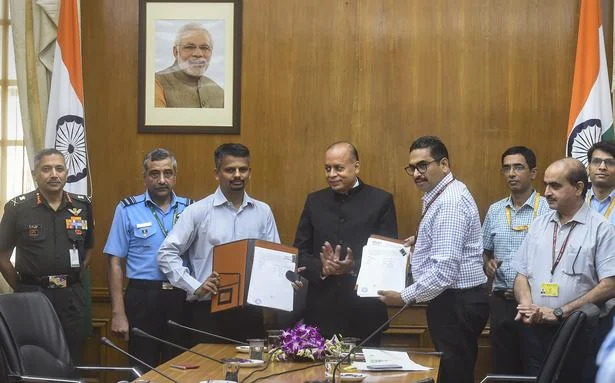
New Delhi: The indigenisation of the Software Defined Radios (SDRs) will now be fast tracked to meet the demand of the Indian Armed Forces across a broad spectrum of operations. SDR is capable of multiple types of waveforms including wideband and narrowband applications.
Indian Institute of Technology (IIT) Kanpur and Defence Research and Development Organisation (DRDO) are working together to indigenise the SDR, according to an official statement issued by the Ministry of Defence (MoD) on July 26.

Defence Secretary Dr Ajay Kumar in the statement issued by the MoD stated that the indigenisation of the SDR technology is an important milestone which is important for achieving ‘Atmanirbhar Bharat’ in this field.
The indigenous technology will be available to be implemented by the Indian Army and the Indian Air Force. The SDR is used by the forces for transferring rates of voice, data, and video information. It will help troops on the ground carrying handheld portable SDR versions to integrate with higher echelons to achieve real C4I capability along with the possibility of operating Swarms of Drones in future battlefields.
The three services –Indian Army, Air Force and Navy have been working towards the development of a family of modular and interoperable SDRs versions – Manpack (SDR-MP) and SDR-HH (Hand Held), Airborne (SDR-AR), Naval Combat (SDR-NC), and Tactical (SDR-TAC).
The process of life cycle management is very important and is needed to protect and secure sensitive SDR technology and products. The whole process involves indigenous development, manufacturing, design, testing/certification and maintenance ecosystem.

Under Make-II category, the Indian Army has been in the process of replacing the legacy radios with the indigenously developed V/UHF Manpack SDRs. In the coming years, the CNR for Armoured Fighting Vehicles (CNR-AFV) too shall be SDR based.
Two important elements of indigenous SDR technology are — Standardised Operating Software Environment (OE) and Applications (also known as waveforms) and are associated waveforms repository and test/certification facility.

According to the MoD, the Standard OE enables waveform portability and interoperability among multiple vendors of SDRs and a decision has been taken by the ministry to develop and define reference implementation of India specific operating environment. This is known as India Software Communication Architecture (SCA) profile.
The idea of having ‘India SCA Profile’ has been pioneered by Director, IIT Kanpur Dr Abhay Karandikar, who is the Chairman of SCA Committee under the MoD. To help in fast tracking the indigenisation process a draft project report has already been prepared by DEAL/DRDO which clearly states the timelines and roadmap.
The Directorate of Standardisation (DoS) in the Department of Defence Production will be involved for developing IRSA in three to six months with the help of Industry, academia, and DRDO. Additional months will be used for testing, compliance certification tools as well as reference implementation. The three institutions involved in the development namely, DEAL/DRDO, IIT-Kanpur and DoS have already started the work as per DPR and it is expected to be completed in a time bound manner.
To be notified by DoS, IRSA will help the Indian software vendors to integrate and make the SDRs security gradable and interoperable. IRSA will be shared with the industry for the development of the SDRs which will be used by the Indian Armed Forces and also be exported to friendly nations.