

As this January-March 2026 issue goes to print, the experiences of 2025 are still fresh — and highly instructive. The past year was not simply a period of execution and delivery; it was a year that tested resilience, adaptability and long-term thinking across the global defence and aerospace industry. For Schiebel, 2025 sharpened our understanding of what it truly means to operate in an environment shaped by geopolitical uncertainty, supply-chain fragility and evolving operational demands. Those lessons now directly inform how we are positioning ourselves for 2026, both in India and across our global markets.
From an Indian perspective, these reflections carry particular significance. India’s defence ecosystem continues to mature at pace, driven by operational necessity, policy clarity and a clear national commitment to self-reliance. At the same time, global supply chains have become increasingly constrained and politicised. Technology, once viewed primarily as an enabler, is now frequently used as leverage in strategic competition between major powers. In this environment, defence capability can no longer be separated from questions of access, assurance and industrial resilience.

Looking back, 2025 reinforced a core principle for Schiebel: operational relevance cannot exist without resilience. Defence and security organisations worldwide are no longer evaluating platforms solely on performance metrics. They are asking more fundamental questions about availability, lifecycle support and long-term continuity — especially in times of crisis. These considerations have become central to procurement thinking globally, particularly in the maritime domain, where sustained presence and readiness are critical.
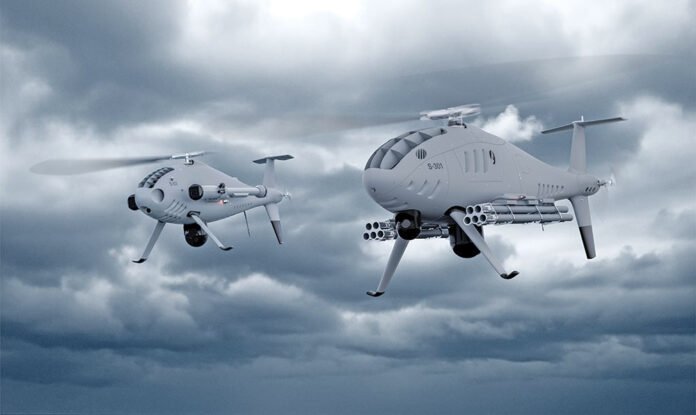
Throughout 2025, Schiebel focused on consolidating and advancing the strengths of the CAMCOPTER® family. The CAMCOPTER S-100 continued to demonstrate why it remains a reference system for shipborne VTOL unmanned aviation, proven in demanding maritime environments around the world
Throughout 2025, Schiebel focused on consolidating and advancing the strengths of the CAMCOPTER® family. The CAMCOPTER S-100 continued to demonstrate why it remains a reference system for shipborne VTOL unmanned aviation, proven in demanding maritime environments around the world. In parallel, the CAMCOPTER S-300 progressed as a next-generation capability designed to deliver greater endurance, higher payload capacity and persistent wide-area maritime coverage. Together, these platforms reflect our long-held belief that maritime unmanned aviation must balance agility with persistence – immediate responsiveness with long-duration presence.
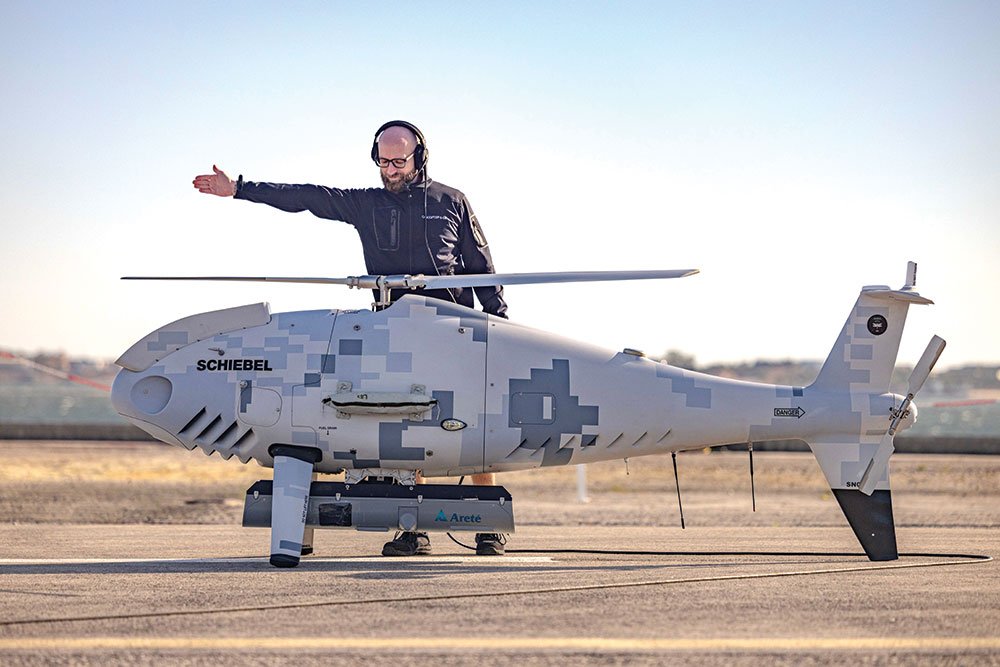
India has been central to this journey. Over the course of 2025, discussions with Indian maritime stakeholders – including the Indian Navy and other organisations responsible for maritime security and safety – continued to underline the operational relevance of rotary-wing unmanned systems in one of the world’s most complex maritime theatres. Blue-water operations in the Indian Ocean Region coexist with dense coastal traffic, humanitarian responsibilities and law-enforcement missions. In such an environment, unmanned helicopters are increasingly recognised as essential enablers of maritime awareness and operational planning.

One of the most notable shifts during 2025 was the evolution of dialogue with stakeholders. Conversations moved decisively beyond the question of what a platform can do, to how reliably it can be sustained, upgraded and supported over decades. This shift mirrors a broader global trend. Supply-chain disruptions – driven by geopolitical tensions, export controls and industrial bottlenecks – have exposed vulnerabilities in defence programmes that rely on narrowly sourced components or rigid support models.
For India, these challenges intersect directly with the national objective of Aatmanirbhar Bharat. Strategic autonomy in defence is not achieved through manufacturing alone; it requires control across the full lifecycle of a system – from sustainment and upgrades to skills, training and long-term availability. The experience of 2025 made it clear that self-reliance must be systemic rather than symbolic.

In this context, the role of Schiebel India has continued to evolve. Our focus has been on strengthening local competence, building technical depth and aligning global technology roadmaps with Indian operational priorities. The objective is clear: to ensure that unmanned systems intended for Indian maritime use can be supported, adapted and sustained within the country over the long term. This approach is essential if India’s maritime forces are to retain freedom of action in an increasingly contested global environment.
As we look ahead through 2026, the strategic context is unlikely to become simpler. Global competition remains intense, and supply chains for advanced technologies will continue to be influenced by political, economic and security considerations. For operators, this reality reinforces the need for platforms that offer not just capability, but confidence – confidence that systems will remain available and supportable regardless of external disruptions.
Schiebel’s business strategy for 2026 is built around this understanding. Globally, our focus is on three interlinked pillars: operational maturity, supply-chain resilience and scalable growth. Operational maturity means continuing to refine systems that are already proven, ensuring they remain adaptable to new sensors, evolving missions and changing threat environments. It is a deliberate choice to prioritise reliability and evolutionary development over short-term novelty.
Supply-chain resilience has become a strategic imperative rather than a supporting function. In 2026, this translates into diversifying sourcing, strengthening trusted partnerships and reducing single points of dependency. For users and decision-makers, the benefit is tangible: greater assurance that unmanned fleets can remain operational when they are most needed, even in times of global disruption.
Scalable growth forms the third pillar – and here, India occupies a particularly important position. India is not only a key market, but also a strategic anchor in the Indo-Pacific. Demand for maritime surveillance, unmanned aviation and persistent ISR will continue to grow, driven by legitimate security, safety and humanitarian requirements. Schiebel India is well positioned to contribute to this trajectory by aligning global experience with Indian needs, while also ensuring that insights from Indian maritime operations inform developments elsewhere in the world.
The role of Schiebel India has continued to evolve. The focus has been on strengthening local competence, building technical depth and aligning global technology roadmaps with Indian operational priorities
In a volatile world, consistency matters. Trust is earned through performance over time. Resilience is not an abstract concept, but a capability in its own right. And partnerships endure when they are built on long-term commitment rather than short-term advantage.
Schiebel enters 2026 with a clear objective: to remain a reliable, forward-looking partner for India and for customers worldwide, delivering unmanned aviation solutions that are not only technologically advanced, but industrially and strategically dependable. In an era where access and assurance matter as much as innovation, that distinction will define success.

The writer is a Chief Executive Officer, Schiebel System India Pvt Ltd
