
“Netanyahu promised Israelis that this campaign would lead to the end of the Islamic regime, that by cutting the head of the snake, this war would remove an existential threat from Iran… Yet, the snake turned into a hydra,” says Shira Efron, the Israel policy chair at the US-based RAND corporation.
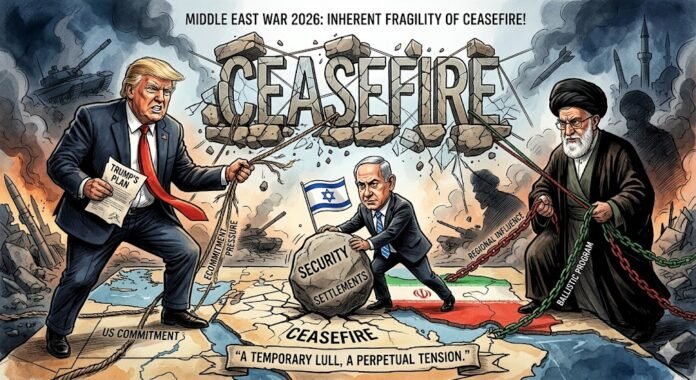
The ceasefire between the opposing parties of the Middle East war was destined to go to its ‘grave’ from the moment it was announced because of its inherent fragility. The fragility sprang from the insincerity of not only the opposing parties but also of the mediator, who had not done proper homework. In fact, it seems that it was a drama of absurdity, conjured to find an escape route from the maximalist position adopted by the United States. And its surrogate, Pakistan, did its best to hog the limelight, as a ‘peace maker’, though fully knowing its instability.

The first brick in the fragility of the ceasefire agreement sprang from the misleading notion that the civilian administration of President Ali Prezeshkian controlled Iran. It is not so. The power lay in the hands of IRGC, who had drawn their power from the direct command of slain Supreme Leader, Ali Khamenei and now his seriously injured son, Mojtaba Khamenei. Iran’s constitution does not allow the President and the security council to countermand the Supreme Commander’s directive. Therefore, it was the IRGC who called the shots in Iran and not the President’s administration. Any deal on a ceasefire had to be worked out with the IRGC.
The US will never accept four points raised by Iran: Total withdrawal of US military forces from the Middle East; total control of the Strait of Hormuz; complete protection against attacks, particularly its ‘axis of resistance’; and freedom to enrich uranium
The second obstacle to a lasting ceasefire is the Mosaic leadership of the IRGC, which divides Iran into 31 autonomous provinces. According to the Supreme Commander’s directive, they were all independent of each other and free to take any action against ‘enemies of Iran’. These autonomous commanders were to take orders only from the Supreme Commander, who is already dead and his replacement, Mojtaba Khamenei, was reportedly incapacitated and unconscious, to make any decision.
More so, all 31 Commanders were so brainwashed and fundamentalists that they might not agree on a ‘ceasefire’. It is evident that even hours after the announcement of the ceasefire, Kuwait, the UAE and Saudi Arabia were attacked by the IRGC. It shows that all IRGC commanders might not be on the same page for a ceasefire with the civil government of President Ali Prezheskian.
The major factor in the non-functioning of the ceasefire was the absence of any meeting point between the proposals from the two sides: the US and Iran. There were 15 points from the US in their proposals, and Iran had proposed 10 points. They were self-contradictory. Unfortunately, Pakistan, the sole mediator, had merely acted as a messenger without first seeking an agreeable common point, which could lay the foundation for meaningful negotiations. Pakistan was in a hurry to exploit global sentiments against this war as a ‘peacemaker’, without going into the nuts and bolts of the proposals.

It would be interesting to note the proposals from two sides, which militate against a meaningful ceasefire. Among the points raised by Iran, four issues will be strongly objected to. They are: one, total withdrawal of US military forces from the Middle East; two, total control of the Strait of Hormuz and allowed to charge an entry fee; three, complete protection against attacks, particularly its ‘axis of resistance’, ratified by
Netanyahu is already being questioned by the opposition in Israel. Yair Lapid, leader of the opposition in Israel, has chided Netanyahu by saying, “Israel was not even at the table when decisions were made concerning the core of our national security”
These four points will not be accepted by Israel and the US because it gives Iran not only the upper hand but also a nuclear enrichment programme and ballistic missiles manufacturing, which were an existential threat to Israel. President Trump has minced no words in saying that Iran would never be allowed to develop a nuclear bomb and ballistic missiles. In fact, he wants Iran to hand over 450 kg of enriched uranium to the US. Besides, the US cannot pull out its forces from the Middle East in entirety. It will leave these tiny-tot nations at the mercy of Iran. For the release of Iran’s frozen funds in the US and EU, it needs the consensus of all others.

Though Israel’s Prime Minister Netanyahu has agreed in principle with the US for two weeks ceasefire, he was under pressure from within Israel. This being the election year in Israel, therefore, Netanyahu has to question the ceasefire on three main Iranian terms as desired in 10 points proposals of Iran.
First, he cannot accept Iran’s proxies, such as Hezbollah, Hamas and Houthis, being left out of the ceasefire agreement. Then, he cannot accept Iran being allowed to enrich uranium and clandestinely work for the nuclear bomb, which is an existential threat to Israel. Finally, he would like to see all such facilities of nuclear enrichment and ballistic missiles manufacturing be demolished.
On his failure to do so, he is already being questioned by the opposition in Israel. Yair Lapid, leader of the opposition in Israel, has chided Netanyahu by saying, “Israel was not even at the table when decisions were made concerning the core of our national security.”
Israel’s ambassador to India, Reuven Azar, says, “We don’t see Pakistan as a credible player. I think that the United States has decided to use the services of the facilitation of Pakistan for their own reasons.” Pakistan is just the ‘errand boy’ of the US
Therefore, Netanyahu has to continue his fight against Iran’s proxies, which makes ‘ceasefire’ undesirable for Israel in letter and spirit. Hence, he has continued his operations against Hezbollah in Lebanon and Hamas in Gaza. On the night of April 8, Israel carried out 100 sorties, and some 254 citizens were killed, and over 1,100 were injured. This prompted Iran to close the Strait of Hormuz within hours of its opening. Also, Iran promised its proxies that it would seek revenge on Israel.
Thus, there is no doubt that the ceasefire announced in a hurry amounted to miscarriage before conception, or you can say it was divorce before marriage. There was NO meeting ground in the proposals put up by the two sides. It was for Pakistan to reconcile the two hardliners, Israel and the IRGC. It should have known that Israel would not accept the exclusion of Iran’s proxies from the ceasefire agreement. The consent of the IRGC was essential to pursue the contours of the ceasefire. Not necessarily mean that Israel will accept whatever the US says. The same is true of the IRGC refusing to go with Iran’s President.
A mediator ought to be on good terms with two warring nations. Pakistan is neither trusted by Israel nor by the IRGC. It is interesting to note what Israel’s ambassador to India, Reuven Azar, has said. He believes that the US has used Pakistan for its own reasons. It is no doubt that Pakistan was the ‘errand boy’ of the US. To quote Reuben Azar, “We don’t see Pakistan as a credible player. I think that the United States has decided to use the services of the facilitation of Pakistan for their own reasons.” Therefore, this ceasefire was as fragile as is its initiator, it was destined to die at its birth!

-An ex-NDA and Wellington Staff College graduate, Col Rajinder Singh is a renowned author and security analyst. He has authored four books, two individually and two in collaboration. His best-selling books are Kashmir – A Different Perspective and The ULFA Insurgency. The views expressed are of the author and do not necessarily reflect the views of Raksha Anirveda
