

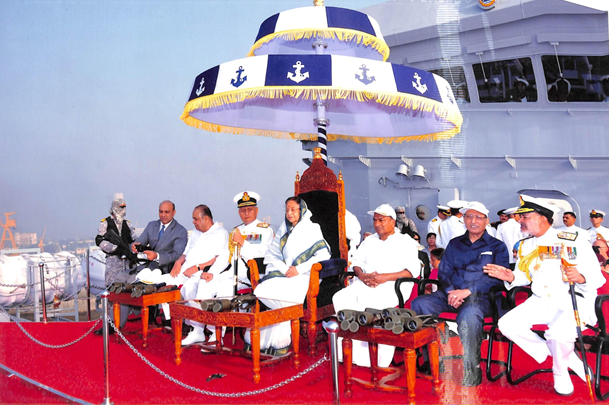
The upcoming International Fleet Review (IFR) 2026 in Visakhapatnam is set to be more than a display of naval tradition; it is a live audit of India’s industrial transformation. Starting from the Presidential Fleet Review in 1953 to showcasing the Indian Navy’s capabilities in the International Fleet Review, our narrative gradually took a different course from ‘What we have’ to ‘What we can Build, Do & Offer’. While historically India relied on imported hulls and foreign sensors, the 2026 assembly marks a decisive pivot toward a “Builder’s Navy”. This shift represents a sophisticated blend of heavy engineering, indigenous intellectual property, and strategic self-reliance.
The Evolution of the Yard
The journey towards this industrial milestone began decades ago. From sailors serving on vessels mostly born in foreign yards to the breakthrough of the 1980s. The 1989 review was a watershed moment, featuring the INS Godavari, the first missile frigate designed entirely in India. That vessel proved that Indian engineers could do more than maintain ships; they could architect them.

Fast forward to 2026, and the “Builder’s Navy” club has expanded into elite territory. The fleet now integrates nuclear-powered submarines and sophisticated indigenous frigates, a feat that required the development of a localised ecosystem of steel production, propulsion technology, and specialised electronics, thereby creating a synergy between industry and the Indian Navy.
IFR-MILAN 2026: A Showcase of High-Tech Naval Industrialisation
The 2026 event serves as a showcase for the “Make in India” initiative in the maritime sector. Hosting nearly 50 foreign navies and 100 vessels at the Eastern Naval Command serves two industrial purposes:
- Capability Signaling: It demonstrates to global partners that Indian manufacturers and technology players are now capable of producing world-class hardware, from aircraft carriers to stealth destroyers.
- Interoperability Standards: Events like Exercise MILAN provide the “R&D” environment where this hardware is tested against diverse international platforms.
What began in 1995 as a modest four-nation gathering has scaled into a massive multilateral operation. By 2024, MILAN involved over 40 navies, shifting its focus from basic seamanship to advanced humanitarian response and high-end combat drills. This evolution shows that Indian-built hardware is increasingly the “connective tissue” of Indo-Pacific security. With a convergence of three strategic naval events on our shores, the showcase of Aatmanirbharta reaches far and wide.
Strategic Utility Over Ceremony
Critics often view these grand reviews as resource-heavy spectacles. However, in the context of global trade and collaboration, especially in 2026, they are strategic investments. By convening global naval leaders for the Indian Ocean Naval Symposium (IONS) alongside the IFR-MILAN 2026, India is utilising its industrial capacity as a tool for “Soft Power” diplomacy.

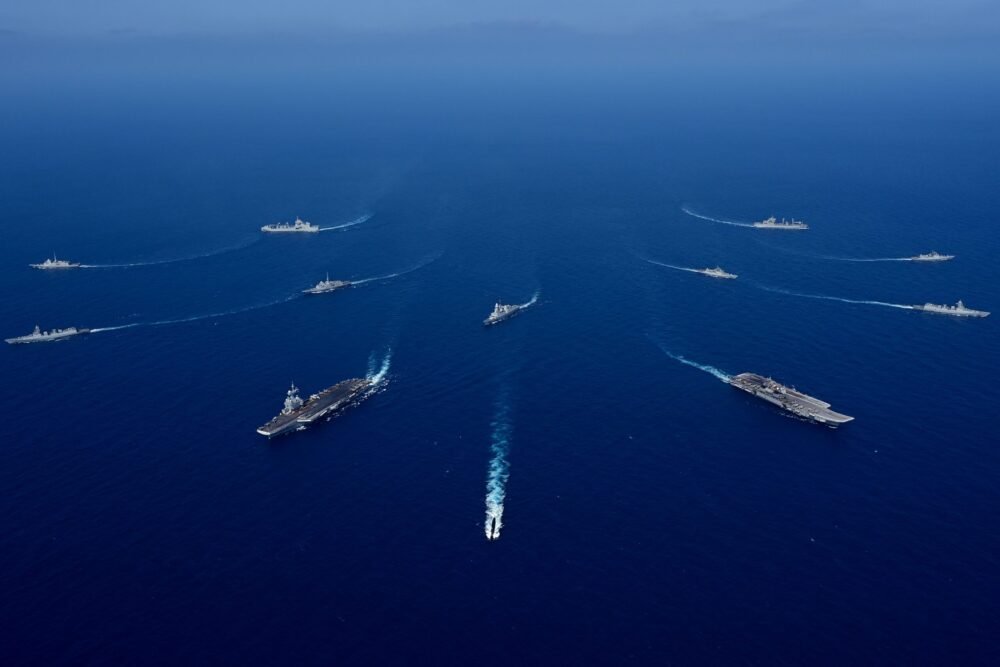
The strategy is clear: Reassure neighbours through presence, build trust through professional exchange, and signal deterrent capability through indigenous technology. This “maritime statecraft” ensures that India isn’t just guarding its coastline; it is exporting stability.

The Industrial Horizon
As the Indo-Pacific becomes more contested, the ability to maintain and build a fleet domestically is a critical strategic advantage. The Maritime Convergence 2026 isn’t just about ships at anchor; it is about the thousands of engineers, designers, and workers behind them. By combining 20th-century tradition with 21st-century manufacturing, India has turned the Bay of Bengal into a mirror of its own industrial ambition. The horizon is no longer a limit but a marketplace for cooperation and a stage for sovereign strength and a handshake for trade and security collaboration.

