

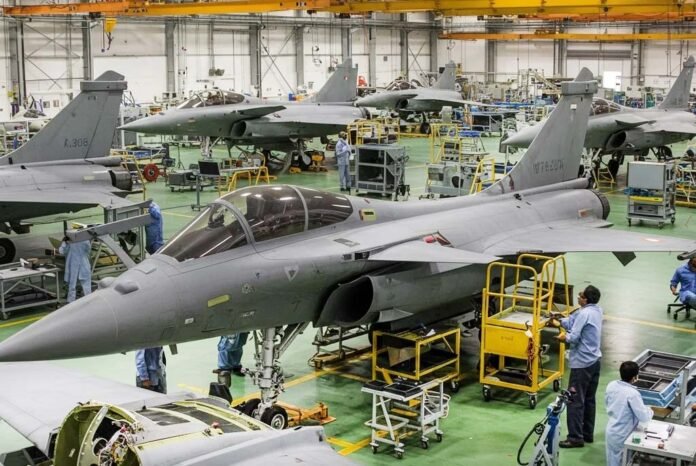
In this interaction, he said India is currently working on a framework that will enable the production of Rafale fighter aircraft in India with a substantial amount of localisation. His comments were a component of a more comprehensive discussion regarding the government’s initiative to enhance indigenous defence production and the proposed procurement of additional fighter aircraft.
The Defence Secretary said that Rafale aircraft would be manufactured outside France for the first time, with significant levels of localisation. He emphasised that India is striving for 40-50% local content and that the agreement would facilitate the integration of Indian systems and munitions.

India is not just buying aircraft; rather, it is attempting to integrate production capabilities into its domestic industrial ecosystem. This statement is indicative of a distinct policy direction.
A Historic Development in Fighter Production
In the past, the aircraft has been assembled in France, and consumers have received the completed jets. The move to produce the jets in India marks a new era of trust and collaboration between France and India, and it emphasises India’s expanded role as a defence manufacturing partner rather than just a consumer.
India’s overarching objective is to transform itself into a key aerospace manufacturing centre and decrease its dependence on imports for essential military equipment. This announcement is consistent with this objective.
Technology Integration and Localisation
The Defence Secretary’s emphasis on localisation is of particular significance. Indian companies will be required to engage in the manufacturing of components, the assembly of aircraft, and the support of maintenance and enhancements in order to achieve a significant portion of local content.

Defence Secretary Rajesh Kumar Singh says Rafale would be manufactured outside France for the first time, with significant localisation. India is striving for 40-50% local content and the integration of Indian systems and munitions. India is not just buying aircraft; rather, it is attempting to integrate production capabilities into its domestic industrial ecosystem
The potential for the integration of indigenous avionics and armaments is equally significant. By incorporating domestic systems with greater flexibility, the armed forces would be able to customise their capabilities in accordance with changing requirements without relying on external approvals in an excessive manner, thereby enhancing operational independence.
This approach also contributes to the development of technical expertise in India, allowing engineers and technicians to acquire experience with advanced aerospace technologies.

Enhancing India’s Air Force
The plan to produce Rafales domestically is inextricably attached to India’s requirement to enhance its air combat capabilities. The Indian Air Force has long run into obstacles associated with the retirement of ageing aircraft, which resulted in a decrease in the number of squadrons. The expansion of the Rafale fleet is perceived as a means of preserving a credible deterrent and guaranteeing readiness in a multifaceted regional security environment.
Rafale’s multirole capabilities, electronic warfare systems, and sophisticated radar make it well-suited for both defensive and offensive missions, such as maritime operations, precision strikes, and air superiority.
By facilitating faster maintenance and support, the aircraft availability rate could be enhanced, and supply chains could be shortened by producing them locally.
The economic benefits of domestically manufacturing a sophisticated fighter aircraft are substantial. Investment in infrastructure and supply chains would stimulate broader economic activity, while high-skill employment in engineering, manufacturing, and research would be created
Infrastructure and Industrial Ecosystem
India has a developing aerospace manufacturing base that is capable of sustaining such a programme. The foundation for more extensive industrial involvement has been established by existing facilities and partnerships with international aerospace firms. The domestic ecosystem would be significantly strengthened by the expansion of these capabilities to encompass the final assembly or main subassembly of Rafales.
The expansion of ancillary industries that provide precision components, electronics, materials, and specialised services would be facilitated by local production. This can result in a more resilient defence industrial base that is capable of sustaining other advanced programmes over time.
Economic and Technological Advantages
The economic benefits of domestically manufacturing a sophisticated fighter aircraft are substantial. Investment in infrastructure and supply chains would stimulate broader economic activity, while high-skill employment in engineering, manufacturing, and research would be created.
Participation in Rafale production can expedite the acquisition of knowledge in areas such as advanced composites, avionics integration, quality assurance, and systems engineering from a technological standpoint. These capabilities are valuable not only for defence but also for civil aerospace and high-technology industries.
The programme could also assist India in its long-term objectives to develop indigenous engine technologies and next-generation combat aircraft.
Although the programme is promising, its implementation will necessitate meticulous planning and a steadfast dedication. Establishing supply chains, negotiating technology transfer agreements, and guaranteeing compliance with rigorous quality standards are intricate responsibilities
Diplomatic and Strategic Aspects
The Defence Secretary’s statement highlights the depth of India’s strategic partnership with France. Over the years, the two nations have consistently increased their defence cooperation, which now includes joint exercises, technology collaboration, and significant procurement programmes.
This relationship would be further solidified, and confidence in the sharing of sophisticated capabilities would be demonstrated through the local manufacturing of Rafales. In addition, it is indicative of a more generalised trend in which India is prioritising domestic production while diversifying its defence partnerships.
Challenges in Implementation
Although the programme is promising, its implementation will necessitate meticulous planning and a steadfast dedication. Establishing supply chains, negotiating technology transfer agreements, and guaranteeing compliance with rigorous quality standards are intricate responsibilities.
Coordination among government agencies, industry partners, and foreign collaborators will be indispensable to ensure that workforce training and infrastructure development remain in sync with programme requirements. It will also be crucial to manage costs and timelines to preserve the support of the public and institutions.
The Defence Secretary emphasises a transformation in India’s defence strategy. The production of Rafales in India will not only improve military capabilities but also serve as an indicator of the nation’s industrial potential. It signifies a transition from transactional procurement to capability development
A Step Towards Self-Reliance
The Defence Secretary’s statement emphasises a more extensive transformation in India’s defence strategy. A desire for greater strategic autonomy and resilience is evident in the transition from import dependence to domestic production.
Not only would the production of Rafales in India improve military capabilities, but it would also serve as an indicator of the nation’s industrial potential. It signifies a transition from transactional procurement to capability development, with long-term advantages for technological development and national security.
Looking Ahead
The likelihood of Rafale production in India is one of the most important events in the country’s defence sector in recent years as discussions progress and agreements take shape. The Defence Secretary’s statement has set expectations for a programme that could significantly alter India’s aerospace landscape.
The initiative could serve as a model for future collaborations by integrating domestic innovation with international expertise, provided that it is effectively implemented. It demonstrates the potential for strategic partnerships to support both industrial growth and operational requirements, thereby establishing India as a significant participant in the global aerospace manufacturing industry.

The writer is the Publisher of Frontier India and the author of the book Foxtrot to Arihant: The Story of Indian Navy’s Submarine Arm.
