
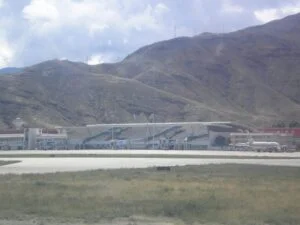
New Delhi: Amid Sino-Indian tension along the Ladakh-China border, China is enhancing its military capabilities at the Lhasa Gonggar airport renovating the surface-to-air missile (SAM) facilities and setting up hardened shelters for fighter jets and combat helicopters in addition to making a third airstrip, satellite images suggest.
The airport is used for military as well as civilian purposes.

Recent satellite images show how the facilities at the airport are being upgraded for use of air force amid the India-China tussle at the Line of Actual Control in Ladakh. The standoff started early May and the deadlock continues.
After India inducted special delivery of Rafales at Ambala Air Force Station, China started additional deployment of H-6 bombers and J-20 stealth fighters along with Y-20 strategic transporters opposite India.
The latest satellite images of Lhasa Gonggar dual-use airport indicate a flurry of activities to upgrade the airbase in every facet. The airport is 200 km from the Arunachal border and 250 km from the Sikkim border.
Although talks on disengagement have been taking place at the military and diplomatic level, China continues ramping up its military facilities.

Satellite images from August 27 indicate very hectic activity at the eastern end of the airbase.
There are almost 12 shelters, possibly for combat helicopters along with almost 24 hardened aircraft shelters for fighter aircraft.

Some new platforms for helicopter parking have also been observed.
The completion of these facilities will make it a complete airbase for more than a regiment of PLA Air Force (PLAAF).
The PLAAF had a surface-to-air missile location prepared over the last decade. The site had first HQ-2 SAMs deployed.
However, later it was changed to HQ-9 with support radars at the location itself.
Latest satellite imagery shows hurried renovation being undertaken at this site.
The SAMs have been shifted temporarily until completion of construction to south of the airbase on a parking apron created away from the airport.
A new road is being constructed to reach the mountain top probably for a new radar site to be built there.
The PLAAF possibly needs faster scrambling of its aircraft located at this airbase. The latest satellite images also show some clearing activities north of the second airstrip.
With this new airstrip, China’s PLAAF will be able to take off four fighters or two transporters/airborne early warning aircraft at the same time.
The recent developments at Gonggar airport indicate China’s aggressive military planning threatening a change in the status quo all along the Indian borders.
The Chinese aviation authorities have begun the construction of a large new passenger terminal and a cargo terminal at the western end of the airport.
After completion of the terminals, the Gonggar airport will be able to cater to almost nine million passengers. The Gonggar cargo terminal will have a capacity of 80,000 tonnes once complete.