

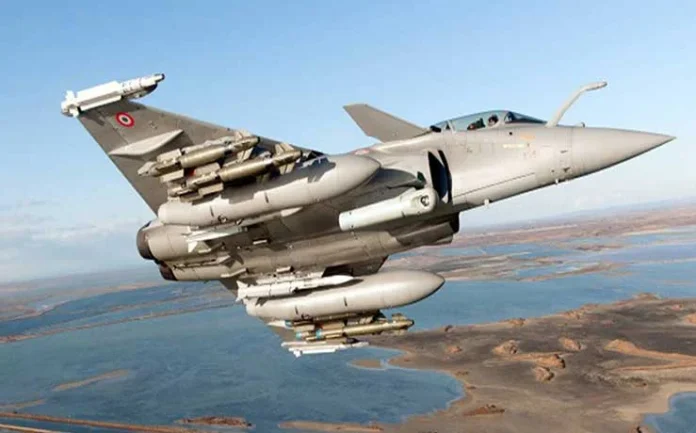
just days before French President Emmanuel Macron’s scheduled visit to India to attend a summit on artificial intelligence, the Indian Ministry of Defence (MoD) announced a slew of decisions worth ₹3.60 lakh crore, including the purchase of 114 Rafale-M aircrafts.
The procurement of MRFAs, the ministry said, will enhance capability in undertaking air dominance roles across the spectrum of conflict and significantly boost the deterrence powers of the IAF with long-range offensive strikes.

The majority of the Rafale aircraft being ordered will be manufactured in India, the ministry said. It, however, did not specify the number of Rafales being purchased but sources said it would be 114, with 90 to be manufactured in India and the rest likely to be procured in fly-away condition to meet the air force’s immediate operational needs.
Just days before French President Emmanuel Macron’s scheduled visit to India to attend a summit on artificial intelligence, the Indian Ministry of defence (MoD) has announced a slew of decisions worth ₹3.60 lakh crore, including the purchase of 114 Rafale-M aircrafts
Rafale’s Performance
The Indian Air Force (IAF) already operates 36 Rafale jets. The deal was mired in controversy when Prime Minister Narendra Modi announced it during his April 2015 visit to France.
As per the latest decision, India will purchase 18 off-the-shelf Rafales from French manufacturer Dassault Aviation, while the remaining 96 fighter jets will be made in partnership with private sector companies in India. A number of these jets would be twin-seater aircraft to be used for training.
As per the latest decision, India will purchase 18 off-the-shelf Rafales from French manufacturer Dassault Aviation, while the remaining 96 fighter jets will be made in partnership with private sector companies in India. A number of these jets would be twin-seater aircraft to be used for training.
With the retirement of the MiG-21 last year, the IAF’s fighter squadron strength has depleted to 29 against the sanctioned strength of 42, the lowest since the 1960s. A squadron of fighters in the IAF has between 16 and 20 aircraft. The IAF chief has bemoaned this fact several times, yet no concrete step has been taken in this regard.

Meanwhile, an internal assessment following Operation Sindoor, indicated that the IAF may need to field more than the authorised number of squadrons to meet future challenges.
The Defence Acquisition Council (DAC) considering induction timelines, life-cycle cost, techno-industrial fit and the IAF’s urgent operational needs, recommended expanding Rafale numbers. Additional Rafales would bring substantial operational, commercial, and logistical benefits through commonality with existing fleets. With Maintenance, Repair and Overhaul (MRO) facilities already offered by Dassault Aviation, further induction would lower overall costs and help rationalise the IAF’s diverse fighter inventory, reducing sustainment burden and improving availability.

Although described as multirole, Rafale is essentially an omni-role aircraft, capable of striking targets, conducting air combat, and gathering intelligence within a single mission profile, without requiring reconfiguration between roles. The aircraft has been operationally proven in conflicts from Syria, Mali, and Libya to Operation Sindoor in the Indian context. On its part, Dassault has continuously upgraded Rafale from the F3 variant supplied to India to the F5 variant now being offered, and integration of Indian weapons is envisaged in the forthcoming deal.
Reportedly, Sweden’s SAAB has proposed to the GoI the creation of the world’s most advanced aerospace ecosystem, comprising multi-layered design, production, and maintenance as well as induction of fighter jet Gripen E, according to Mikael Franzen, Chief Marketing Officer, Gripen
The Rafale MRFA deal is thus a genuine win-win for the IAF and its combat potential. Interoperability with existing IAF and Indian Navy Rafales will enable seamless integration into the IAF’s operational network and significantly enhance national air power. At the same time, the IAF still requires the LCA and AMCA to restore numbers and maintain a qualitative edge. With Tejas Mk1A production underway and development of Tejas MkII and AMCA in progress, India’s aerospace ecosystem is slowly inching towards its goal.
Strategy for the future
Even before the Rafale deal was announced there were overtures from other global fighter jet manufacturers. The manner in which they started courting the Government of India (GoI) shows the financial clout and ability as a major buyer for India, both of which could be utilised by the GoI in its favour for big ticket purchases.
Reportedly, Sweden’s SAAB has proposed to GoI the creation of the world’s most advanced aerospace ecosystem, comprising multi-layered design, production, and maintenance as well as induction of fighter jet Gripen E, according to Mikael Franzen, Chief Marketing Officer, Gripen, and Vice President of Business Area Aeronautics at the Swedish group.
“The highest availability of any fighter gives an unrivalled combat mass to counter any adversary. Gripen will fit perfectly in IAF together with Rafale and Tejas,” Franzen told PTI at the Singapore Airshow, earlier this month.
While the IAF operates Rafale and Tejas fighters, there is a large space for a game changer like Gripen E, at two levels: First, a fighter than can be inducted quickly and in large numbers; second, a technology powerhouse that has already solved the recipe for constant updating, upgrading and incorporation of the latest technology to become the masters of Net Centric Warfare, Electronic Warfare and Kill Chain
Gripen is the only fighter aircraft with the ability not only to incorporate new technology without significant fleet downtime due to its ability to rapidly qualify and certify new software. Gripen provides air forces unique capability to build, qualify, incorporate, and certify their own software without the involvement of the manufacturer, said Franzen.
“Saab would be making the biggest transfer of technology and capability in the history of defence aviation, engaging with 300+ of tier 1,2 and 3 companies including MSMEs. The infusion of industrial capabilities and new technologies make Gripen a potential stepping stone to bolster India’s indigenous fighter projects such as AMCA,” underscored the Swedish business executive.
At the core of Saab’s India proposition is to deliver aircraft quickly – as soon as the third year from contract. This would be followed by a steep capacity ramp-up to enable the IAF to multiply its fleet options, he said.
This approach may empower the IAF to incorporate customised national software and AI in the highly agile platforms at the core of Gripen avionics, which could be rapidly scaled up as greater processing power and AI evolves, said Franzen.
Meanwhile, the French engine maker Safran is ready to build an engine assembly line in India to meet the country’s requirements for local production as the French and Indian governments discuss the purchase of 114 more Rafale jets, its CEO said, last week.
Additionally, the Rafale MRFA acquisition promises a significant IAF capability enhancement within a relatively short timeframe as inductions progress over the next few years. The government’s insistence that 60 per cent of production value be realised domestically will also give a major boost to the indigenous aerospace and defence industry.
New Buying Model
While the IAF operates Rafale and Tejas fighters, there is a large space for a game changer like Gripen E, at two levels: First, as a fighter which could be inducted quickly and in large numbers; second, a technology powerhouse that has already provedcconstant updating, upgrading and incorporation of the latest technology to become the masters of Net Centric Warfare, Electronic Warfare and Kill Chain, Franzen highlighted.
SAAB’s offer will create a backbone of future aircraft, bringing capability which is currently well outside the envelope of any fighter aircraft. This also points to the future strategy which should be adopted by the GoI, buy additional Rafale for quickly fulfilling the jet shortfall for the IAF and in addition expand its fleet by induction of Gripen E, which will ensure critical technological inputs for both the Tejas MkII and AMCA projects, and also fulfill its Aatmanirbhar Bharat commitments
Apparently, Gripen E not only ticks all the boxes with its rapidly increasing AI capabilities, it has already put it well ahead of every other fighter aircraft. It is the most modern and cost-effective fighter jet system on the market and could significantly improve air power of the IAF, with world leading sensor and networking capability.
To sum up, what is different in SAAB offer is an aircraft that will not only fly far into the future, but will also add to the ‘Make in India’ mission creating a backbone of future aircraft, bringing capability which is currently well outside the envelope of any fighter aircraft.
This also outlines a potential future strategy which should be adopted by the GoI. In addition to buying additional Rafale for quickly fulfilling the IAF’s strength, GOI should also consider expanding the IAF’s fleet by induction of Gripen E, which may ensure critical technological inputs for both the Tejas MkII and AMCA projects, besides fulfill its Aatmanirbhar Bharat commitments, and evolving a new buying strategy bolstering the Indian might and air power.

-The writer is a New Delhi-based senior commentator on international and strategic affairs, environmental issues, an interfaith practitioner, and a media consultant. The views expressed are personal and do not necessarily carry the views of Raksha Anirveda
