

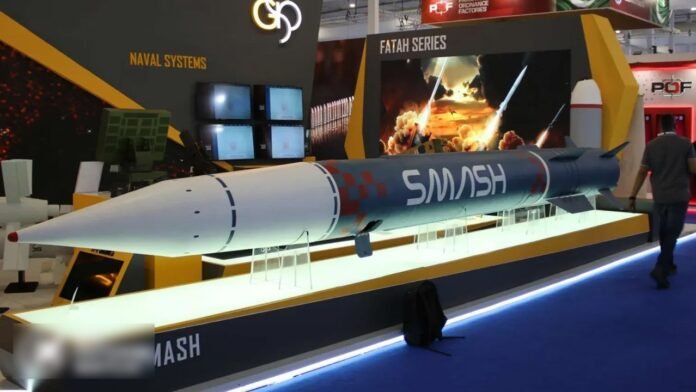
Tel Aviv: Israel is following any weapon system developed in a country that might export it to enemy countries like Iran. A new missile developed in Pakistan was part of the Pakistani display in the Saudi defence exhibition.
Israeli experts have analysed the SMASH missile and shared the details with Raksha Anirveda.

The SMASH missile, developed by Pakistan’s GIDS (Global Industrial Defence Solutions) for the Navy, is a dual mission anti-ship and land attack ballistic missile. It was first test-fired from a naval platform in November 2024, with a second successful flight on November 25, 2025. The missile shares similarities with the Pakistani Fatah-II ballistic missile. While Pakistani authorities have labelled it hypersonic, Western observers classify it as an ASBM.
The missile is a single stage, unified missile. No data of weight is available, estimations: up to 7.5 tons. The missile is 9 metre long and has a diameter of 0.85 to 0.9 metre.
According to the experts, the primary mission of the missile is Ship-launched anti-ship ballistic missile (ASBM). The missile is powered by a single-stage solid rocket motor with 2 thrust levels.
The missile trajectory is quasi-ballistic along with complex manoeuvres at the endgame. Impact speed – over 680 m/s.

The experts assess that the missile has a 350-kilometre range. The next model SMASH 2 will have a range of 800 km and even beyond. The missile is armed with a 384 kilograms maritime unitary blast and blast-fragmentation. Navigation of the missile is made by a High-Precision Image Aided Inertial Navigation (HDGNS) which is a combined IMU with GNSS receiver based on Chinese origin.
For the endgame, the missile uses an X band RF seeker. The missile’s CEP is estimated to be between 10 and 15 metres.

The SMASH system, according to the experts, is central to Pakistan’s approach for improving anti-access/area-denial (A2/AD) operations in the Indian Ocean, aiming to deter adversary fleets.

-The writer is an Israel-based freelance journalist. The views expressed are of the writer and do not necessarily reflect the views of Raksha Anirveda
