

Tel Aviv: Detection and verification – these are the two critical capabilities that will make the systems developed to deal with the dramatically fast growing threat of armed drones, capable. Both capabilities still need a lot of improvement.
As if to prove the urgently needed solution, on April 1, an armed drone launched from Iraq hit the Israeli navy base in Eliat on the Red Sea. The explosion caused damage to a building in the base. The problem is very clear on in the border zone between Israel and Lebanon. Almost every day armed drones operated by the Hezbollah manage to enter the Israeli air space and in many cases cause damage and casualties.

The Israeli defence companies were among the first to develop anti-drone systems. But since the war started on October 7, what happens over northern Israel proves that while these systems combine the most advanced technologies they are not capable of protecting the air space of a country in a war.
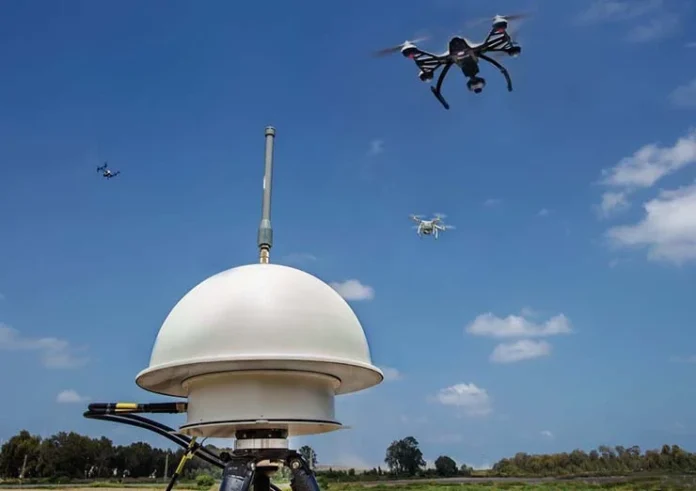
In late March, Elbit Systems demonstrated its ReDrone anti-drone system in a testing ground in the eastern part of the country. Potential customers saw some interception scenarios.
According to the Israeli company, the ReDrone features multi-layered protection against drone threats. The system uses some soft kill measures like jamming/take-over and by hard-kill measures such as projectiles and missiles.
The company officials said that the interest in the systems has reached an all-time peak. “Recent developments in drones being used in a war has increase the interest in our advanced system,” one of them said.

In the demonstration, the system proved its capability to protect from fixed wing and multi-rotor drones. But the demonstration was performed in ideal conditions namely with a line of sight between the drone’s take-off point and the system’s sensors.
A senior Israeli expert who talked with Raksha Anirveda on condition of anonymity said that the main problem, when there is no line of sight throughout the drone’s flight, is to detect and identify it as a threat. “In the mountainous area in the border zone with Lebanon such a line of sight does not exist.”

The expert added that if the identification is not positive, anti-drone systems are a real threat to the manned and unmanned aerial platforms operated by the defending side.
“The currently used systems do not have these capabilities, especially when they have to protect a long border zone,” the expert added.

-The writer is an Israel-based freelance journalist. The views expressed are of the writer and do not necessarily reflect the views of Raksha Anirveda
