
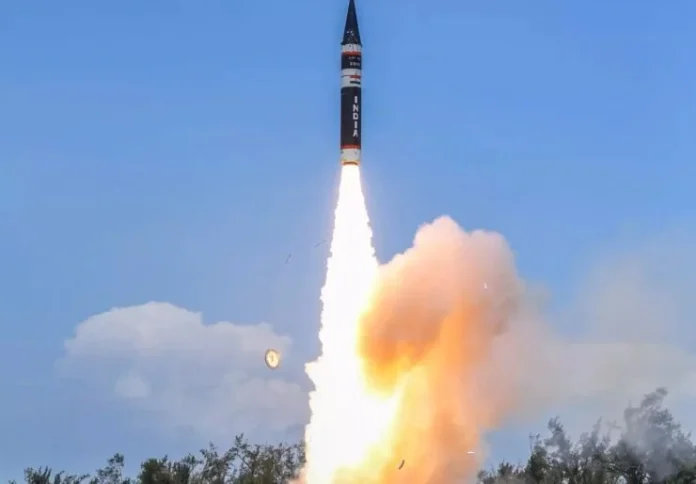
New Delhi: In a significant boost to India’s military capabilities, the Intermediate Range Ballistic Missile (IRBM) Agni-4 was successfully tested on June 6 from the APJ Abdul Kalam Island in Odisha.
The defence ministry in a brief statement said the test was carried out at around 7:30 pm. The successful test was part of routine user training launches carried out under the aegis of the Strategic Forces Command, it stated.

The ministry said the successful test of Agni-4 reaffirms India’s policy of having a “credible minimum deterrence” capability and the launch validated all operational parameters as also the reliability of the system.
The Agni-4 missile has a range of over 3,500 km and is one of many in the Agni series of strategic missiles.
The test comes amidst the continuing military confrontation with China in eastern Ladakh, which has entered its third year now without showing any signs of de-escalation in the high-altitude region.
The tri-Service SFC already has the Prithvi-II (350-km), Agni-I (700-km), Agni-II (2,000-km), Agni-III (3,000-km) and Agni-IV missile units, while the induction of the country’s first intercontinental ballistic missile Agni-V (over 5,000-km) is currently in an advanced stage.

The road-mobile Agni-IV and Agni-V are primarily meant for deterrence against China, which can target any Indian city with its formidable inventory of long-range missiles. The Agni-V brings the northernmost part of China within its strike envelope. The shorter range Agni missiles, in turn, are designed for Pakistan.
DRDO is also working towards “manoeuvring warheads or intelligent re-entry vehicles” to defeat enemy ballistic missile defence systems as well as MIRVs (multiple independently targetable re-entry vehicles) for the Agni missiles.

An MIRV payload basically means a single missile capable of carrying several nuclear warheads, each programmed to hit different targets. The SFC has also conducted a “user launch” of the three-stage solid fuelled Agni-V missile in October last year.
India has also for long modified some Sukhoi-30MKI, Mirage-2000 and Jaguar fighters to deliver nuclear gravity bombs. The new French-origin Rafale fighters inducted by the IAF are also capable of doing it.
The third leg of India’s nuclear triad is, however, still far away from becoming robust, represented as it is by the solitary nuclear ballistic missile submarine (SSBN) INS Arihant armed with only 750-km range K-15 missiles as of now.
Countries like the US, Russia and China have SSBNs with well over 5,000-km range submarine-launched ballistic missiles (SLBMs). India has three more SSBNs under development, with INS Arighat now slated for commissioning this year after some delay. The K-4 missiles, with a strike range of 3,500-km, in turn, will take at least one more year to be ready for induction.