

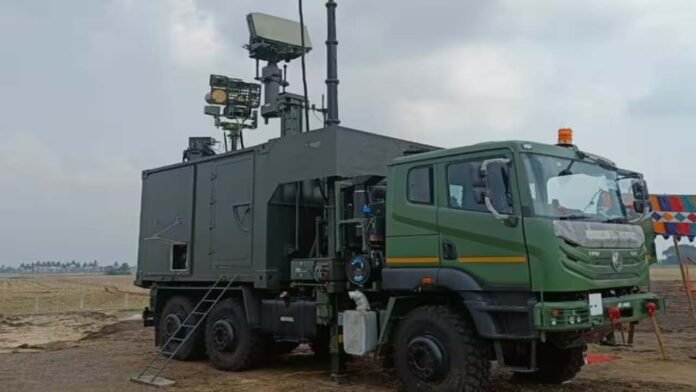
New Delhi: India’s naval expansion has reached a pivotal juncture with the formal induction of the indigenous D4 Anti-Drone Shield, developed by the Defence Research and Development Organisation (DRDO) and manufactured by Bharat Electronics Limited (BEL).
This counter-unmanned aerial system (CUAS), dubbed “Drone Detect, Deter, and Destroy,” embodies New Delhi’s “Make in India” ambitions amid escalating regional tensions.

The system’s rapid deployment underscores a strategic pivot towards advanced electronic warfare capabilities. Framed by Indian officials as a triumph of self-reliance, the D4 integrates multi-sensor fusion for comprehensive 360-degree surveillance, leveraging active phased-array radars, radio frequency (RF) sensors, and electro-optical/infrared (EO/IR) trackers.
At its core, the D4 employs a layered response protocol. Detection occurs through real-time scanning of drone signatures, followed by soft-kill measures such as GPS spoofing and high-power electronic jamming to disrupt command links. For hardened threats, it escalates to hard-kill options, including directed energy weapons (DEWs) like high-energy lasers capable of neutralising targets at ranges exceeding several kilometres.
This induction follows heightened hostilities, particularly the high-altitude skirmishes of 2025, retrospectively labelled “Operation Sindoor” in Indian discourse. Deployments are now prioritised at key naval dockyards, coastal installations, and forward bases along the North Arabian Sea frontier, enhancing protection against low-cost, asymmetric drone incursions.
From a Pakistani vantage, the D4 represents not merely technological prowess but a provocative escalation. Islamabad’s analysts interpret it as India’s bid to counter the proliferation of unmanned systems, validating the efficacy of Pakistan’s own indigenous platforms, including long-range loitering munitions like the Mudamir-LR and unmanned surface vessels (USVs).

Pakistan’s naval doctrine has increasingly emphasised asymmetry, prioritising agile, cost-effective unmanned technologies over symmetric arms build-ups. Developments such as swarming USVs and kamikaze drones offer reconnaissance, strike, and saturation capabilities, challenging conventional defences without matching India’s resource-intensive investments.
The D4’s laser-based hard-kill component introduces directed energy weapons into South Asia’s maritime domain, a domain historically dominated by ballistic missiles and submarines. These systems promise precision intercepts with minimal collateral damage, operating silently and with near-infinite “ammunition” limited only by power supply.

DEWs demand stable power sources and clear atmospheric conditions, potentially faltering in monsoonal weather or cluttered electromagnetic environments prevalent in the Arabian Sea. Jamming arrays, while potent, risk spectrum saturation, inadvertently aiding adversaries with frequency-hopping drones.
Regionally, this move amplifies the drone arms race. China’s exports of affordable UAVs to Pakistan, coupled with India’s acquisitions from Israel and indigenous scaling, have transformed reconnaissance and precision strikes into routine tools. The 2025 tensions exposed gaps, prompting both sides to refine countermeasure suites.
India’s acceleration aligns with broader modernisation under the Aatmanirbhar Bharat framework. BEL’s production ramp-up signals serial manufacturing, with variants eyed for army and air force integration. Export potential looms, positioning the D4 as a marketable asset in global counter-UAS markets dominated by US and Israeli firms.
Pakistan’s response strategy hinges on innovation and alliances. Enhanced integration of AI-driven autonomy in USVs reduces vulnerability to jamming, while partnerships with Turkey for Bayraktar derivatives bolster aerial inventories. Doctrine shifts towards networked swarms aim to overwhelm layered defences like the D4.
The implications for regional stability are profound. By lowering engagement thresholds with automated intercepts, India risks miscalculation spirals, where a single rogue drone triggers kinetic responses. This mirrors global trends, from Ukraine’s drone saturation to Red Sea shipping disruptions.
India’s D4, though indigenous, entails substantial R&D outlays, straining defence budgets amid competing priorities like carrier strike groups and nuclear submarines. Pakistan’s leaner approach leverages commercial-off-the-shelf components, preserving fiscal agility.
Technological overreach or strategic necessity? For New Delhi, the D4 fortifies deterrence against hybrid threats from multiple fronts. Further, it underscores a paradox: countermeasures beget counter-countermeasures, perpetuating an innovation spiral that erodes stability.
Islamabad must calibrate its reply judiciously. Bolstering electronic warfare resilience, pursuing hypersonic decoys, and diplomatic advocacy for drone non-proliferation norms offer balanced paths. Unchecked escalation could destabilise the subcontinent’s fragile equilibrium.
The arms race in the skies is no longer a future prospect; it is the current reality of the subcontinent. As unmanned systems redefine warfare’s asymmetry, both powers must navigate this domain with prudence to avert unintended conflict.

