

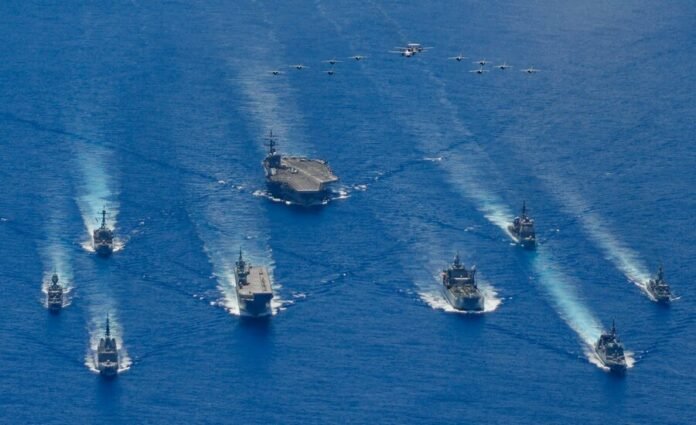
For India, the world’s 4th economic power, the security and stability of the Indian Ocean is essential for its own strategic interest. Stretching from Africa’s eastern coast to Australia’s western coast, the Indian Ocean is the key conduit of global trade.
According to Brookings, every day, 36 million barrels of oil are shipped through the Indian Ocean — equivalent to about 40% of the world’s oil supply and 64% of oil trade. Besides, one-third of bulk cargoes pass through it, thereby making the world’s third-largest ocean a significant lifeline of the region.

In this context, naval diplomacy has assumed a vital role, as on the one hand, it helps in building bridges of friendship and strengthening international cooperation, on the other hand, it signals capability and intent to deter potential adversaries. But in the case of Sri Lanka, India’s objective was to strengthen bridges of friendship when its three naval ships — Landing Craft Utility platforms such as LCU51, LCU 54 and LCU 57 made a port call at Colombo from November 22 to 25.
Growing Bond with Sri Lankan Navy
Amid rapidly changing international geopolitics, India’s effort to strengthen bilateral naval engagement with Sri Lanka assumes high significance. The port call by three Indian naval ships at Colombo marked a commitment in New Delhi’s move to inject dynamism in the longstanding tradition of friendship, mutual respect, and cooperation between the navies of the two nations.
Writing in his book, ‘Navies and Foreign Policy’, Ken Booth, a British international theorist, argues that the navy is often deployed by countries to engage in political or diplomatic activities, such as to foster cooperation with other navies and enhance collaboration through increasing interoperability.
This enables a nation to build synergy in key areas of common interest. It is evidently clear in the two navies’ regular cooperation in intelligence-driven interception of drugs like methamphetamine, often being pushed by Pakistani trafficking networks from its Makran coast.

India’s effort to strengthen bilateral naval engagement with Sri Lanka assumes high significance. The port call by three Indian naval ships at Colombo marked a commitment in New Delhi’s move to inject dynamism in the longstanding tradition of friendship, mutual respect, and cooperation between the navies of the two nations
In November last year, approximately 500 kg of crystal meth was seized in the Arabian Sea following a coordinated operation between the Indian and Sri Lankan navies. If experts are to be believed, Indian and Sri Lankan navies today share a strong and well-established bond, and this has evolved steadily over time rather than emerging overnight.
Besides joint exercises and coordinated patrols, the Indian Navy provides training to the Sri Lankan Navy. This includes training for maritime interdiction, technical support for vessel tracking, exchange on boarding procedures and assistance during major operations.

Capacity Building: Core Pillar of India’s Naval Diplomacy
In fact, capacity building has become a core pillar of India’s defence diplomacy across the world. It is clearer with the Gulf countries. In 2024, 76 cadets from the King Fahad Naval Academy in Saudi Arabia were trained at Kochi under the Southern Naval Command.
Earlier this year, the two countries held their first Navy-to-Navy Staff Talks. On August 27-28, as part of naval exchanges, INS Tamal, a multi-role frigate, and Surat, a guided missile destroyer, visited Jeddah Port. The first India-Saudi Arabia joint naval exercise, Al-Mohed Al-Hindi, was held in August 2021 and the second in 2023.
Yet, what is imparting thrust to India’s ongoing naval diplomacy is New Delhi’s ability to invest warmth and cordiality in all its engagements with Gulf countries. For example, at the 13th India-UAE Joint Defence Cooperation Committee meeting held this year in July in New Delhi, UAE’s Under Secretary of Defence, Lt General Ibrahim Nasser M Al Alawi, who headed the high-level defence delegation, pitched for customised training courses tailored to the country’s naval needs.
The Indian Navy has never been at odds with its partners; it has always been open to sharing its expertise and learning from others. This was seen during the just concluded visit of India’s Chief of Defence Staff General Anil Chauhan to Oman, where the two countries reaffirmed their commitment to deepen defence cooperation through strong training engagement, developing a Military Logistic Complex, enhanced collaboration in shipbuilding, maintenance, repair, and overhaul.
In contrast, such bonhomie is missing between the Chinese Navy and the navies of Gulf countries. Despite the fact that China relies heavily on Gulf countries to meet its energy requirements, which increased by 10% up to 11.3 million barrels per day of crude oil supply from 2022 to 2023, Beijing conducts only occasional joint naval exercises with Gulf countries.
In the second half of October, the Chinese PLA Navy and the Royal Saudi Naval Forces (RSNF) conducted joint drills ‘Blue Sword 2025’ in Jubail. It was the third naval drill between the Chinese PLA Navy and the RSNF since 2019, signalling clearly the limited and sporadic nature of their naval cooperation.
Like the Indian Navy, the Chinese PLA Navy has never come forward to patrol waters in the Gulf, even as the region has witnessed turbulence with Houthis in recent years. Last year, the Indian Navy deployed a dozen ships, with two advanced vessels in the Gulf of Aden and at the mouth of the Persian Gulf, following an increase in attacks in the Red Sea — all this to present itself as a reliable regional partner.
In this context, External Affairs Minister Dr S Jaishankar’s remark that “we will not be considered a responsible country when bad things are happening in the surrounding country and we say ‘I have nothing to do with this’,” merits attention. It reflects India’s commitment to shoulder responsibility to protect international trade from any harm and freedom of navigation through strategically vital waterways. This spirit was apparent when INS Kolkata was deployed to safeguard a merchant vessel and its 17 crew members from 35 pirates in the Gulf of Aden in March 2024.
Growing Warmth with African Navies
In the past ten years, the momentum of naval engagement between the Indian Navy and its counterparts from Mozambique, Seychelles, Madagascar, Kenya, Tanzania, and South Africa has increased.
The key factors, which have played a significant role in enhancing cooperation between the two sides, are the increasing maritime security threats such as piracy, drug trafficking, unregulated and unreported fishing in the region and India’s commitment to provide safeguards from such activities through the sharing of information and surveillance and conducting regular exercises.
However, for the first time multilateral maritime engagement exercise with African countries, called ‘Africa-India Key Maritime Engagement’, was held in mid-April 2025. Also known as ‘AIKEYME’, which means unity, the six-day exercise was participated in by India, Tanzania, Kenya, Madagascar, Mauritius, Mozambique, Seychelles, Comoros, Djibouti, Eritrea, and South Africa.
India and Saudi Arabia held their first Navy-to-Navy Staff Talks this year. On August 27-28, as part of naval exchanges, INS Tamal, a multi-role frigate, and INS Surat, a guided missile destroyer, visited Jeddah Port. The first joint naval exercise between both countries, Al-Mohed Al-Hindi, was held in August 2021 and the second in 2023
During the exercise, held in Dar-es-Salam, stress was laid on interoperability, information sharing, combined training among participating navies on handling of piracy, search and rescue operations, small arms firing and helicopter operations.
In March 2019, following the request from Mozambique, the Indian Navy promptly deployed three ships and directed them to Port City of Beira when Cyclone IDAI hit it. Apart from rescuing more than 192 people from the cyclone-affected region, India provided healthcare support to 1,381 people and food aid to approximately 700 people — highlighting the country’s role as a responsible actor in the Indian Ocean Region.
The Indian Navy has always stood by Mozambique and aided it whenever the African country required it. Marking a new chapter in its engagement with Maputo, the Indian Navy’s First Training Squadron, comprising INS Tir, INS Shardul, INS Sujata, and ICGS Sarathi entered the Mozambique Port in September this year. During its visit, the training squadron undertook various joint training activities with the Mozambique Navy, which included cross-training on navigation and communication procedures, diving operations, and training on firefighting and damage control aspects.
With the Kenyan Navy, the Indian Navy is enjoying very warm and friendly relations. Imparting more depth to it, Kenya Navy Commander Maj Gen Paul Owuor Otieno visited New Delhi in September 2025 and held talks with Navy Chief Admiral Dinesh K Tripathy on a wide range of issues, including operational training, hydrographic engagements, the conduct of multilateral ‘Exercise AIKEYME’, and consolidation of the partnership under the India-Kenya ‘BAHARI’ Maritime Vision.
Fulfilling Broader Aspect of Act East Policy
Through its strategic deployments, joint exercises, and diplomatic engagements, the Indian Navy has strengthened its maritime partnership with the navies of Southeast Asia. This year in August, as part of the ongoing operational deployment to South East Asia, the Indian Navy deployed INS Delhi (guided missile destroyer), INS Shakti (fleet tanker), and INS Kiltan (anti-submarine warfare corvette) made their port call at Manila, Philippines.
“The port call to the Philippines marked a significant milestone in strengthening India–India-Philippines maritime partnership. Through high-level diplomacy, operational engagement, cultural exchanges, and community outreach, the Indian Navy reaffirmed its role as a dependable and cooperative maritime partner, committed to promoting peace, stability, and shared progress in the Indo-Pacific,” the Ministry of Defence said.
Earlier in July, INS Delhi, INS Satpura, INS Shakti and INS Kiltan visited Singapore. The visit was part of the Indian Navy’s operational deployment to Southeast Asia, and it helped in strengthening the longstanding friendship and cooperation between the two navies through a series of engagements and activities.
Overall, India’s naval diplomacy in Southeast Asia has emerged as a central pillar of its broader Act East Policy and Indo-Pacific vision. The Indian Navy uses operational presence, capacity-building, and multilateral cooperation to strengthen maritime security and deepen strategic trust with ASEAN and regional powers.
The multilateral maritime exercise called ‘Africa-India Key Maritime Engagement’, was held in mid-April 2025. Also known as ‘AIKEYME’, which means unity, the six-day exercise included participants from India, Tanzania, Kenya, Madagascar, Mauritius, Mozambique, Seychelles, Comoros, Djibouti, Eritrea, and South Africa
Conclusion
India’s expanding naval diplomacy, from Sri Lanka and Southeast Asia to the Gulf and the African littoral, reflects a confident maritime posture suited to its status as a major economic and strategic power.
Yet, what distinguishes India’s approach is not only the scale of its deployments but the quality of its engagement: Persistent presence, capacity-building, humanitarian responsiveness, and respect for partner nations’ sovereignty.
Whether through coordinated anti-drug operations with Sri Lanka, training missions in the Gulf, or multilateral exercises with African navies, New Delhi has consistently demonstrated that it views maritime partnerships as shared investments in regional stability, not instruments of leverage.

–The writer is a senior journalist with wide experience in covering international affairs. The views expressed are of the writer and do not necessarily reflect the views of Raksha Anirveda
