

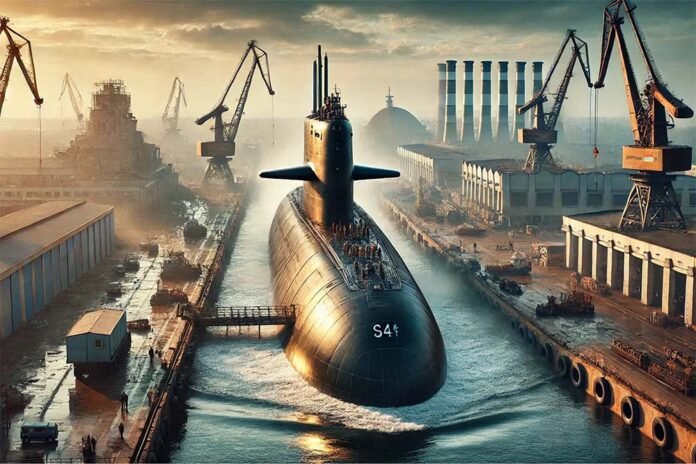
New Delhi: India’s strategic submarine fleet continues to expand with the recent launch of its fourth nuclear-powered ballistic missile submarine, codenamed S4*. This vessel marks a pivotal advancement in the nation’s sea-based nuclear deterrence.
Launched on October 16, 2024 at the Ship Building Centre in Visakhapatnam, the submarine S4* is presently in the fitting-out phase, prior to commencing sea trials.

Unlike its predecessors, the S4* represents a stretched and enhanced design within the Arihant class. It boasts greater dimensions and improved capabilities, allowing for an increased missile payload. This upgrade addresses limitations observed in earlier submarines, positioning the S4* as a more potent platform for extended-range operations.
The submarine’s primary armament comprises the indigenously developed K-4 submarine-launched ballistic missile (SLBM). With a strike range of 3,500 kilometres, the K-4 significantly outpaces the K-15 Sagarika missile, which has a mere 750-kilometre reach and equips the inaugural INS Arihant. The K-4’s vertical launch system enables multiple tubes, enhancing salvo capacity and operational flexibility.
This development underscores India’s commitment to its “Credible Minimum Deterrence” doctrine and “No First Use” policy. A robust sea-based leg ensures a survivable second-strike option, integral to the nuclear triad alongside land and air vectors. The S4*’s stealth and endurance bolster this triad’s resilience against pre-emptive threats.
The broader Advanced Technology Vessel (ATV) programme, shrouded in classification, drives this fleet’s growth. Initiated decades ago with Russian collaboration, it now emphasises indigenous expertise through entities like the Defence Research and Development Organisation (DRDO) and Mazagon Dock Shipbuilders Limited.

INS Arihant (S2), the class lead, entered service in 2016 after extensive trials. Operational since then, it has validated core technologies despite initial constraints on missile loadout. Its deployment patrols vital sea lanes, maintaining continuous deterrence.
The second vessel, INS Arighaat (S3), achieved formal induction in August 2024. It has since demonstrated K-4 compatibility through successful test firings, affirming the platform’s maturity. Arighaat’s entry doubled India’s SSBN strength, amplifying patrol endurance.

INS Aridhaman (S4), the third in line, nears completion. Currently in the final sea trial stages, it is slated for imminent commissioning into the Indian Navy. This progression ensures a steady ramp-up, with Aridhaman mirroring Arighaat’s enhancements over Arihant.
The S4* diverges as a larger hull variant, often termed “Arihant 1.5” in strategic circles. Its expanded beam and length accommodate additional VLS cells, potentially up to 24 K-4 missiles. Such capacity rivals regional peers, fortifying India’s undersea posture amid evolving Indo-Pacific dynamics.
Construction occurs at the secretive Ship Building Centre, a dedicated facility for nuclear submarines. Equipped with 80 MW pressurised water reactors, these vessels achieve over 30 knots submerged speeds. Indigenous fuel fabrication and reactor design minimise foreign reliance.
Challenges persist, including miniaturised propulsion refinement and acoustic stealth. Delays in earlier boats stemmed from welding complexities and missile integration. Yet, recent milestones reflect matured shipbuilding prowess, with private sector inputs accelerating timelines.
Geopolitically, the fleet counters asymmetries with neighbours like China, whose Type 094 Jin-class SSBNs patrol the Indian Ocean. India’s SSBNs ensure mutual deterrence, safeguarding sea lines of communication critical for energy imports.
Future iterations, including the S4* follow-on and S5 class with longer-range K-5 missiles (5,000 km), promise further evolution. These will integrate Agni-VI derivatives, extending reach across continental Asia.
Operational protocols emphasise dual-crew rotations for perpetual deterrence patrols. Integration with P8I maritime patrol aircraft and Project 75(I) conventional submarines forms a layered undersea architecture.
In summary, the S4*’s launch heralds a new deterrence epoch. As fitting-out advances, it will join a maturing fleet, cementing India’s status as a responsible nuclear power with assured retaliatory might from the deep.

