
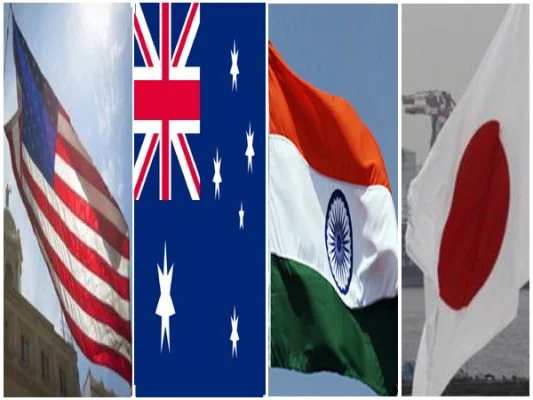
New Delhi: India is increasing relations with other Quad member nations – US, Australia and Japan – in the area of space.

The four countries plan to establish a series of working groups that will focus on climate change; critical and emerging technologies, including working to set technology standards and norms and jointly developing some of the critical technologies of the future, officials said.
The Indian Space Research Organisation (ISRO) last week shipped the S-band Synthetic Aperture Radar (SAR) to US space agency NASA’s Jet Propulsion Laboratory as the joint NASA-ISRO SAR (NISAR) mission moved forward.
NISAR is a joint collaboration for a dual-frequency L and S-band SAR for earth observation.
“NISAR will be the first satellite mission to use two different radar frequencies (L-band and S-band) to measure changes in our planet’s surface less than a centimetre across,” according to NASA (National Aeronautics and Space Administration).

The mission is targeted for launch in 2022 from ISRO’s Sriharikota spaceport in Andhra Pradesh’s Nellore district, about 100 kms north of Chennai.
NASA is providing the mission’s L-band SAR, a high-rate communication subsystem for science data, GPS receivers, a solid-state recorder and payload data subsystem.

ISRO is providing the spacecraft bus, the S-band radar, the launch vehicle and associated launch services for the mission, whose goal is to make global measurements of the causes and consequences of land surface changes using advanced radar imaging.
On March 11, Bengaluru-headquartered ISRO and Japan Aerospace Exploration Agency (JAXA) reviewed the ongoing cooperation in earth observation, lunar cooperation and satellite navigation.
“Both sides have agreed to explore opportunities for cooperation in space situational awareness(SSA) and professional exchange programme,” according to ISRO.
On the occasion, ISRO and JAXA signed an ‘Implementing Arrangement’ for collaborative activities on rice crop area and air quality monitoring, using satellite data”.
ISRO and JAXA have planned a joint mission — Lunar Polar Exploration (LUPEX) — to explore the Moon’s south pole in 2023.
LUPEX received a boost as Japan reportedly earmarked 2.8 billion Yen (US$ 26 million) for it for the fiscal 2021.
In February, ISRO and Australian Space Agency (ASA) inked an Amendment of the ‘2012 India Australia Inter-Governmental MoU for cooperation in Civil Space Science, Technology and Education’.
This Amendment makes India’s Department of Space and ASA as the Executive Organisations and provides scope for other related entities to conclude implementing arrangements for specific cooperation activities.
The two agencies reviewed the status of ongoing cooperation activities in earth observation, satellite navigation, space situational awareness and establishment of transportable terminal in Australia to support India’s ‘Gaganyaan’ programme.
Australia’s Minister for Industry, Science and Technology Karen Andrews had said the new agreement strengthens existing ties between Australia and India and allows the two countries to work closer than ever in space for the benefit of both nations.
Head of the ASA, Enrico Palermo, said the signing symbolises the importance of the strong collaborative partnership between the Agency and ISRO, which will look to identify new areas of cooperation in space technology, applications, education and outreach.
“An ISRO built L- and S-band Airborne SAR (ASAR) was flown over the United States aboard NASA’s aircraft during November – December 2019 and data acquisitions were made in 92 sites.
ASAR repeat flight campaigns are being planned for spring and summer 2021,” according to ISRO.
“Both agencies are working for an implementing arrangement to carry NASA’s Laser Reflectometer Array (LRA) in Chandrayaan-3.
ISRO-NASA Joint Working Group on Human Spaceflight Programme (HSP) is exploring collaboration opportunities”, it said.
ISRO and JAXA are specifically working on sharing earth observation data and to carry out calibration/validation experiments, and establishing ISROs NavIC reference station in Japan.
NavIC refers to the space segment consisting of the IRNSS (Indian Regional Navigation Satellite System) constellation of eight satellites.
Both agencies have completed the feasibility study for the LUPEX and are currently finalising the Phase-A study report, according to ISRO.