

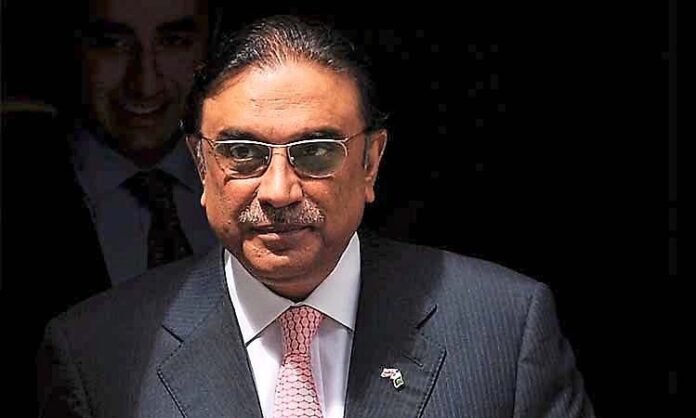
New Delhi: Pakistan’s President Asif Ali Zardari delivered a forthright address to a joint sitting of Parliament, amid vocal protests from opposition members.
Speaking for the ninth time in such a forum since assuming office, he focused on escalating tensions with India, regional security threats, and global conflicts. His remarks underscored Islamabad’s commitment to peace while issuing pointed warnings.

Zardari directly accused Indian leaders of gearing up for another war, a claim he framed as reckless adventurism. As a self-described lifelong advocate for regional peace, he cautioned against such escalation. “India’s leaders say they are preparing for another war. I would not recommend it,” he stated bluntly, urging New Delhi to abandon what he termed a “theatre of war” in favour of meaningful negotiations.
He emphasised Pakistan’s openness to dialogue as the sole pathway to lasting security in South Asia. “My message to them is to move away from the war theatre to meaningful negotiation tables,” Zardari declared. This overture came against a backdrop of strained bilateral ties, exacerbated by recent military skirmishes and diplomatic standoffs.
A major point of contention raised was India’s suspension of the Indus Waters Treaty, which Zardari branded as “plain and simple hydro-terrorism.” He accused New Delhi of weaponising water flows for political leverage, a move that threatens Pakistan’s agricultural lifeline in the Indus basin. This criticism highlights the treaty’s fragility, originally mediated by the World Bank in 1960 to allocate river waters between the two nuclear-armed neighbours.
Zardari also reaffirmed Pakistan’s steadfast diplomatic and moral support for the people of Jammu and Kashmir. He insisted that enduring peace in South Asia remains impossible without resolving the Kashmir dispute, a longstanding flashpoint that has sparked multiple wars and ongoing insurgencies since 1947.

Shifting focus westward, the President highlighted a recent United Nations report on terrorist threats emanating from Afghanistan. The document warns of potential catastrophic attacks on other nations if the issue is ignored, a peril Zardari stressed Pakistan has confronted directly through cross-border militancy.
Pakistan, he asserted, has exhausted diplomatic avenues to curb military escalation over such activities. “Let me be clear: the soil of Pakistan is sacred,” Zardari proclaimed. He vowed not to tolerate any domestic or foreign entity using neighbouring territory to undermine national stability.

Zardari levelled sharp criticism at Afghanistan’s de facto Taliban government for failing to uphold Doha agreement commitments. These pledges aimed to prevent militant groups from operating from Afghan soil, yet he charged Kabul with allowing safe havens that fuel regional instability. He called on Afghan authorities to dismantle these networks and prevent their country from becoming a proxy battleground.
On the global stage, Zardari condemned the intensifying conflict in the Middle East, expressing deep condolences for the killing of Iranian Supreme Leader Ayatollah Ali Khamenei. He denounced attacks on Gulf states including the UAE, Bahrain, Jordan, Kuwait, Qatar, and Saudi Arabia, portraying them as assaults on regional stability.
Pakistan’s position on Palestine remained unequivocal. Zardari reiterated support for an independent Palestinian state based on pre-1967 borders, with Al-Quds Al Sharif (Jerusalem) as its capital—a stance aligned with longstanding Islamabad policy amid the broader Israel-Palestine crisis.
The address was marred by disruptions from opposition Pakistan Tehreek-e-Insaf (PTI) members, who chanted slogans demanding the release of their jailed leader, former Prime Minister Imran Khan. These interruptions underscored domestic political divisions, even as Zardari pressed his foreign policy agenda.
Zardari’s speech blended defensive posturing on India and Afghanistan with appeals for dialogue and solidarity on global issues. It signals Pakistan’s intent to navigate a volatile neighbourhood through diplomacy, while rallying domestic support amid internal challenges.

