

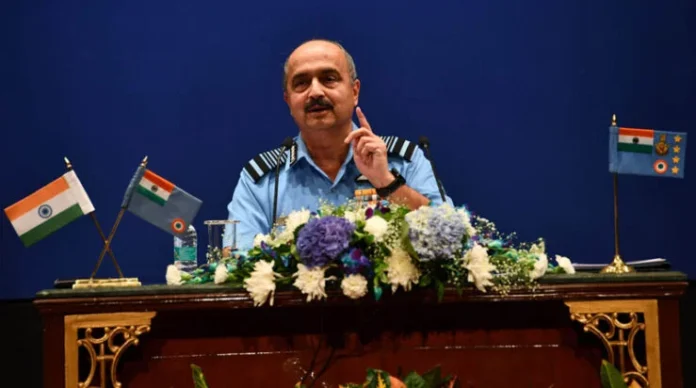
New Delhi: In light of the ongoing conflict in West Asia, ex-IAF Chief Air Chief Marshal V R Chaudhari underscored the necessity for India to bolster its air defence capabilities. He stressed the critical need for more advanced weapon systems, radars, and a robust integration of various operational capabilities.
While discussing the increasing use of drones in modern warfare, as seen in Ukraine and West Asia, Chaudhari warned against relying solely on these unmanned systems, emphasising that they should enhance but not replace existing military efforts.

The former air chief’s remarks came during a national conclave hosted by Synergia Foundation in New Delhi, where defence and strategic affairs experts convened to explore the implications of the West Asia conflict, highlighting its potential to inform India’s future military strategy.
“Drones are going to play a ‘huge role’ in any forthcoming future conflict that we can envisage,” the former IAF chief said, and that “In order to strengthen India’s air defence, we need to have more weapon systems, more radars, more integration of the systems, integration of the cyber capabilities, and conjoin all together”.
In the background of the continuing war in West Asia, Chaudhari said that the first takeaway for India from this war is the necessity to build a “very strong air defence” system.
Cmdr Chaudhari also referred to the use of drones in the conflicts in Ukraine and in West Asia, and said they are going to play a huge role in any future conflict, even as he cautioned that right now “we should not place all our bets just on drones”.

Chaudhari delivered the keynote address at the conference on the theme ‘India’s Multi-domain Air Spine’. Defence and strategic affairs experts from India and neighbouring countries took part in the three-day conclave held from March 11-13 and hosted by Synergia, a Bengaluru-based think-tank, at New Delhi’s Manekshaw Centre.
When asked if he foresaw an end to the West Asia conflict any time soon, the veteran military leader quipped, “Your guess is as good as mine.” “I think primarily, the first takeaway from the ongoing conflict is the necessity to have a very strong air defence for the nation. And because what we have probably may not suffice in a conflict of this nature, which is going on there.

“So, in order to strengthen it, we need to have more weapon systems, more radars, more integration of all the systems, integration of the cyber capabilities, into all this. So that is the need of the hour to first and foremost have a very strong air defence network over the country,” Chaudhari said.
When asked for key areas in terms of integration and jointness, the former IAF chief, said, “So … to build a very robust network, a mesh network which will join all the sensors, the shooters, the platforms, all of them together on one common mesh, on one common national network.” He added, “And this will require a lot of work… such diverse systems all onto one grid. So, I think that is the first step to get everybody on one network so that in any multi-domain operational scenario, we should not look at the capabilities of individual services, but the capabilities of the national power have to be brought to bear on the adversary.”
The Indian military has drawn several lessons from the prolonged Russia-Ukraine conflict that began in 2022, and the combat use of drones in it has become a case study for many researchers and think-tanks, he said.
“The element of being able to carry out actions using low-cost platforms like drones has been highlighted in Ukraine, and here (in West Asia conflict) also, and the necessity to spend more on defence against such drones has also been highlighted,” he said.
Organised by the Synergia Foundation, the 10th edition of Synergia Conclave has positioned itself as a high-level strategic platform bringing together policymakers, defence leaders, regulators, industry heads, and technology strategists to examine the intersection of security, economy, energy, and emerging technologies.
Anchored in the belief that resilience – not just capability – will define advantage in the coming decade, the 2026 edition was guided by three core pillars: resilience as the new deterrence, AI governance as a strategic domain, and the recognition that strategic advantage lies in system design, not prediction.

