

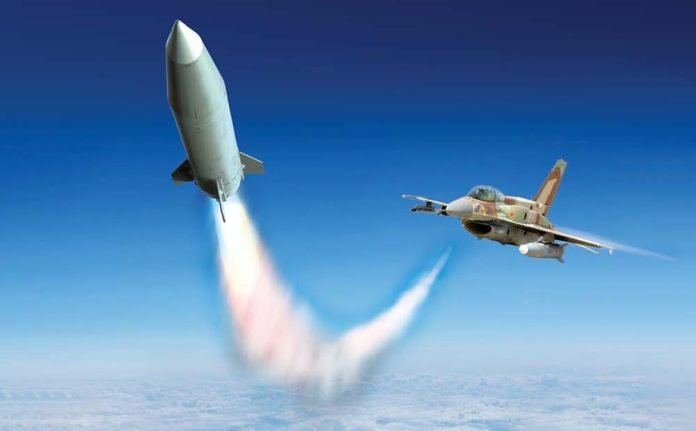
Tel Aviv: The use of two air launched ballistic missiles (ALBM) by Israeli Air Force against Iran has increased the international interest in these weapons. India may become the first foreign customer with local production of the missiles.
During the recent annual meeting of the Joint Working Group (JWG) of Israel and India, ALBM was discussed.
During the meeting, the two countries signed a Memorandum of Understanding (MoU) to enhance defence, industrial, and technological cooperation.
India is in advanced negotiations with Israel about the local production of the two ALBM’s – the Air Lora made by Israeli Aerospace Industries (IAI) and the Ice Breaker made by Rafael. The local production is according to the Indian “make in India” policy.
Air Lora is the air launched version of the Lora ground launched ballistic missiles and is designed to destroy high value targets from very long stand-off ranges.
With a robust warhead of various types, Air Lora enables Air Forces to strike enemy targets from far distances outside the reach of the enemy Air Missile Defence (AMD). It features high survivability with advanced immune INS/GNSS navigation and strong anti-jamming capabilities, allowing for 24/7 operation in extreme weather conditions and highly contested battlefields. The Air Lora can be simply integrated into fighter and bomber aircraft as a stand-alone configuration or through the avionics system, easy to train, with simple fire-and-forget and autonomous operation.
Earlier this year, the Indian ministry of defence has been trying to sign a contract for the local production of the Rafael Ice Breaker. The negotiations have been recently accelerated with some Indian companies taking part as candidates for the local production of the missile.
According to Rafael, the Ice Breaker is an aerial force-multiplier designed to overcome modern warfare arena challenges through Rafael’s legacy of high-end precision-guided solutions.
The company says that Ice Breaker is resilient to electronic countermeasure and is fully operational in GNSS-denied arenas. Rafael says in an official announcement that the Ice Breaker provides surgical, pinpoint precision strike capabilities from standoff ranges up to 300 km.
Rafael says that the cruise missile features an advanced IIR (Imaging Infra-Red) seeker, ideal for stationary or moving land and maritime target engagement in advanced Anti Access/Area Denial (A2/AD) arenas.
The official release says that Ice Breaker is compatible with various aerial platforms including, jet fighters, light aircraft, helicopters, and is fully operational across all weather conditions. The missile’s datalink supports real-time man-in-the-loop decision-making and tactical updates, with midflight abort and Battle Damage Assessment (BDA) capabilities.
The company says that the missile was developed, employing Rafael’s unique combat proven artificial intelligence technology, deep-learning and big data based scene-matching, enabling Automatic Target Acquisition (ATA) and Automatic Target Recognition (ATR).
Rafael says that the missile is flying at high subsonic speeds, and has a multi-directional, synchronised full sphere attack capability, based on predefined attack plans, according to waypoints, azimuth, impact angle and aim point selection. This the Israeli company says ensures high probability of mission success.
The Ice Breaker is 4 metres long and weighs 770 lbs , including a 250 lb. penetration, blast and fragmentation warhead.
A Memorandum of Understanding (MoU) and full technology transfer rights have been secured, meaning India will gain access to the full manufacturing “recipe” for both systems, including design, seeker integration, guidance technologies, and system architecture. Key Indian firms such as Bharat Electronics Limited (BEL) and Hindustan Aeronautics Limited (HAL) are expected to play central roles in integrated manufacturing, with ongoing interfaces for digital integration and missile assembly.
The final approval by India’s Cabinet Committee on Security is anticipated by mid-2026, after completion of financial, export compliance, and supply chain arrangements. The move comes against the backdrop of accelerating missile modernisation pressures from China’s layered air defence deployments and Pakistan’s GPS jamming practices, recently observed during Operation Sindoor.

-The writer is an Israel-based freelance journalist. The views expressed are of the writer and do not necessarily reflect the views of Raksha Anirveda
