

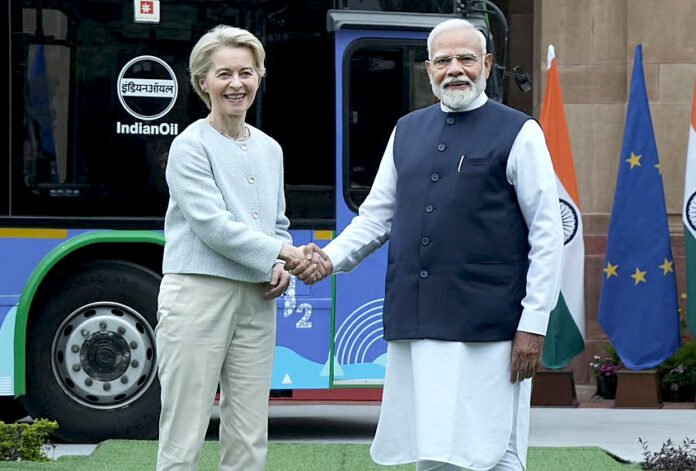
The proposed major trade deal between the European Union and India is taking place at a time when geopolitics, security, and economics are becoming more intertwined. This agreement is being viewed as more than a business contract, according to reports that the EU decided not to impose duties on Indian exports. This decision was reportedly influenced by the size and political significance of the discussions, as claimed by Scott Bessent. As a strategic actor in a multipolar world, it is a component of a larger reevaluation of Europe’s relationship with India.
But for India, durability—rather than optimism—is the crucial factor. Trade agreements made in geopolitically unstable settings need to be evaluated for their potential economic benefits as well as their intersections with political clout, security cooperation, and long-term strategic independence.

The Internal Division of the EU and Its Impact on Security
Although the EU portrays itself as a cohesive geopolitical body, it is nevertheless a group of states with different industrial interests, foreign policy priorities, and threat assessments. One example is the recent India-Poland diplomatic spat. India is directly impacted by this fragmentation. The capacity of individual member states to indirectly influence outcomes through regulation, compliance standards, and political pressure is not eliminated by a trade deal negotiated at the EU level.
This is significant since security narratives frequently impact EU trade behaviour. Decisions about market access are increasingly influenced by worries about supply-chain dependence, dual-use technology, carbon exposure, and even strategic alignment. Indian exports run the risk of becoming entangled in fluctuating European political discussions that are not always predictable or consistent throughout the bloc as security gets “embedded” in trade policy.
This implies that a trade agreement cannot be viewed as a buffer against political risk from India’s point of view. Rather, it needs to be viewed as a dynamic tool that will function inside the EU’s contentious internal politics, which may solidify in the event of a crisis involving China, Russia, climatic shocks, or transatlantic pressure from the US.
But for India, durability—rather than optimism—is the crucial factor. Trade agreements made in geopolitically unstable settings need to be evaluated for their potential economic benefits as well as their intersections with political clout, security cooperation, and long-term strategic independence
EU–India Security Partnership: Growing, but Not Symmetrical
India and the EU have been strengthening their security and defence cooperation in tandem with trade talks. This includes discussions on defence industry partnership, cyber security coordination, marine cooperation in the Indo-Pacific, counterterrorism conversation, and space cooperation. India is now seen by Europe as a balancing force against China and a stabilising force in the Indian Ocean.

But there are political inequalities in this cooperation. While the EU’s security posture is still strongly linked to NATO and US geopolitical interests, India handles security through a concept of strategic autonomy. As a result, there is an inherent asymmetry. European security concerns may take precedence over economic obligations during times of international crisis, particularly if pressure comes from allies or local political forces.
The impact for India is clear: trade integration with the EU will be evaluated more and more from a security perspective, which may not be in line with Indian aspirations. Even if they are not explicitly included in the agreement, issues like sanctions regimes, limitations on technology transfer, and diversification of defence procurement could have an impact on how trade is implemented.

Conditionality, Strategic Trust, and Market Access
Therefore, the EU’s increasing propensity to tie trade to security and values – based conditionality must be balanced against the prospect of better market access for Indian goods and services. Carbon accounting, labour standards, digital governance, and environmental compliance are all being presented as security requirements rather than just legal requirements.
This causes uncertainty from a strategic perspective. India is open to discussing norms, but it cannot support a system in which adherence to them is subject to shifting political pressures from within Europe. Unilateral reinterpretation of commitments cannot be the foundation of strategic trust.
Therefore, even while it acknowledges that total separation is no longer feasible in international trade, India must insist that the trade agreement explicitly distinguish economic commitments from political messaging.
While the EU’s security posture is still strongly linked to NATO and US geopolitical interests, India handles security through a concept of strategic autonomy. As a result, there is an inherent asymmetry. European security concerns may take precedence over economic obligations during times of international crisis, particularly if pressure comes from allies or local political forces
Indian Federalism and Defensive Economic Security
India does not allow its member states to formally veto trade deals, in contrast to the EU. Although this is often portrayed as a weakness, it also offers coherence from a security standpoint. India reduces the possibility of internal fragmentation being exploited externally by speaking with a single voice in trade negotiations.
Nevertheless, when economic upheaval happens, Indian states continue to play a leading role. States will pay the social and political price if EU imports pose a threat to critical industries or jobs. Their capacity to employ procurement policy, regulatory supervision, and compliance enforcement adds a significant degree of economic security.
From a strategic standpoint, this calls for cooperation rather than conflict. India’s federal system must serve as a stabilising force rather than a cause of unpredictable policy. Therefore, the centre’s function is essential to maintaining the legal soundness and strategic alignment of state-level responses.
Defence Industrial Cooperation and Economic Leverage
The trade agreement’s possible effects on defence industry cooperation are one neglected aspect. While India is pursuing self-sufficiency with selective external cooperation, the EU is looking for alternatives to its excessive reliance on a small number of suppliers. Joint ventures, co-development, and technology partnerships are made possible by this.
However, leverage is also introduced through defence collaboration. During political disputes, export limits, end-use limitations, and intellectual property restrictions can be employed as pressure tactics. Therefore, India needs to make sure that economic openness doesn’t result in strategic vulnerability, especially when it comes to vital technologies having dual-use or military applications.
Ignoring this aspect in a trade deal could force India into dependencies that limit its ability to make strategic decisions in the future.
The massive trade agreement between the EU and India should be viewed as a component of a larger strategic partnership that encompasses geopolitical cooperation, security, and defence. It provides India with a lot of opportunity, but it does not ensure protection from Europe’s internal strife or remove political risk
Trade as an Enabler, Not a Shield
The massive trade agreement between the EU and India should be viewed as a component of a larger strategic partnership that encompasses geopolitical cooperation, security, and defence. It provides India with a lot of opportunity, but it does not ensure protection from Europe’s internal strife or remove political risk.
India needs to view the arrangement as a managed exposure from the standpoint of strategic security. Headline tariff reductions are not as important as safeguards, policy flexibility, and clear dispute resolution. India’s resilience must be strengthened by economic integration, not diminished.
Although geopolitical alignment and optimism may be reflected in Europe’s current tariff restraint, history indicates that EU unity is situational rather than permanent. Therefore, India’s bargaining stance needs to be based on reality rather than expectations.
The success of the India-EU trade agreement will ultimately be determined by whether it strengthens India’s long-term strategic position in a more politicised global trading system, where economics and security are no longer two distinct fields but rather two sides of the same geopolitical coin.

The writer is the Publisher of Frontier India and the author of the book Foxtrot to Arihant: The Story of Indian Navy’s Submarine Arm.
