

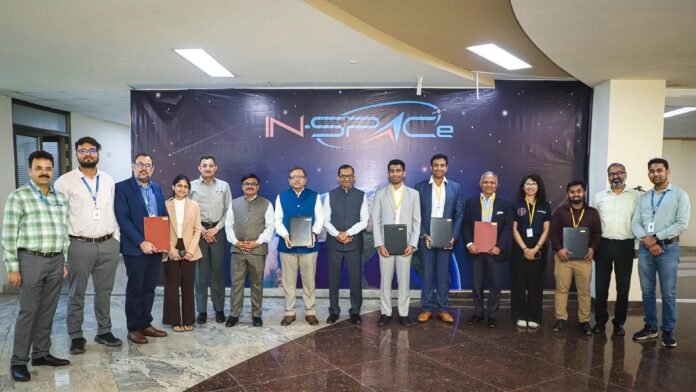
Ahmedabad. The Indian National Space Promotion and Authorisation Centre (IN-SPACe), announced the Satellite Bus as a Service (SBaaS) initiative through an Announcement of Opportunity (AO) in April 2025, inviting proposals from Indian Non-Governmental Entities (NGEs) to develop indigenous small satellite bus platforms for hosted payload services. A total of 15 Proposals were received up to July 2025, and following a rigorous, transparent, and multi-stage evaluation process, three selected NGEs are Astrome Technologies Pvt. Ltd., Bengaluru; Azista Industries Pvt. Ltd., Hyderabad; and Dhruva Space Pvt. Ltd., Hyderabad.
Each selected company will receive a grant of ₹5 crore to support the development and demonstration of a robust, modular and scalable small satellite bus. The satellite buses developed under the SBaaS initiative will serve as a cost-effective platform to accommodate multiple hosted payloads, catering to both domestic and global market requirements. IN-SPACe has signed contract agreements with the selected companies on February 11, 2026, marking the formal commencement of implementation under the scheme.

Commenting on the announcement, Dr Pawan Goenka, Chairman, IN-SPACe, stated, “The Satellite Bus as a Service initiative marks an important step in building a robust, sustainable, and globally competitive small satellite manufacturing ecosystem in India. By enabling indigenous satellite bus platforms and integrating them with India’s emerging small satellite launch capabilities, we are laying the foundation for India to become a preferred global destination for end-to-end small satellite manufacturing, launch, and hosted payload services.”
Rajeev Jyoti, Director – Technical Directorate, IN-SPACe, said, “The SBaaS initiative is a key enabler for the development and manufacturing of indigenous small satellite bus platforms in India. By providing standardised and flight-proven satellite bus platforms for hosted payload missions, IN-SPACe aims to reduce entry barriers for payload developers while strengthening domestic manufacturing capabilities and reinforcing India’s position in the rapidly growing global hosted payload services market.”
As per the AO guidelines, IN-SPACe will continue to support the selected companies through milestone-linked grant disbursement and by facilitating access to ISRO/DOS and IN-SPACe infrastructure, testing facilities, and technical expertise, as required. In subsequent phases, IN-SPACe plans to enable hosted payload missions on these satellite bus platforms, further expanding public–private partnership-led programmes that allow industry to scale from platform development to operational missions.
Sanjay Nekkanti, CEO and Co-founder, Dhruva Space, commented, “IN-SPACe’s Satellite Bus-as-a-Service programme is a timely and strategic intervention that addresses a critical gap in India’s Space ecosystem by decoupling payload innovation from spacecraft ownership. It enables faster in-orbit validation, optimised costs, and reduced risk for payload developers, exactly what a sunrise sector needs to scale with credibility. Dhruva Space’s LEAP (Launching Expeditions for Aspiring Payloads) hosted payload programme complements this initiative by enabling early customer engagement and mission readiness, while the Satellite Bus-as-a-Service selection for our upcoming P-Nova microsatellite strengthens our ability to support scalable, indigenous hosted payload missions. Together, these efforts reinforce the Government of India’s confidence in private-sector-led, end-to-end spacecraft capabilities being built in India for global markets.”

The announcement further strengthens IN-SPACe’s continuing efforts to enable private sector capability building in satellite platforms and hosted payload services. Recently, IN-SPACe had signed a concession agreement with the PixxelSpace India and, Allied Orbits Pvt Ltd (SPV formed by Pixxel-led consortium), for establishment of an Earth Observation constellation under Public-Private Partnership (PPP) framework. The partnership is aimed at advancing the development of indigenous Earth Observation capabilities through Indian industry and establishing a robust, commercial EO ecosystem.

