

“To be secure on land, we must be supreme at sea,” proclaimed India’s first Prime Minister, Jawaharlal Nehru, envisioning a future where maritime power would define national destiny. More than seven decades later, his foresight stands vindicated. The 21st century has been termed the “Maritime Century,” and India’s rise as a major global power is closely intertwined with its ability to secure and command the seas. With global trade routes increasingly contested and the Indo-Pacific emerging as the theatre of Great Power competition, the strength and sophistication of the Indian Navy are pivotal to ensuring national security and regional stability.
The Indian Navy, currently ranked seventh among the world’s navies, plays an essential role in defending India’s maritime borders, protecting sea lanes of communication, and ensuring that the country’s strategic and economic interests remain secure in the Indian Ocean Region (IOR). As a maritime nation with a coastline stretching over 7,500 kilometres, India’s prosperity and safety are deeply dependent on maritime dominance. In this context, the Navy’s motto — “Sham No Varunah” (May the Lord of the Oceans be Auspicious unto Us) — perfectly captures its enduring mission and spirit.

Strength across the Seas
India’s maritime geography places it at the crossroads of some of the world’s busiest shipping lanes. Seven countries share maritime borders with India, and nearly 90 per cent of India’s trade by volume and 77 per cent by value moves through sea routes. Protecting these arteries of commerce is both an economic and strategic imperative. Simultaneously, the growing maritime assertiveness of China, which boasts the world’s largest navy with an estimated 750 vessels by 2025, poses a significant challenge in the Indo-Pacific region.
The Indian Navy, formally established in 1950, celebrates its Diamond Jubilee this year, marking seventy-five years of valour, professionalism, and evolution. From a small coastal defence force at Independence, it has transformed into a multi-dimensional, network-centric, and blue-water navy capable of operating across oceans. Its modernisation journey reflects the nation’s march toward Aatmanirbhar Bharat (Self-Reliant India), giving top priority to indigenisation — the domestic development and production of naval platforms, systems, and equipment.
The Indian Navy, currently ranked seventh among the world’s navies, plays an essential role in defending India’s maritime borders, protecting sea lanes of communication, and ensuring that the country’s strategic and economic interests remain secure in the Indian Ocean Region.
The Navy’s vision is not merely to defend India’s coastline but to project power, maintain maritime peace, and ensure a stable and secure Indian Ocean that remains free from coercion. From safeguarding shipping routes to extending humanitarian aid and disaster relief to friendly nations, the Navy’s presence today symbolises India’s growing stature as a regional stabiliser.
Fleet Expansion and Capability Building
The Navy’s long-term Maritime Capability Perspective Plan (MCPP), spanning 2012–2027, had envisioned a 250-ship fleet by 2035, backed by an advanced air arm and a strong undersea component. As of November 2025, the Navy operates over 200 ships and submarines, with plans to reach 230 by 2037. Despite challenges of funding and industrial delays, the Navy’s progress reflects remarkable strategic continuity and institutional foresight.

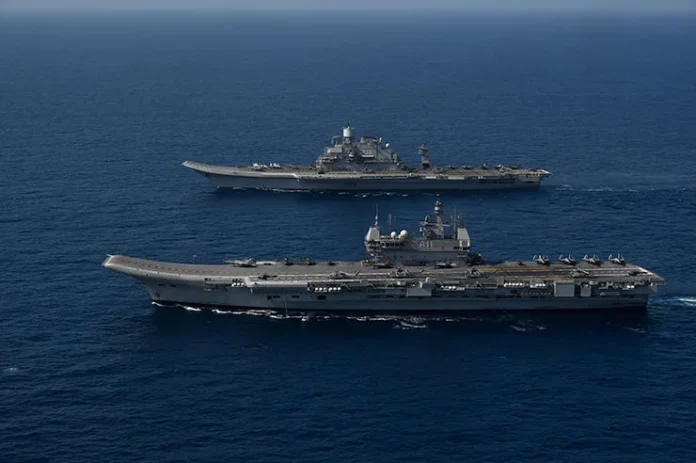
The commissioning of INS Vikrant, India’s first indigenously built aircraft carrier, represents a monumental leap in maritime capability. Displacing 45,000 tonnes, measuring 262 metres in length and 62 metres in width, and operating on the Short Take-Off But Arrested Recovery (STOBAR) system, INS Vikrant showcases India’s ability to design, engineer, and construct complex warships. The carrier can operate up to 36 aircraft, including MiG-29K fighters and Dhruv Mk-III, Sikorsky MH-60R, and Kamov Ka-31 helicopters, enabling a mix of Airborne Early Warning (AEW), Anti-Submarine Warfare (ASW), and Search and Rescue (SAR) operations.


INS Vikrant’s Combat Management System (CMS), developed by Tata Advanced Systems, marked a significant milestone — the first CMS from a private Indian company to enter service. The gearboxes were designed by Elecon Engineering, while its four General Electric LM2500+ gas turbines deliver over 80 megawatts of power, giving the ship formidable endurance and operational agility.
Beyond Vikrant, the Navy’s shipbuilding programmes include destroyers, frigates, corvettes, and submarines built indigenously under major projects like Project 15B (Visakhapatnam-class destroyers) and Project 17A (stealth frigates). These platforms feature state-of-the-art stealth, electronic warfare, and combat systems, making them among the most advanced in their class.
The commissioning of INS Vikrant, India’s first indigenously built aircraft carrier, represents a monumental leap in maritime capability. Displacing 45,000 tonnes and operating under the Short Take-Off But Arrested Recovery (STOBAR) system, INS Vikrant showcases India’s ability to design, engineer, and construct complex warships
Indigenous Drive and Technological Edge
The Indian Navy’s transformation into a “Builder’s Navy” stands as a cornerstone of national technological advancement. Under the Project SWAVLAMBAN initiative, 54 vessels are currently under construction across six Indian shipyards, marking the largest-ever indigenous warship-building effort. These include aircraft carriers, guided missile destroyers, stealth frigates, corvettes, and submarines — all contributing to India’s aspiration for self-reliance in defence manufacturing.
This drive aligns with the Aatmanirbhar Bharat initiative, which seeks to reduce foreign dependence and boost indigenous design, development, and production capabilities. By 2035, the Navy aims to operate over 200 warships and submarines, with ten vessels scheduled for commissioning within 2025 itself.
The Navy’s technological evolution also encompasses adoption of Artificial Intelligence (AI), Big Data Analytics, Directed Energy Weapons (DEWs), Unmanned Aerial Vehicles (UAVs), and autonomous underwater systems. These innovations are reshaping naval warfare by enhancing surveillance, early warning, decision-making, and predictive maintenance.
The Navy’s operational excellence is visible in its ongoing anti-piracy missions in the Gulf of Aden and Operation Sankalp, which safeguards Indian merchant shipping through the Strait of Hormuz amid regional tensions. The Navy also conducts Humanitarian Assistance and Disaster Relief (HADR) missions, providing critical support during cyclones, tsunamis, and other calamities across the Indian Ocean.
As of December 2024, the Navy possessed over 130 warships and 251 aircraft and helicopters, with active contracts worth ₹99,500 crore (US$12 billion). The Defence Acquisition Council (DAC), chaired by the Defence Minister, has accorded Acceptance of Necessity (AoN) for 74 additional warships, amounting to ₹2.35 lakh crore (US$28 billion). These acquisitions include next-generation destroyers of 10,000 tonnes displacement and a new aircraft carrier, ensuring sustained modernisation well into the 2030s.
Strategic Depth and Future Outlook
Between January and October 2025, the Navy commissioned ten warships and one submarine, with four more slated for year-end delivery. By 2026, it expects to induct 19 vessels, followed by 13 more in 2027, maintaining an average of one induction every forty days. This pace exemplifies India’s growing industrial capacity and the Navy’s focus on sustained readiness.
Under the Project SWAVLAMBAN initiative, 54 vessels are currently under construction across six Indian shipyards, marking the largest-ever indigenous warship-building effort. These include aircraft carriers, guided missile destroyers, stealth frigates, corvettes, and submarines — all contributing to India’s aspiration for self-reliance in defence manufacturing
To strengthen its Naval Air Arm, the Navy signed a contract in April 2025 for 26 Dassault Rafale-M multirole carrier-based fighters, which will significantly enhance its strike capability and interoperability. Concurrently, work on the Hindustan Aeronautics Limited (HAL) Twin Engine Deck-Based Fighter (TEDBF) continues, expected to serve as the indigenous mainstay for future carriers by the mid-2030s.
The Navy is also investing heavily in anti-submarine warfare (ASW) through the Kamorta-class corvettes, Boeing P-8I Neptune long-range maritime reconnaissance aircraft, and IAI Heron-1 UAVs. Following the 2020 Ladakh border crisis, the Navy began upgrading bases in the Andaman & Nicobar and Lakshadweep Islands, establishing a chain of island airbases across the Arabian Sea and Bay of Bengal to enhance maritime domain awareness and freedom of navigation.
The Technology Perspective and Capability Roadmap (TPCR) 2025, published by the Ministry of Defence (MoD), outlines ambitious plans for the Navy to operate at least ten nuclear-propelled surface vessels, including the next-generation aircraft carrier INS Vishal.
Under the Roll-on Indigenisation Plan 2023–26, the Centre for Indigenisation & Self Reliance (CISR) monitors indigenous progress across categories of Float (Hull), Move (Propulsion), and Fight (Weapons and Sensors). As of October 2024, indigenisation levels stood at 90 per cent, 60 per cent, and 50 per cent, respectively. The Navy also plans to retrofit indigenous systems on legacy vessels such as INS Vikramaditya, Kalvari-class submarines, and Deepak-class fleet tankers.
The Indian Navy will celebrate Navy Day 2025 with a spectacular Operational Demonstration on December 4, 2025, at Shangumugham Beach, Thiruvananthapuram — a fitting tribute to the valour and versatility of India’s maritime warriors
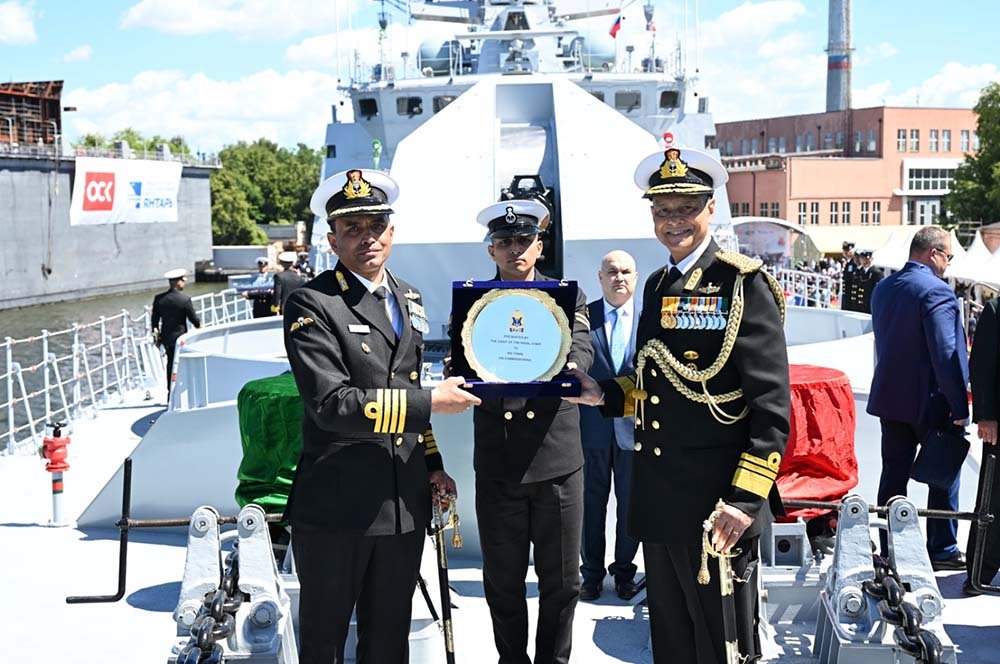
The commissioning of INS Tamal in Russia on July 1, 2025, marked the final foreign-built ship to enter Indian service — a turning point in India’s naval history. Henceforth, all vessels will be indigenously constructed. By 2030, the Navy will field 13 destroyers and 20 frigates, together equipped with over 300 BrahMos supersonic cruise missiles.
Commemorating Naval Excellence
The Indian Navy will celebrate Navy Day 2025 with a spectacular Operational Demonstration on December 4, 2025, at Shangumugham Beach, Thiruvananthapuram. The event will showcase cutting-edge operations, including missile firings, carrier-based aircraft manoeuvres, and amphibious landings — a fitting tribute to the valour and versatility of India’s maritime warriors.
From its modest beginnings in 1947 to becoming a modern, networked, and combat-ready blue-water force, the Indian Navy’s journey embodies resilience, technological innovation, and national pride. It stands today as a credible, capable, and confident guardian of India’s maritime frontiers — truly the Guardians of the Blue Frontier, ensuring that India’s flag flies proudly across the world’s oceans.

– The writer is a senior journalist and media consultant. The views expressed are of the writer and do not necessarily reflect the views of Raksha Anirveda.
