

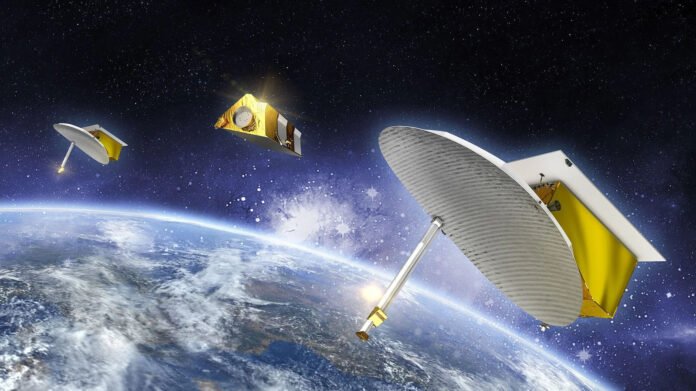
Berlin: Germany will invest €35 billion ($41 billion) in space-related defence projects by 2030, stepping up the country’s technological independence and ability to protect its assets in orbit amid an increasing militarisation of outer space, Defence Minister Boris Pistorius said.
Pistorius made the announcement in a speech at the German industry’s third Space Congress, held in Berlin.

“Satellite networks today are an Achilles heel of modern societies. Whoever attacks them paralyses entire nations,” Pistorius said. He pointed to the Russian cyberattack on the ViaSat satellite network before the Ukraine invasion, which affected the operational control of approximately 6,000 wind turbines in Germany, he said.
Pistorius outlined plans for a comprehensive military space security architecture, including hardened systems against attacks, improved orbital surveillance through radars and telescopes, future “guardian satellites,” and Germany’s own military satellite operations centre within the Bundeswehr’s Space Command. The command was created in 2021 under the umbrella of the country’s air force.
Pistorius singled out Russia and China as potential space opponents, saying two Russian Luch-Olymp reconnaissance satellites were tracking two Intelsat satellites used by the Bundeswehr. He questioned “the purely peaceful nature” of such behaviour and emphasised how close Germany has come to “real threat scenarios.”
“Russia’s behaviour, especially in space, poses a fundamental threat to us all. It is a threat that we can no longer ignore,” Pistorius said.

The 1967 Outer Space Treaty, which 117 countries have ratified, including all major spacefaring nations, prohibits placing weapons of mass destruction into orbit and stipulates that celestial bodies may be used “exclusively for peaceful purposes.”
A notable policy shift emerged from the remarks, too, with Pistorius stating that Germany must consider developing offensive capabilities in space to maintain credible deterrence. This marks a departure from Germany’s prior space policies, which had been explicitly defensive. “We must also be able to deter in space in order to be defensible,” he declared.

Germany’s space defence investment comes amid broader increases in its military budget. With recent boosts to military funding, Germany is already fourth globally in terms of defence expenditures, behind the US, China and Russia.

