

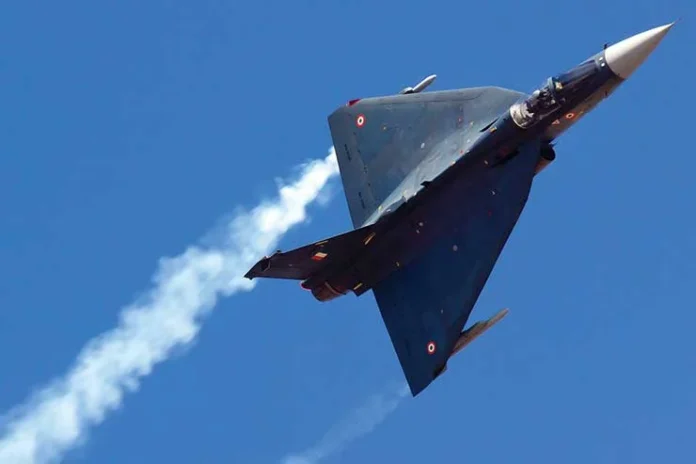
Jodhpur: American engine maker General Electric (GE) has assured India of a fresh delivery schedule, starting November this year, for the F404-IN20 engines that will power the country’s Tejas MK-1A aircraft.
Media reports quoting sources in the defence establishment said the commitment by GE came after Defence Minister Rajnath Singh raised the matter during his visit to the US last month.

“GE has given a new schedule…They will start the delivery of engines from November,” a high-ranking source said. Sources further said GE has promised them two engines per month.
According to the contract between Tejas manufacturer Hindustan Aeronautics Limited (HAL) and GE in August 2021, the American firm was supposed to deliver 99 engines starting March this year to cater to the IAF’s order for the 83 light-combat Tejas MK-1A aircraft inked earlier that year. No delivery has been made yet.
Incidentally, the IAF is currently working on ordering an additional 97 Tejas planes to strengthen its fleet.
As reported earlier, one of the main reasons behind the delay in Tejas’s delivery has been GE’s failure to stick to the contract timeline.

GE was to deliver engines at the rate HAL was to deliver the aircraft — 16 each financial year, according to the terms of the contract.
Government sources said GE had informed them there were supply issues and that re-certification of new vendors took time. However, they said one was never fully sure whether other dynamics were also not at play.

The first aircraft of the Tejas MK-1A series, LA 5033, took to the skies in March this year, after the delivery schedule was hit by a delay of at least four months if not more.
The aircraft did not fly with a new engine but with Category B engines, which are reserve machines that may have been used in the past or those that had remained unused as part of an earlier deal with GE for the Tejas series.
Sources said HAL’s production plans were on schedule, and that the engines would be integrated as soon as they came in.
“Engines are a critical part. First, an engine is selected and then the aircraft is made around it. It is not that the Tejas can be fitted with any other engine. It is not a simple plug-and-play system,” a source explained.
HAL has set up a new production line in Nasik for the Tejas MK-1As, besides the one in Bangalore which can produce 16 aircraft in a year. The public sector defence company can now make a total of 24 aircraft.
According to IAF projections back then, the squadron strength would be 27 by 2032 and a mere 19 by 2042 even if the 36 Rafales, six squadrons of Tejas and two more squadrons of Su-30 MKI were taken into account.

Raksha Anirveda's editorial desk team brings in the collective experience of creative professionals - a fine mix of senior copy editors, writers, proofreaders and designers. Working as a team, they continuously create, manage, and curate content to sustain the magazine's profile and reputation in line with market trends and achieve magazine's goal.
