
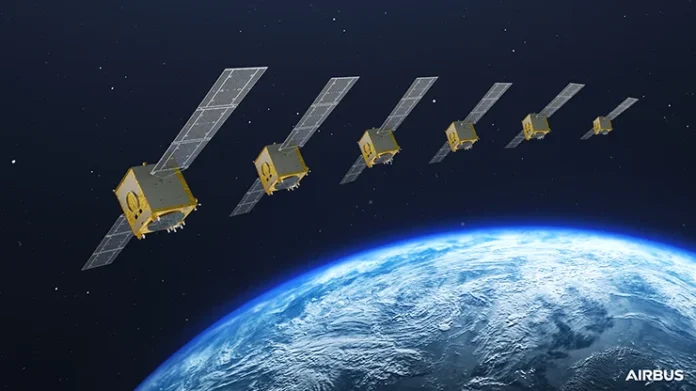
Friedrichshafen. Airbus has successfully completed the Preliminary Design Review (PDR) for its system concept for the second generation Galileo navigation satellites. During this important milestone, Airbus’ proposed preliminary design and the customer’s system requirements have been fully reviewed and agreed.

In parallel, the Airbus site in Friedrichshafen, on Lake Constance, is preparing for an industrialised production line for currently six second-generation Galileo satellites. The satellite integration centre, is being completely upgraded to meet current and future requirements for efficient, environmentally friendly, safe and secure production for the Galileo 2nd generation satellites. Galileo second generation is a key milestone in European satellite navigation services that European citizens and billions of users around the world will benefit from, powered by Airbus know-how brought to the project by over 200 highly skilled space engineers. The first Galileo second generation are planned to be launched in 2024.
The world of navigation is changing, driven by rapidly emerging and changing user needs (availability and reliability), a growing number of security threats (jamming and spoofing) and the evolution of other navigation systems. The new batch of Galileo spacecraft built by Airbus is the answer to this changing context. It will make the Galileo service more accurate, secure and dependable, and adaptable over its lifetime spanning two decades.
Weighing around 2.3 tons, each satellite is designed to operate for about 15 years. The state-of-the-art and all-electric medium-Earth orbit (MEO) platform from Airbus, reuses flight proven building blocks from our Telecoms and Earth Observation programmes, taking advantage of a unique combination of heritage and in orbit experience. The flexible and modular navigation payload solution with future growth capability is also based on telecom elements for beam forming and signal generation.
Galileo is managed and funded by the European Union. The European Commission, ESA and EUSPA have signed an agreement by which ESA acts as design authority and system development prime on behalf of the Commission and EUSPA as the exploitation and operation manager of Galileo. The views expressed in this Press Release can in no way be taken to reflect the opinion of the European Union and/or ESA